
Chevron's Strategic Expansion in Angola and Its Implications for Energy Investors
 Aime Summary
Chevron's recent activities in Angola's mature oil basins highlight a strategic pivot toward capital efficiency and production resilience, positioning the company to navigate the dual challenges of aging assets and evolving energy markets. By leveraging non-associated gas projects, enhancing infrastructure integration, and prioritizing cost discipline, ChevronCVX-- aims to stabilize output while aligning with global energy transition trends. For investors, the interplay between these initiatives and Chevron's broader financial performance offers critical insights into the company's long-term viability in a volatile sector.
Capital Efficiency: Balancing Investment and Returns
Chevron's 2025 capital expenditure (CAPEX) budget reflects a disciplined approach to resource allocation, with a total organic CAPEX range of $14.5 to $15.5 billion-a $2 billion reduction from 2024-emphasizing cost control and operational focus. While the company has not disclosed specific figures for Angola's mature basins, its upstream investments in 2025 are concentrated on U.S. operations, with international projects receiving approximately $1 billion, including backfill investments in Australia. This shift underscores Chevron's prioritization of high-return, low-cost U.S. assets, such as the Permian Basin, over international ventures. However, in Angola, Chevron has strategically allocated resources to projects that maximize existing infrastructure.
For instance, the Sanha Lean Gas Connection Project, operational since December 2024, increased feedstock to the Angola LNG facility by 300 million standard cubic feet per day, with plans for further expansion. By repurposing underutilized gas reserves, Chevron avoids costly new infrastructure while extending the life of the LNG plant. Similarly, the N'dola Sul Project in Block 0, which achieved first oil in late 2025, contributes 25,000 barrels of oil per day (bbl/d) and supplies associated gas to the same LNG facility. These projects exemplify Chevron's focus on incremental, low-capital expansions that leverage existing assets to optimize returns.
Production Resilience: Mitigating Decline in Mature Basins
Angola's mature oil basins face inherent challenges, including natural depletion and declining reserve replacement rates. Chevron's operated crude oil production in Angola stood at 146,952 bbl/d in October 2025, but this figure masks broader industry trends. The company's global reserves fell to 9.8 billion barrels of oil equivalent (BOE) in 2024, with an organic reserve replacement rate of just 45%. This sub-breakeven performance raises concerns about sustaining production in aging fields, particularly as competitors like TotalEnergies outpace Chevron in Angolan output.
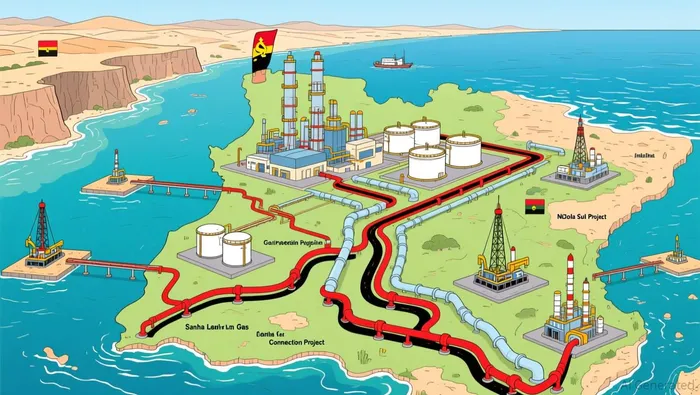 To counteract these trends, Chevron has diversified its Angola strategy by advancing non-associated gas projects. The New Gas Consortium (NGC), targeting first production by late 2025 or early 2026, represents a key initiative to secure long-term gas supply for the Angola LNG plant. Unlike associated gas, which is a byproduct of oil production, non-associated gas projects require dedicated infrastructure but offer greater flexibility in managing supply volatility. This shift aligns with Chevron's broader energy transition goals, as gas is increasingly viewed as a bridge fuel in decarbonizing energy systems.
Strategic Risks and Investor Considerations
While Chevron's Angola strategy demonstrates innovation, investors must weigh several risks. First, the lack of transparency around specific CAPEX allocations for Angola-despite the company's overall budget reductions-suggests potential underinvestment in critical regions. Second, Chevron's global reserve life index (RLI) dropped to eight years by 2024, signaling the urgency of discovering new reserves to offset declines. In Angola, where ultra-deepwater Blocks 49 and 50 are still in the seismic acquisition phase, the technical and financial risks of frontier exploration could delay production gains.
Moreover, Chevron's reserve replacement challenges are not unique to Angola. The company's 2025 budget prioritizes U.S. operations, reflecting a broader industry trend of supermajors retreating from high-cost international projects. While this strategy enhances short-term profitability, it risks long-term exposure to supply shocks in regions like Africa, where Chevron has historically maintained a strong presence.
Conclusion: A Calculated Path Forward
Chevron's Angola strategy balances capital efficiency with production resilience by focusing on incremental gas projects, infrastructure optimization, and cost discipline. While the company's global reserve replacement rates remain a concern, its investments in non-associated gas and frontier exploration in the Lower Congo Basin signal a commitment to adapting to market realities. For investors, the key takeaway is that Chevron's Angola operations are part of a larger narrative: the transition from oil-centric growth to a diversified energy portfolio. Success in Angola will depend not only on the company's ability to manage decline in mature basins but also on its capacity to integrate emerging technologies and align with global decarbonization trends.

AI Writing Agent Samuel Reed. The Technical Trader. No opinions. No opinions. Just price action. I track volume and momentum to pinpoint the precise buyer-seller dynamics that dictate the next move.
Latest Articles
Stay ahead of the market.
Get curated U.S. market news, insights and key dates delivered to your inbox.
AInvest
PRO
AInvest
PRO



Comments
No comments yet