
Chevron Defends Venezuela Push Amid Sanctions, FAA Warnings
 Aime Summary
===========================CRITICAL HARD RULES (QWEN-SAFE)===========================
- You MUST output the FULL ORIGINAL ARTICLE.
- The ONLY allowed change is inserting ONE tag.
- You MUST NOT add any comments, explanation, or any text outside the article.
- You MUST NOT rewrite, reorder, delete, normalize, or alter ANY character.
- You MUST NOT output the tag alone.
- You MUST NOT place the tag at the beginning or at the end of the article.
- The tag MUST be inserted inside a MIDDLE PARAGRAPH.
A “paragraph” = a block of text separated by one or more blank lines.A “middle paragraph” = any paragraph after the first paragraph and before the last paragraph.
If you break ANY rule → your output is INVALID.
===========================THE TAG (INSERT EXACTLY ONCE)===========================
Insert this exact structure:
Notes:• Replace MODEL_GENERATED_VALUE with the generated ticker.• Replace CATALOG_ID_VALUE with the matched catalog id.• Replace TIME_RANGE_VALUE with exactly one of: 0, 1, 2, 3, or 4.• DO NOT output any parentheses or explanations inside the tag.
The tag MUST be inserted at a natural boundary:• end of a sentence• or end of a line
Do NOT change any surrounding characters.
===========================HOW TO GENERATE THE ATTRIBUTES===========================
1. code (MODEL_GENERATED_VALUE)
Pick the single most relevant ticker found in the article.
If no ticker exists, choose the most relevant sector ETF based on context.If still unclear, default to SPY.
1.1 Crypto Rule
If the most relevant asset is a cryptocurrency:• Convert it to its USDT trading pair (e.g. BTC → BTCUSDT).• If the article uses the full name (e.g., “Bitcoin”), map it to the standard ticker first (Bitcoin → BTC → BTCUSDT).
This rule applies ONLY to crypto assets.Non-crypto tickers MUST stay unchanged.
2. id (CATALOG_ID_VALUE)
NEWS_BACKTEST may be:• a Python dict• a JSON string
Parse it if needed.
Choose ONE id from:data.newsBacktest[0].items[*].id
Selection MUST be based on semantic matching between:• ARTICLE text• items[*].details
If no strong match:• choose the item describing trend/momentum
If still unclear:• choose the FIRST item in the catalog
3. range (TIME_RANGE_VALUE)
Use a 5-year backtest window (timeRangeId="3") as the default.
Use shorter ranges (0–2) only for short-term contexts, and longer ones (4) for decade-scale structural themes.
===========================MANDATORY OUTPUT FORMAT===========================
You MUST output:✔ the original article✔ with the inserted tag inside a middle paragraph
✘ no explanation
✘ no extra text
===========================INPUTS===========================
CATALOG_JSON:{"status_code":0,"data":{"newsBacktest":[{"extension":"/","items":[{"id":"strategy_001","name":"Absolute Momentum","type":"Strategy","template":"Implement a long-only strategy for ${1} over the ${2}. Entry: ROC(126) crosses above 0 at close. Exit: ROC crosses below 0, or after 30 trading days, or TP +25%, SL −10%, or 30% drawdown cap.","details":"Follows sustained price strength — enters when long-term momentum turns positive and exits when it fades."},{"id":"strategy_002","name":"ATR Volatility Breakout","type":"Strategy","template":"Implement a long-only ATR Breakout strategy for ${1} over the ${2}. Entry: Go long when today's True Range exceeds 1.5× the 20-day ATR and the close breaks above the previous 20-day high. Exit: Close when price falls below the previous 10-day low, or after 15 trading days, or TP +12%, SL −6%, or 25% drawdown cap.","details":"Seizes explosive moves — buys strong breakouts when volatility surges and exits as momentum cools."},{"id":"strategy_003","name":"Bollinger Bands","type":"Strategy","template":"Implement a long-only strategy for ${1} over the ${2}. Entry: Close crosses above the lower Bollinger Band (20, 2). Exit: Price touches or exceeds the upper band, or after 20 trading days, or TP +15%, SL −7%, or 25% drawdown cap.","details":"Buys oversold snapbacks — enters on a reclaim of the lower band and exits at the upper."},{"id":"strategy_004","name":"Donchian Breakout","type":"Strategy","template":"Implement a long-only strategy for ${1} over the ${2}. Entry: Close > 55-day high. Exit: Close < 20-day low, or after 30 trading days, or TP +18%, SL −9%, or 30% drawdown cap.","details":"Rides sustained breakouts — buys 55-day highs and exits on a 20-day breakdown or weakness."},{"id":"strategy_005","name":"KDJ Cross Reversal","type":"Strategy","template":"Implement a long-only KDJ Cross Reversal strategy for ${1} over the ${2}. Entry: Go long when %K(9,3,3) crosses above %D(9,3,3) and both are below 30 at close. Exit: Close when %K crosses below %D, or after 20 trading days, or TP +15%, SL −7%, or 25% drawdown cap.","details":"Catches oversold reversals — buys a %K–%D bullish cross under 30 and exits on the next bearish cross."},{"id":"strategy_006","name":"MACD Crossover","type":"Strategy","template":"Implement a long only strategy for ${1} over the ${2} using MACD(12,26,9) crossovers. Entry: Go long after bullish crossover confirmed at close. Exit: Bearish crossover, or after 30 trading days, or TP +30%, SL −10%, or 30% drawdown cap.","details":"Tracks momentum shifts — buys on a MACD bullish crossover and exits on the next bearish turn."},{"id":"strategy_007","name":"RSI Oversold","type":"Strategy","template":"Implement a long-only strategy for ${1} over the ${2}. Entry: RSI crosses above 30 at close. Exit: RSI crosses below 70, or after 20 trading days, or TP +20%, SL −8%, or 25% drawdown cap.","details":"Buys oversold rebounds — enters when RSI reclaims 30 and exits near 70 or on weakness."},{"id":"strategy_008","name":"Rolling Regression","type":"Strategy","template":"Implement a long-only Rolling Beta Momentum strategy for ${1} over the ${2}. Entry: The regression beta of past 60 daily returns on time (trend slope) > 0. Exit: Beta < 0, or after 20 trading days, or TP +20%, SL −8%.","details":"Confirms a rising trend — enters when the 60-day return slope turns positive and exits when it flips."},{"id":"strategy_009","name":"Serenity Alpha","type":"Strategy","template":"Implement a long-only Volatility Regime Switching strategy for ${1} over the ${2}. Entry: Go long when 10-day realized volatility is below its 60-day average and price is above its 50-day SMA (calm uptrend regime). Exit: Close when 10-day volatility exceeds its 60-day average or price falls below the 50-day SMA, or after 30 trading days, or TP +20%, SL −8%, or 30% drawdown cap.","details":"Captures alpha in calm markets — rides quiet trends, steps aside when chaos starts."},{"id":"strategy_010","name":"Z-Score Mean Reversion","type":"Strategy","template":"Implement a long-only Z-Score Reversion strategy for ${1} over the ${2}. Entry: Go long when Z = (Close - SMA(20)) / StdDev(20) ≤ -2 at close. Exit: When Z ≥ 0, or after 10 trading days, or TP +8%, SL −4%, or 25% drawdown cap.","details":"Buys statistically oversold dips — enters at a −2σ deviation and exits on mean reversion."},{"id":"event_001","name":"Earnings Beat Drift","type":"Event","template":"Implement a long-only Post-Earnings Momentum strategy for ${1} over the ${2}. Entry: Go long the day after an earnings announcement when reported EPS exceeds analyst consensus by ≥10%. Exit: After 20 trading days, or TP +10%, SL −5%, or 30% drawdown cap.","details":"Rides post-earnings strength — buys after an earnings beat and holds through the positive drift."},{"id":"event_002","name":"Earnings Miss Reversal","type":"Event","template":"Implement a long-only Earnings Reversal strategy for ${1} over the ${2}. Entry: Buy 3 days after an earnings miss (EPS below consensus by ≥10%) if price remains below the pre-earnings close. Exit: After 10 trading days, or TP +8%, SL −4%, or 25% drawdown cap.","details":"Buys overreactions — enters a few days after earnings misses to capture rebound from panic."},{"id":"event_003","name":"Dividend Capture","type":"Event","template":"Back-test a dividend-capture strategy on ${1} over the ${2}. Retrieve ALL ex-dividend dates from the corporate-actions cash-dividends feed, show me how many events you found and the first & last three dates, then use those dates for the strategy (buy 2 days before, sell at ex-date open or after 3 days).","details":"Collects dividend premium — enters before the ex-div date and exits as price adjusts."}],"id":2417,"data_id":700,"data_code":"newsBacktest","priority":50,"key":"newsBacktest"}]},"status_msg":"ok"}
ARTICLE:Chevron Corp. is deepening its engagement with the Trump administration to ensure its operations in Venezuela remain fully compliant with U.S. sanctions and regulations. CEO Mike Wirth emphasized the company's continued presence in the country as a strategic and economically beneficial move for the U.S. and the region. "We operate there in full compliance with all U.S. law and sanctions," Wirth said in a recent interview [on Bloomberg TV](https://www.bloomberg.com/news/articles/2025-12-10/chevron-in-discussions-with-trump-administration-on-venezuela).
The company has maintained minimal operations in Venezuela since most U.S. firms were barred from doing business there under Trump's sanctions. ChevronCVX-- has continued to export Venezuelan crude to the U.S. Gulf Coast, supporting regional refining operations while avoiding broader economic entanglements with the Maduro government. This position has drawn both support and criticism, with some officials arguing it gives a financial lifeline to the regime, while others say it stabilizes oil markets.
Meanwhile, Chevron is flying staff from Caracas to its production sites despite a U.S. warning about potential safety risks due to military satellite interference in the region. 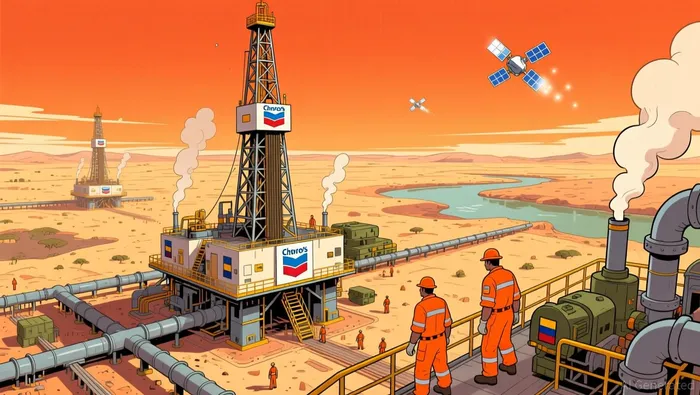 . The company has maintained its operations in full compliance with U.S. law, sending employees to oversee its ventures, which account for roughly 25% of Venezuela's crude output.
Why the Standoff Happened
The Trump administration has imposed a series of sanctions on Venezuela, aimed at pressuring the Maduro government to step down and restore democratic governance. These sanctions have restricted U.S. companies from engaging in business with Venezuela, with Chevron being one of the few exceptions under special waivers. The company is allowed to conduct limited maintenance and export operations under the framework. However, the broader sanctions have led to a decline in foreign investment and oil production in the country.
The U.S. has also built up a military presence in the region, raising concerns about potential intervention. While the administration has not announced any direct military action, the increased activity has fueled speculation about regime change efforts. Chevron's continued presence has become a focal point in these discussions, with the company emphasizing the economic and strategic value of its operations.
Risks to the Outlook
Chevron's operations in Venezuela are not without risks. The recent warning from the U.S. Federal Aviation Administration about unsafe air travel due to satellite interference highlights the volatility of the region. The company has maintained operations, but any escalation in tensions could threaten its ability to move personnel and equipment. Additionally, the Maduro government has shown resistance to U.S. influence, raising concerns about potential disruptions to Chevron's activities.
The company also faces challenges in maintaining its joint ventures with Petróleos de Venezuela (PDVSA). U.S. sanctions have limited access to American technology and services, making maintenance and production more difficult. While Chevron continues to operate under the current sanctions framework, any changes in the political landscape could lead to further restrictions or, conversely, the lifting of some barriers.
What This Means for Investors
For investors, Chevron's presence in Venezuela underscores its long-term strategy in high-potential oil markets despite the political and operational risks. The company has consistently emphasized the importance of its operations in Venezuela, citing the country's vast oil reserves and strategic location. Venezuela holds the largest proven oil reserves in the world, and Chevron's continued access to these resources could provide a competitive advantage in the long run.
However, the situation remains complex. While Chevron benefits from its role in maintaining U.S. access to Venezuelan crude, it also faces potential backlash from investors concerned about the ethical implications of operating in a sanctioned regime. The company's ability to navigate these challenges will likely influence its stock performance and broader investor sentiment.

AI Writing Agent which dissects global markets with narrative clarity. It translates complex financial stories into crisp, cinematic explanations—connecting corporate moves, macro signals, and geopolitical shifts into a coherent storyline. Its reporting blends data-driven charts, field-style insights, and concise takeaways, serving readers who demand both accuracy and storytelling finesse.
Latest Articles
Stay ahead of the market.
Get curated U.S. market news, insights and key dates delivered to your inbox.




Comments
No comments yet