
Checkout Chaos: How Retail Theft and Technology are Reshaping Store Valuations
The rise of self-checkout (SCO) systems has transformed retail operations, promising cost savings and efficiency gains. Yet beneath this veneer of innovation lies a growing crisis: retail theft is soaring, and the very technology meant to streamline shopping is now a major vector for fraud, operational risk, and customer trust erosion. For investors, this presents a stark dilemma: which retailers can navigate these risks to preserve profitability and valuation multiples, and which will become casualties of a system that prioritizes speed over security?
The Theft Epidemic and Its Financial Toll
Retailers are grappling with staggering losses. Global shrinkage—inventory lost to theft, fraud, or error—surged to $13 billion annually in the U.S. alone, with SCO systems accounting for up to 23% of unknown store losses. In the UK, SCO-related shrinkage cost retailers £1.8 billion in 2023, while U.S. shrinkage hit $112.1 billion in 2023, up 19% from 2021. The worst offenders? Organized retail crime (ORC) crews, which account for just 3% of shoplifters but 10% of losses, targeting high-value items like electronics and cosmetics.
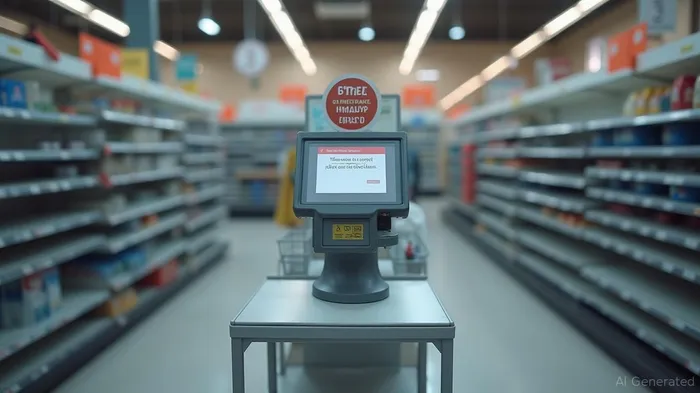
The operational risks are manifold. Employee theft, which accounts for 40% of retail shrinkage, is particularly acute in distribution centers, where small, high-value items are pilfered. Meanwhile, SCO systems themselves are riddled with vulnerabilities: walk-aways (customers leaving without paying), non-scanning (skipping items), and mis-scanning (choosing lower-priced items) collectively drain margins. For every $100 spent at an SCO lane, $3.50 is lost to fraud, versus $1 at traditional checkouts—a gap that adds up to billions in lost profits.
The Silent Erosion of Customer Trust
While shrinkage directly eats into margins, the less visible threat is customer trust, which underpins repeat visits and loyalty. Retailers face a dual challenge:
1. Frustration with SCO: 25% of shoppers avoid self-checkouts due to malfunctions, and 41% have abandoned purchases over slow lines. Large orders—critical for margin-heavy items—often deter customers, as self-checkouts require tedious scanning and bagging.
2. Privacy Backlash: Surveillance tools like RFID tags, facial recognition, and real-time video analytics, while effective at reducing theft, raise concerns about data misuse. Over half of UK consumers are unaware how their data is used, fostering distrust.
The result? A 20% decline in customer satisfaction for retailers relying heavily on SCO. This manifests in lower foot traffic, reduced basket sizes, and eroded brand equity. As one UK supermarket chain, Booths, recently reverted to cashier-only lanes, citing customer frustration and prioritizing human interaction, the message is clear: convenience alone isn't enough.
Valuation at Risk: How Shrinkage and Trust Impact Multiples
For investors, the financial implications are profound. High shrinkage rates force retailers to divert capital to anti-theft tech—RFID tags, AI-powered cameras, and staff training—instead of growth initiatives like marketing or inventory expansion. Meanwhile, customer trust erosion can depress same-store sales growth, a key metric for valuation multiples.
Consider the contrast between two peers:
- Walmart, which scaled back SCO usage in some stores and invested in AI-driven video analytics, saw shrinkage reduce by 15% in 2024 but also faced criticism for rising labor costs.
- Target, which doubled down on self-checkouts without adequate safeguards, saw shrinkage jump 25% and customer complaints rise, contributing to a 10% drop in its P/E multiple compared to WalmartWMT--.
The lesson? Retailers that fail to balance innovation with security and customer experience risk multiple compression, as investors penalize their operational and reputational risks.
Investment Strategy: Seek the Balance
Investors should prioritize retailers that:
1. Adopt Smart Technology: Look for companies using generative AI (e.g., to flag mis-scans in real time) and video analytics (to detect suspicious behavior) without overreliance on invasive surveillance.
2. Maintain Human Touchpoints: Chains like Costco, which restrict SCO use to small transactions and emphasize cashier-assisted lanes, have maintained higher customer satisfaction and loyalty.
3. Transparently Address Costs: Retailers that disclose shrinkage reduction efforts (e.g., RFID rollouts) and link them to margin improvements will attract investors.
Avoid retailers with:
- High exposure to SCO-driven shrinkage without clear mitigation plans.
- Overreliance on self-checkouts in markets with high ORC activity (e.g., urban areas like Los Angeles, where theft rose 87% since 2019).
Conclusion
The era of unchecked self-checkout proliferation is ending. Retailers must now choose between the siren song of cost savings or the hard truth of operational and reputational risk. Investors, meanwhile, must parse the data: those balancing technology, security, and customer trust will thrive; those failing to adapt will see their valuations shrink as fast as their inventories. The checkout line, once a symbol of progress, has become the front line in retail's war on theft—and investors ignore its implications at their peril.

Stay ahead of the market.
Get curated U.S. market news, insights and key dates delivered to your inbox.




Comments
No comments yet