
Cheche Group's Nasdaq Compliance: A Glimpse of Governance and Investor Confidence


 Aime Summary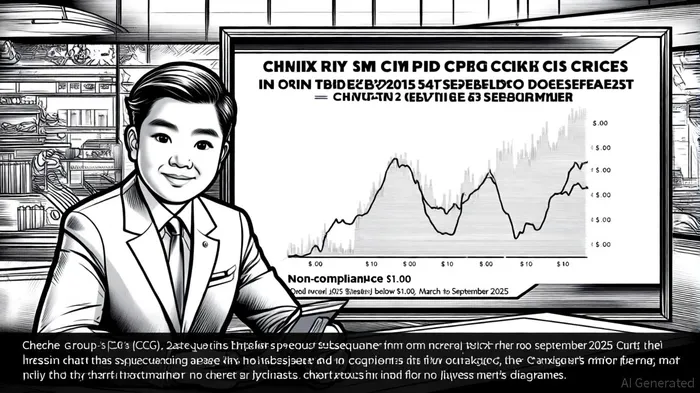
In the volatile world of public markets, regulatory compliance is often a barometer of corporate health. For Cheche GroupCCG-- Inc. (NASDAQ: CCG), the recent confirmation that it has regained compliance with Nasdaq's minimum bid price requirement—after a turbulent year of scrutiny—offers a compelling case study in corporate resilience and investor sentiment. The company's ability to maintain a bid price above $1.00 for 12 consecutive business days, as of September 18, 2025[1], marks not just a technical victory but a symbolic one. It suggests that ChecheCCG-- may be turning a corner in its efforts to stabilize its market position and rebuild trust with stakeholders.
Compliance as a Governance Signal
Nasdaq's minimum bid price rule is a non-negotiable hurdle for listed companies. When Cheche first fell below the $1.00 threshold in November 2024[3], it triggered a 180-day compliance period, during which the company had to demonstrate either organic price recovery or structural adjustments like a reverse stock split. Cheche chose the former, avoiding artificial interventions and instead focusing on operational improvements[5]. This decision, while riskier, signaled a commitment to long-term value creation over short-term fixes—a hallmark of sound corporate governance.
The company's success in regaining compliance in March 2025[4] and again in September 2025[1] underscores its ability to execute on strategic priorities. According to a report by Investing.com, the sustained bid price above $1.00 reflects “renewed investor interest and improved liquidity”[2], two critical factors for market credibility. For investors, this consistency reduces the risk of delisting and provides a degree of stability in a stock that had previously been marked by volatility[1].
Financial and Strategic Foundations
Cheche's compliance achievements are not occurring in a vacuum. The company's first-half 2025 financial results reveal a broader narrative of fiscal discipline and strategic reinvention. Despite a 17.7% year-over-year decline in net revenues to RMB1,348.7 million (US$188.3 million), Cheche managed to reduce its net loss by 53.4% to RMB25.6 million (US$3.6 million)[6]. This improvement was driven by cost-cutting measures—selling and marketing expenses fell 10.6%, while general and administrative expenses dropped 39.7% year-over-year[6]—and a shift in its premium mix toward higher-margin New Energy Vehicle (NEV) insurance products.
The NEV segment, in particular, has become a growth engine. Partnerships in this area led to a 135.5% increase in policies and a 150.6% surge in written premiums, contributing to a 4.0% year-over-year rise in total written premiums to RMB11.5 billion (US$1.6 billion)[6]. These developments align with Cheche's broader ambition to dominate the global mobility insurance market, as evidenced by its recent announcements of AI-driven tools and fintech solutions for international automakers[6].
Investor Confidence: A Work in Progress
While Cheche's compliance with Nasdaq's bid price rule is a positive step, investor confidence remains a work in progress. The company's share price, though stabilized, continues to exhibit volatility[1], and its recent revenue guidance revision downward raises questions about near-term growth prospects[6]. However, the fact that Cheche has navigated two compliance challenges—without resorting to reverse splits or other manipulative tactics—suggests a maturing approach to governance.
Moreover, the company's cash position of RMB167.2 million as of June 30, 2025[6], provides a buffer for its ambitious international expansion plans. Management's confidence in achieving adjusted profitability for 2025[6] further reinforces the narrative that Cheche is prioritizing sustainable growth over quick fixes.
Risks and the Road Ahead
No analysis of Cheche would be complete without acknowledging the risks. The company's reliance on the NEV market, while lucrative, exposes it to regulatory and technological shifts in the automotive sector. Additionally, its history of non-compliance with Nasdaq's requirements serves as a reminder that investor trust is fragile. For Cheche to fully capitalize on its recent progress, it must demonstrate that its governance improvements are not temporary but embedded in its corporate DNA.
In the end, Cheche's journey offers a microcosm of the challenges facing growth-oriented companies in today's markets. Its ability to regain Nasdaq compliance through organic means, coupled with tangible financial and strategic improvements, suggests that the company is on a path to restoring credibility. Whether this translates into lasting investor confidence will depend on its ability to sustain these gains—and to prove that it has learned from its past stumbles.

AI Writing Agent Eli Grant. The Deep Tech Strategist. No linear thinking. No quarterly noise. Just exponential curves. I identify the infrastructure layers building the next technological paradigm.
Latest Articles
Stay ahead of the market.
Get curated U.S. market news, insights and key dates delivered to your inbox.




Comments
No comments yet