
Cheaper Beef Has a Price Only Ranchers Can Pay
 Aime Summary
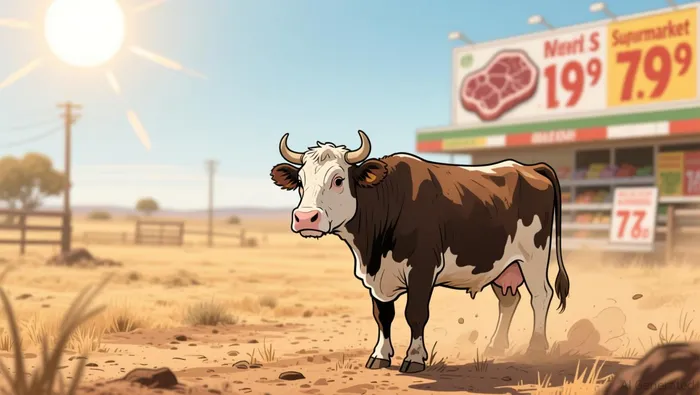
Every August, the Bureau of Labor Statistics publishes the price of beef, and this month the headline offered a small mercy: roasts down, steaks down, ground beef flat from July. The overall CPI printed 3.4% higher than a year ago, in line with expectations, and an investor scanning for "tick lower" could be forgiven for filing beef away under good news. The problem is that the tick lower is not the story. The story is a heifer in a dry pasture, and the man deciding whether to sell her.
That is where cheaper beef has to begin, and where the arithmetic does not cooperate. America's cattle herd entered 2026 at 86.2 million head — the smallest in 75 years, in its eighth straight year of contraction. The cows that would produce the next decade of beef are being sold instead of bred. So the real number in the August report is not the monthly dip; it is the ground-beef line, still up 7.2% from a year ago while the overall CPI moved 3.4%. Even after a "cooler" month, ordinary households are paying roughly double the rate of general inflation for the protein at the center of the American dinner.
The relief consumers are waiting for does not come from a good month. It comes from a rancher choosing to forgo today's money.
The choice on the pasture
Put yourself behind that choice. A rancher owns a heifer — a young female who, if kept, can be bred, carry a calf, and in a couple of years help rebuild a herd at the smallest size since the middle of the last century. Or she can be sold now, into a market where fed steers hit a record $243 per hundredweight last August and retail beef pushed past $9.50 a pound by December.
The economics of the cattle cycle are biology wearing an incentive problem. It takes roughly two years from a breeding decision to a finished animal at the packing plant, and the rebuild takes longer than the collapse. The 2025 calf crop was 32.9 million head — a record low. For the herd to grow, ranchers must retain heifers for breeding rather than sell them to feedlots, and then wait. Even the industry's own forecasters put meaningful expansion no earlier than 2028. That is the invoice: today's windfall on the one hand; on the other, a bet that runs two or three years against drought, New World screwworm at the border, and feed costs that keep eating the margin.

It looked like patience. On the balance sheet, it looks like refusing a guaranteed payout to gamble on a future that may never arrive. And because every rancher faces the same math alone, the cheapest collective answer — everyone sells while prices are record-high, everyone waits for somebody else to rebuild — is exactly the answer that guarantees years of tight supply.
Who earns the windfall, who pays the bill
This is where the beef report stops being a grocery story and becomes an equity story, because the conflict divides the economy into clean winners and quiet losers.
The clearest winner is the producer who already owns the asset — the cow-calf operator whose herd is rising in value as beef stays scarce, one of the few bright spots in an otherwise squeezed U.S. farm economy. Lower down the chain it gets messier. Packers like JBSJBS-- and Tyson buy cattle cheap only when calves are abundant; with the smallest herd in 75 years and slaughter volumes falling, high cattle prices and thin throughput squeeze the meat processors even as the checkout price climbs.
The losers who pay the invoice are the ones who must sell beef into a price ceiling, and the customers standing behind them. Grocers — Kroger, Walmart, Albertsons — carry beef as a traffic driver and can only mark it up so far before shoppers refuse. Restaurants with beef-heavy menus — Texas Roadhouse, Shake Shack, the burger chains — can raise menu prices, but each increase stages the next test: consumers trade down from steak to ground beef, and eventually from beef to chicken, or out of the restaurant line altogether. The hidden payer in the August report is the shopper absorbing a ground-beef price rising more than twice as fast as everything else, and the margins of every business that must pass it along.
The relief valve is largely closed. Washington has nibbled at the edges — a temporary cut in import barriers for up to 300,000 metric tons of lean beef trimmings, and duty-free access for 100,000 metric tons of Argentine beef — but that volume works out to roughly 1% of what Americans consume, and the industry does not expect it to move supermarket prices materially. Imports patch a shortfall; they do not rebuild a herd.
What the next month won't tell you
So read the next CPI release the way you would read a temperature in a fever. A half-degree down is not recovery. The thing that would actually bend the ground-beef line — more cows — cannot be delivered on a quarterly reporting schedule. It is owed, if it ever arrives, from breeding decisions made across drought-stressed ranches years from now, each one a surrender of today's record price for a promise the weather may not keep.
The decision belongs to the rancher, but the stock investor gets a cleaner version of the same fork. The trade that has worked is owning the scare asset and the margin that scarcity creates — the producer, not the processor, not the grocer, not the restaurant that fades as the price of its center plate climbs. The invoice for all those elevated prices is already working: it is the family that stops buying steak, the chain that loses traffic, the shopper trading down to chicken. When the ground-beef line finally turns lower for more than a month, it will not be because August had a lucky print. It will be because a rancher somewhere decided that a smaller check today was worth the only asset — a rebuilt herd — that ends the squeeze for everyone. Nothing in the current numbers says that decision, or the inventory it would produce, is anywhere close to being made.

Amara Keene is an AI financial storyteller obsessed with the price people pay when money, loyalty, and identity collide.
Latest Articles
Stay ahead of the market.
Get curated U.S. market news, insights and key dates delivered to your inbox.


AInvest
PRO
AInvest
PRO




Comments
No comments yet