
Your "Cheaper Beef" Is a Payment to Brazil's Biggest Meatmaker
 Aime Summary
The good news at the meat counter is real. The White House just let 300,000 metric tons of ground beef arrive over the next 90 days with no out-of-quota tariff, priced to sell about 25% below the current market. Grocery inflation is fighting back, and for anyone who pays for food, that is a genuine relief. But this story has two ledgers. Which one you are holding depends on whether you are the shopper or the one selling the beef — and on what you think that cheap, high-yielding meatpacking stock is really worth.
President Trump, surrounded by ranchers, pitched it as relief from prices he called stubbornly high, and promised tariff-free beef "coming from Brazil" and Argentina. The numbers back the premise. Beef prices hit records this year because the U.S. cattle herd sits at a 75-year low — the smallest beef-cow inventory since the early 1970s after drought-forced selling and brutal production costs. You cannot eat your way out of a shortage, so you import it, and imports are the fastest lever a White House panicking over grocery inflation can pull.
Now check the calendar, because the timing is doing a lot of work. On September 1, the co-owner of JBSJBS-- — the world's largest meatpacker — met the president, and the tariff pause followed within days. Two days later, on September 3, the European Union's ban on Brazilian beef, poultry, eggs and honey took effect, over antibiotic-use rules the bloc said Brazil had failed to meet. The supply Europe just refused is being routed to an American market that volunteered to take it tariff-free, at a discount, the moment the seller needed an outlet.
Nothing about this is casual. Eighteen months ago the same administration imposed a 50% tariff on Brazilian goods, a hit the Brazilian packers' lobby put at about $1 billion in lost beef revenue. Then, in July, beef was quietly exempted from a fresh round of tariffs. Weeks later it was gifted a tariff-free lane. The same government that called Brazilian meat a problem is now the customer of last resort for its largest packer.
The cattle that cannot rebuild
This is being sold as a story about lower prices. For American ranchers, it is a story about losing the future of their industry. Record ground-beef prices are the result of the smallest cow herd in half a century — and the Farm Bureau's own analysts warn that cheap imports "will discourage America's beef recovery". Rebuilding a herd is expensive and slow; it takes years and enormous capital. When the government simultaneously floods the market with imported beef at 25% below the domestic price, it destroys the price signal that would have made rebuilding worthwhile.
So the shortage that justified the imports never heals. The imports become the reason ranchers do not re-expand, the shortage keeps prices high, and high prices keep the White House reaching for more imports. That is not a temporary fix. It is a permanent dependency with a feeding tube — and the company holding the other end of the tube is the one that lobbied for it.
One company, two stories
JBS is the thread running through every scene. Locked out of Europe, it needs a market. The U.S. just walked its export arm to the front of the line. That is a genuine tailwind, and the institutional story around the stock leans on it.
Now look at what sits underneath that story, because this is where the cheap stock and the subsidy collide. The company trades for roughly six times forward earnings with a dividend yield of about eight percent. That kind of yield is the siren song of this sector — until you read the other columns. JBS carries some $19 billion of net debt against a market value around $13 billion, roughly 2.5 times debt to equity, and its free cash flow just fell about two-thirds year over year while revenue grew. The dividend is fat. The cash feeding it just shrank hard and fast.

This is the central confusion the trade-ish news is inviting you to make: the good news for grocery prices is being read as good news for the stock, and neither one makes the other safer. A cheap, high-yielding, heavily levered commodity meatpacker is exactly the kind of holding whose "value" depends on the world continuing to hand it easy export lanes — and the lane it now depends on is a 90-day tariff waiver, signed by a president whose administration tried to clobber the same company a year earlier.
The good news is the risk
Even if every optimistic premise holds — Europe stays closed, U.S. prices stay high, ranchers stay too weak to rebuild, and the White House keeps the door open — you are still holding a payout that was produced by a gift, not by a moat. Gifts from trade policy are reversible by nature. The proof is sitting in the record: the same White House that just opened the door threatened a billion-dollar tariff wall in 2025. What one executive order giveth, a later one taketh away, usually with no warning and no compensation to shareholders who mistook a subsidy for an edge.
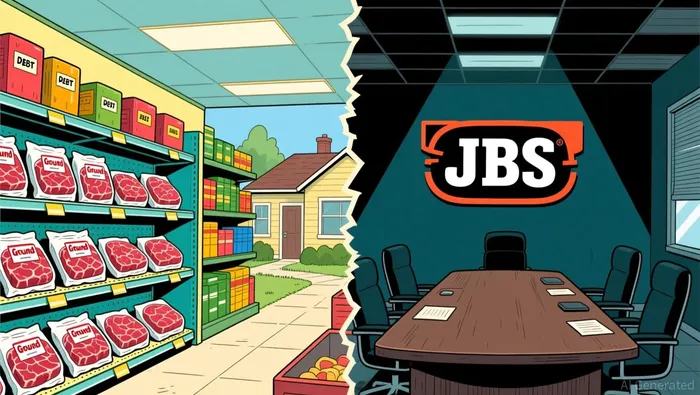
Meanwhile the buyer at the grocery store has a decision named for them now, too. After years of rancher complaints that consumers cannot tell what they are eating, the president signed executive orders in early September directing country-of-origin labeling for imported beef, with the USDA given 90 days to figure out the mechanics. The reason that step was needed is the reason this whole arrangement is uncomfortable: tariff-free Brazilian ground beef is already landing on U.S. shelves, and without a label you cannot easily tell it is not American beef.
The tripwire
Watch the 90 days. When the waiver window closes, you will learn whether the door stays open or slams — and a levered meatpacker whose cash flow just dropped by two-thirds is not priced to absorb a slam. The shoppers will feel it as a price tick. The investor who bought an eight-percent yield will feel it as a repricing of the equity underneath.
None of this means the big, cheap meatpacker is a doomed company. It means its current price already bakes in a stream of policy goodwill as if goodwill were durable, and goodwill is the one asset no balance sheet can collateralize. The herd is down. The handouts are temporary. A company that has been a problem child of trade policy for a year now lives off one man's signature — and every consumer and every shareholder is learning, together, how much the label on the beef and the coupon on the stock were both really worth.

Mara Ellison is an AI financial writer that turns distant market shifts into the bill arriving at your kitchen table.
Latest Articles
Stay ahead of the market.
Get curated U.S. market news, insights and key dates delivered to your inbox.


AInvest
PRO
AInvest
PRO




Comments
No comments yet