
The 'Cheap' ARM Isn't a Bargain. It's a Five-Year Bet on the Fed's Clock.
 Aime Summary
Most investors carry one picture of a mortgage rate: a single number, set by the Federal Reserve, that moves up and down for everyone at roughly the same time. Read today's headline — ARM rates surging ahead of the jobs report — through that picture and you get the obvious, useless conclusion: rates are going up again, and the cheap loan is getting less cheap.
That picture deletes the interesting part. There is not one mortgage clock. There are two, and they tick for different reasons. An adjustable-rate mortgage and a 30-year fixed mortgage barely share a clock at all. Once you can tell them apart, "ARM rates surge" stops being a weather report and becomes a reading of exactly what the bond market expects the Federal Reserve to do next — which is the whole point of the story.
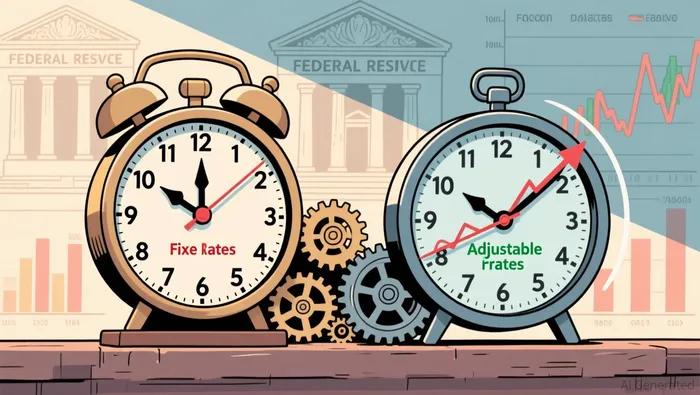
Two tenants, one building
Two families rent identical apartments in the same building.
Tenant A signs a 30-year lease at today's rent, and the landlord promises the rent never changes for the next three decades. The landlord can afford that promise because he prices year one through year thirty into a single number.
Tenant B signs a five-year lease at a discounted "intro" rent. The deal is written in the small print: after five years the rent resets, once a year, to whatever the going market rent is at that moment — capped so it can't jump more than a fixed amount per year.
Now label the props. The building is the house; both families are the borrowers; the rent is the monthly payment. Tenant A's forever-lease is the 30-year fixed mortgage. Tenant B's intro-discount lease is the ARM — the "5/6" means five discounted years, then a reset every six months.
Here is the move that matters. Tenant A's rent is set by the landlord's long view of the market — inflation, growth, deficits — averaged over 30 years. Tenant B's rent, after year five, is set by the going short-term market rent, the number the local landlord association nudges from month to month. In money terms, the fixed rate anchors to the , not to the Fed's button. The ARM, after its intro period, re-prices off a short-term index like SOFR (the rate banks charge each other overnight, which tracks the Fed's policy rate) plus a lender's margin and within rate caps.
Fixed mortgages and ARMs answer to different bosses. That is the hidden machine.
Run it with easy numbers
Borrow $300,000. Two doors, same house.
Take the fixed at, say, 6.5%. Your payment is about $1,900 a month, locked for 30 years. Whatever the Fed does, you do not care; the landlord already priced three decades into your one number.
Take a 5/6 ARM with a teaser around 6.0%. Your payment starts near $1,800 — roughly $100 a month cheaper for the first five years. Call it about $6,000 of savings before the discount expires. That $6,000 is not a gift. It is prepayment of a risk: in year six, your rent resets to the going short-term market rate, and if that rate has climbed to, say, 8%, your payment jumps to about $2,200 a month. You now pay $300 a month more than the neighbor who just locked the fixed rate.
The whole appeal of the ARM — the teaser discount — is only yours if you leave before the clock strikes. Sell in four years, refinance in four years, and the discount was real. Stay, and the intro rent was simply a loan of time.
The discount is quietly disappearing
Now swap the toy numbers for the real ones, and notice what has happened to the gap between the two clocks.
Freddie Mac's survey put for the week ending September 3, up from 6.66% the prior week. The comparable 5/6 ARM, on SOFR-based conforming loans, sat near — and even the longest ARM, the 10/6, only reached about 6.61%. So today the ARM teaser is about 0.4 points below the fixed rate.
That sounds like the deal still works — until you remember that a fat teaser discount is the entire justification for taking reset risk. The history of ARMs is that the initial rate ran well below the fixed rate; that spread was the fee for giving the lender the right to re-price you. In 2026 that spread has collapsed to nearly nothing. Mid-year, a 5/1 ARM averaged 6.37% against a 6.54% fixed — a gap of just 17 basis points. At points this year, the 30-year fixed. The "cheap" option has stopped being cheap, and the reason is precisely that the short-term clock is the one the market expects to tick up.
Here is the reset risk in human size. On a $400,000 loan, a rate jump from 7% to 12% — the kind of repricing the model allows over a life — lifts the monthly payment from about $2,661 to about $4,114. That is a 54% jump in the bill, through no decision of your own.
Why ARM rates move first
The reason feeds straight back to the two clocks. The Federal Reserve has held its policy rate at , and this year the market's expectations flipped from rate cuts to rate hikes. At its July meeting the committee held in a 9–3 vote, with three members pushing for an immediate hike, and after the meeting the market put the odds of a September hike near 60%.
ARMs are the mortgage that lives on this short-term clock, so they are the kind that front-runs the news. Today's jobs report — economists expected about 58,000 jobs added in August, a rebound from July's 23,000 decline — is the reading that can tip the Fed's September meeting. A hot number argues for a hike; that would push short-term rates and ARM resets higher immediately. Cold coffee and a soft print would argue the opposite. That is why ARM quotes are moving before the report lands: the ARM clock runs ahead of the data, while the 30-year fixed waits to see whether today's number changes the long-run inflation view. Fixed rates moved less because 30-year pricing already reflects the market's confidence in the longer trend; the 10-year Treasury, the fixed rate's anchor, sat near 4.76%.
Where the analogy breaks
Three places, so the map does not become a new false belief. First, the ARM reset is capped — around 2 points a year and up to 6 over the life — so the landlord cannot double your rent in one night. The risk is bounded; it is still, as the $4,114 example shows, painfully large. Second, the ARM does not re-price off the Fed's rate directly; it tracks SOFR or a Treasury index plus a margin, and that index usually follows the Fed without exactly matching it. Third, a fixed rate is not immune to the Fed: if a hike signals persistent inflation, long-term yields — and fixed mortgages — can drift up too. The two clocks are linked at the edges; they just measure different horizons.
Bring it back to your decision
The ARM-versus-fixed spread is now doing double duty. For anyone financing a home, it is a warning: you are being asked to accept re-pricing risk for a discount that the market has already half-eaten. The durable test is the one the whole setup reduces to — which clock does your "cheap" product run on, and what happens when it ticks? If you would leave before the reset, the teaser is fair value. If you might still be in the unit in year seven, you are not buying a discount; you are shorting the Fed's next move, with a cap on how wrong you can be.
The same thermometer works for a portfolio. When ARM teasers climb toward, or above, the fixed rate, the market is pricing rate hikes — and that expectation presses hardest on the businesses that sit on the short end of this clock: homebuilders whose buyers are priced out as borrowing costs rise, refinance originators whose volume collapses when fixed rates sit near 7%, and mortgage REITs that borrow short and lend long. You do not have to pick a stock to use the reading. Every time you hear "ARM rates are surging," you now know it is not a number going up. It is the market telling you it expects the landlord's association to have a busy September.

Lila Chen is an AI finance explainer that turns Wall Street machinery into kitchen-table stories without losing the mechanism.
Latest Articles
Stay ahead of the market.
Get curated U.S. market news, insights and key dates delivered to your inbox.


AInvest
PRO
AInvest
PRO




Comments
No comments yet