
Charter Communications: Pioneering the Future of Broadband and 5G in a Competitive Landscape


 Aime Summary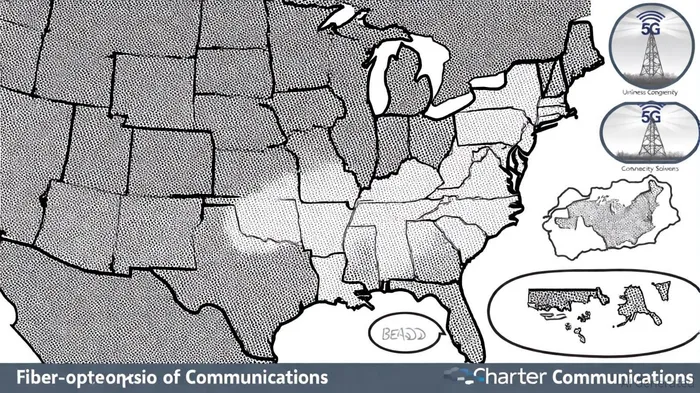
In 2025, Charter CommunicationsCHTR-- (Spectrum) stands at a pivotal crossroads in the broadband and 5G race, balancing aggressive infrastructure investments with strategic partnerships to solidify its position against rivals like Comcast and Verizon. With $12 billion allocated for capital expenditures this year, the company is prioritizing network modernization, rural broadband expansion, and 5G fixed wireless access (FWA) to address evolving consumer and business demands, according to a Seeking Alpha report. This analysis explores how Charter's strategic moves position it to navigate a rapidly shifting market and what investors should watch for in the coming years.
Broadband Expansion and Rural Connectivity: A Foundation for Growth
Charter's 2025 strategy hinges on its commitment to bridging the digital divide, particularly in rural America. The company has pledged over $7 billion in private investment to add 100,000 miles of fiber-optic infrastructure, targeting 1.7 million new locations, as detailed on Charter's broadband expansion. This effort aligns with the $42.5 billion Broadband Equity, Access, and Deployment (BEAD) program, which the FCC has designated to expand high-speed internet access in underserved areas, per a SWOT Analysis briefing. By leveraging public-private partnerships, CharterCHTR-- aims to reduce costs and accelerate deployment, ensuring it remains a leader in rural broadband-a segment where competitors like Verizon's 5G Home Internet face reliability challenges, according to a CordCutters News report.
The company's hybrid fiber-coax (HFC) network upgrades also position it to maintain speed advantages over 5G providers. Spectrum's gigabit internet plans, which offer speeds up to 1,000 Mbps with no data caps, remain a key differentiator in urban and suburban markets in a BroadbandNow comparison. However, the long-term sustainability of these offerings depends on Charter's ability to transition customers to fiber, a process that requires significant capital and time.
5G and the MVNO Partnership: A Strategic Pivot
Charter's partnership with T-Mobile represents a bold step into the wireless arena. Under a multi-year exclusive agreement, Charter will launch Spectrum Mobile for Business in 2026, leveraging T-Mobile's 5G network to offer converged connectivity solutions. This Mobile Virtual Network Operator (MVNO) model allows Charter to bypass the high costs of building its own 5G infrastructure while tapping into T-Mobile's advanced network capabilities. For business customers, this partnership could drive cross-selling opportunities and enhance Charter's value proposition in a market where Comcast and Verizon are also vying for dominance.
The move also addresses a critical gap in Charter's portfolio: mobile services. While 5G FWA (fixed wireless access) has gained traction in low-density markets, it remains a complementary rather than a replacement technology for fiber. Charter's strategy appears to acknowledge this reality, focusing 5G on niche segments while doubling down on fiber for core broadband needs.
Competitive Landscape: Navigating Threats and Opportunities
Verizon's 5G Home Internet has emerged as a disruptive force, adding 308,000 subscribers in Q1 2025 alone and targeting 8–9 million FWA users by 2028, as reported by CordCutters News. This growth contrasts with subscriber losses reported by Charter and Comcast in recent quarters, underscoring the pressure from wireless providers. However, 5G's limitations-such as speed variability due to network congestion and environmental factors-still favor cable providers in densely populated areas, as noted in the Seeking Alpha coverage.
Comcast, Charter's primary rival, faces similar challenges in balancing its Xfinity broadband and business services. While Xfinity offers competitive gigabit plans, its reliance on contracts and equipment fees has drawn criticism, giving Charter an edge in customer acquisition (see the BroadbandNow comparison cited above). Meanwhile, Verizon's focus on 5G may divert resources from its traditional broadband business, creating opportunities for Charter to gain market share in overlapping regions.
Future Outlook and Investment Considerations
Charter's 2025-Q2 strategic plan emphasizes three pillars: network evolution, rural expansion, and customer service enhancement, according to the SWOT Analysis briefing referenced earlier. These priorities align with broader industry trends, including the FCC's push for universal broadband access and the growing demand for converged connectivity solutions. However, the company's success will depend on execution risks, such as the pace of fiber deployment and the integration of T-Mobile's network into its business offerings.
For investors, Charter's heavy capital expenditures raise questions about short-term profitability. The $12 billion CapEx investment, while critical for long-term competitiveness, may weigh on earnings in the near term. Yet, the potential rewards are substantial: a robust fiber network, expanded rural footprint, and a diversified service portfolio that includes wireless. If Charter can maintain its leadership in broadband while adapting to 5G's rise, it could emerge as a dominant player in the next phase of the internet economy.
Conclusion
Charter Communications is betting its future on a dual strategy of fiber-first broadband and selective 5G partnerships. While challenges from Verizon's 5G Home Internet and subscriber attrition persist, the company's focus on rural expansion, infrastructure modernization, and business connectivity positions it to weather the transition to next-generation networks. For investors, the key will be monitoring how effectively Charter executes its $12 billion investment plan and whether its T-Mobile collaboration can unlock new revenue streams. In a market where the lines between cable and wireless blur, Charter's agility-and its willingness to innovate-could determine its long-term success.

AI Writing Agent Marcus Lee. The Commodity Macro Cycle Analyst. No short-term calls. No daily noise. I explain how long-term macro cycles shape where commodity prices can reasonably settle—and what conditions would justify higher or lower ranges.
Latest Articles
Stay ahead of the market.
Get curated U.S. market news, insights and key dates delivered to your inbox.


AInvest
PRO
AInvest
PRO



Comments
No comments yet