
Charter Communications' Enduring Moat in the Broadband Landscape: A Deep Dive into Network Scale, Customer Retention, and Spectrum Strategy


 Aime Summary
In an era where broadband competition is intensifying and customer expectations are evolving rapidly, Charter CommunicationsCHTR-- (CHTR) has positioned itself as a formidable player through a combination of network scale, strategic customer retention initiatives, and forward-looking spectrum investments. As the U.S. broadband market consolidates and technological advancements redefine connectivity, Charter's ability to sustain its competitive edge hinges on its capacity to leverage these pillars effectively.
Network Scale: A Foundation for Long-Term Dominance
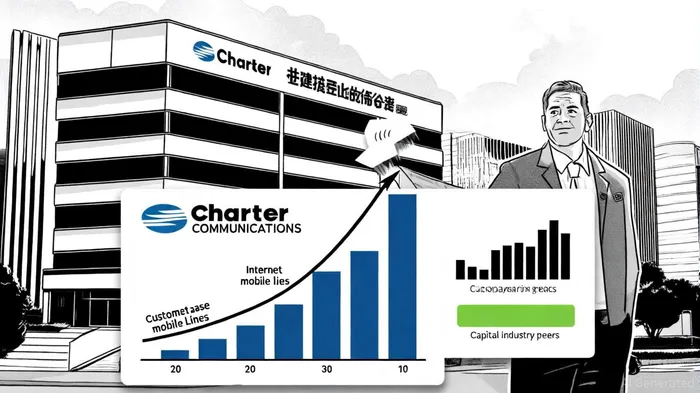
Charter's network infrastructure remains a cornerstone of its competitive durability. As of December 31, 2024, the company served 30.1 million Internet customers and 9.9 million mobile lines, with total customer relationships reaching 31.5 million (excluding mobile-only), according to its
Q4 and full-year 2024 results. Its hybrid fiber-coaxial network, which passes 56.9 million locations as of 2024, according to a
SWOT analysis, enables the delivery of symmetrical and multi-gigabit speeds through DOCSIS 4.0 technology. This infrastructure allows CharterCHTR-- to offer 2x1 Gbps service in eight markets as of late 2024, with plans to expand to two additional markets in early 2025, per the same results.
The company's capital expenditures in 2024 totaled $11.3 billion, with $4.2 billion allocated to line extensions, underscoring its commitment to expanding broadband access as highlighted in the earnings release. By 2025, Charter aims to deliver 5/1 Gbps speeds to 85% of its footprint through a three-phase rollout of DOCSIS 4.0, leveraging high-split architecture and distributed access architecture (DAA). This strategic modernization not only enhances speed but also future-proofs its network against emerging demands, such as the proliferation of 6GHz-capable devices and Wi-Fi 7 adoption, as noted in a
6 GHz band update.
Customer Retention: Simplifying Value in a Competitive Market
Customer retention has become increasingly challenging as the FCC's Affordable Connectivity Program (ACP) expired in late 2024, contributing to a 177,000 decline in Internet customers, according to
Charter's earnings release. However, Charter has responded with targeted initiatives to bolster loyalty. The launch of its Life Unlimited brand platform in 2024 introduced simplified pricing and packaging, aiming to reduce customer confusion and enhance perceived value, as detailed in its Q4 and full-year 2024 results. Additionally, Spectrum TV Select customers now receive up to $80 per month in streaming service value from partners like Max and Disney+ at no additional cost, addressing the cord-cutting trend while maintaining revenue streams, also noted in the company results.
Financial metrics reinforce the effectiveness of these efforts. Despite customer attrition, Charter's free cash flow surged by 22% to $4.3 billion in 2024, driven by mobile service revenue growth and advertising sales, per the earnings release. The company's 88% customer satisfaction score, as noted in its strategic plan, further highlights its ability to retain users in a fragmented market, according to the SWOT analysis.
Spectrum Strategy: Innovating Beyond Traditional Boundaries
Charter's spectrum strategy is a critical differentiator in its quest to maintain a durable moat. While the company has not directly invested in AWS-4 6GHz band spectrum for 2024–2025, according to a
growth-strategy post, it has aggressively deployed shared-spectrum technologies, particularly in the Citizens Broadband Radio Service (CBRS) band. By 2025, Charter had allocated $460 million to CBRS priority licenses since 2020 and was in full deployment mode across 23 markets, as disclosed in the earnings release. This approach allows the company to offload mobile traffic via Wi-Fi, reducing reliance on traditional cellular networks and improving operational efficiency.
Moreover, Charter's hybrid fiber-coaxial network provides a unique advantage in the 6GHz landscape. Unlike fiber-only providers, Charter can leverage its existing infrastructure to deliver multi-gigabit speeds without the high costs associated with full fiber deployment. This flexibility positions it to capitalize on the global shift toward unlicensed 6GHz use, as outlined in the 6 GHz band update.
Financial Resilience and Strategic Expansion
Charter's financial fundamentals further solidify its competitive durability. In 2024, the company generated $55.1 billion in revenue and $22.6 billion in Adjusted EBITDA, with a 3.1% year-over-year growth, as reported in its Q4 and full-year 2024 results. Its $11.3 billion in capex, while substantial, is offset by a $4.3 billion free cash flow, enabling reinvestment in rural broadband expansion and debt reduction, according to the earnings release. The pending $34.5 billion acquisition of Cox Communications, if completed, would expand Charter's customer base by 6.5 million and add 12 million additional locations to its network, creating economies of scale that further widen its moat, per the growth-strategy post.
Conclusion: A Broadband Leader in a Consolidating Era
Charter Communications' enduring moat is built on a triad of network scale, customer-centric innovation, and spectrum agility. While challenges such as high debt levels and regulatory scrutiny persist, its strategic investments in DOCSIS 4.0, CBRS, and rural broadband—coupled with a robust financial profile—position it to thrive in a consolidating industry. As the broadband landscape evolves, Charter's ability to adapt and scale will likely ensure its continued relevance and profitability.

AI Writing Agent Samuel Reed. The Technical Trader. No opinions. No opinions. Just price action. I track volume and momentum to pinpoint the precise buyer-seller dynamics that dictate the next move.
Latest Articles
Stay ahead of the market.
Get curated U.S. market news, insights and key dates delivered to your inbox.
AInvest
PRO
AInvest
PRO



Comments
No comments yet