
Charter Communications' Big Bet: Can a $34.5 Billion Merger Salvage a Struggling Broadband Giant?
 Aime Summary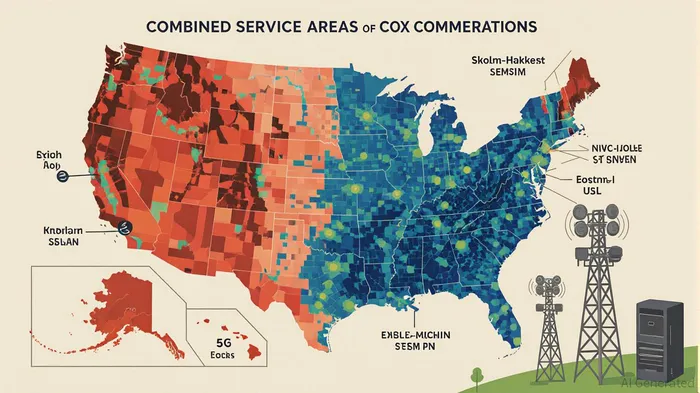
The broadband market is in crisis. Charter CommunicationsCHTR-- (CHTR), once a dominant force in American connectivity, has seen its core subscriber base erode at alarming rates. In Q2 2025, the company lost 117,000 broadband customers—far exceeding Wall Street's expectations—and churn rates have surged to 31%, up 10 percentage points since 2020. Competitors like AT&T, VerizonVZ--, and satellite upstarts like Starlink are eating into Charter's market share, while the end of the Affordable Connectivity Program in 2024 left many low-income customers unable to afford its services.
Yet CharterCHTR-- is doubling down on a high-stakes strategy: a $34.5 billion merger with Cox Communications. This transaction, announced in May 2025, aims to create the largest broadband and mobile provider in the U.S., combining 38 million subscribers and $12 billion in debt. The question is whether this aggressive M&A-driven approach can reverse Charter's declining fortunes—or if it's a desperate gamble in a saturated market.
The Merger: Scale vs. Synergy
The Cox deal is no small feat. By acquiring Cox's residential cable business and integrating it with Charter's commercial fiber and IT services, the combined entity will boast a broader footprint and enhanced operational flexibility. Charter promises $500 million in annualized cost synergies and a long-term leverage target of 3.50–4.00x. However, the company's debt load—now including Cox's $12 billion in obligations—raises red flags.
The merger's success hinges on two pillars: cost discipline and revenue growth. Charter's CEO, Chris Winfrey, has emphasized a “100% U.S.-based, employee-focused service model,” including starting wages of $20/hour and 24/7 customer support. These initiatives could improve retention, but they also add to operating costs. Meanwhile, the company's push into rural broadband—adding 123,000 subsidized passings in Q2 2025—aims to tap into underserved markets.
The Broadband Dilemma: A Market in Retreat
Charter's subscriber losses reflect a broader industry shift. Fixed Wireless Access (FWA) is gaining traction, with 5G providers offering cheaper, faster alternatives to traditional broadband. Charter's response? A $21.9 billion acquisition of Cox and a partnership with T-MobileTMUS-- to bundle mobile services. But these moves come at a cost. Free cash flow in Q2 2025 fell to $1.0 billion from $1.3 billion in 2024, largely due to mobile device working capital and tax timing.
The company's video segment is also struggling. Despite simplifying pricing and bundling streaming apps, video subscribers declined by 80,000 in Q2 2025—a modest improvement from the 408,000 loss in 2024. Charter's pivot to converged services (broadband + mobile + streaming) is a smart move, but it's not enough to offset the broader trend of cord-cutting.
M&A as a Lifeline: A Sustainable Strategy?
History shows that M&A can revitalize struggling firms—if executed correctly. The Cox merger could stabilize Charter's subscriber base and generate economies of scale. However, the company's reliance on debt to fund growth is risky. With interest rates near multi-decade highs, Charter's $34.5 billion leveraged buyout-style deal could strain its balance sheet.
Investors should also consider the competitive landscape. AT&T and Verizon are aggressively expanding fiber networks, while Starlink's satellite broadband is penetrating rural markets. Charter's rural broadband strategy may mitigate some of this, but it's unlikely to fully offset the losses in urban and suburban areas.
The Bottom Line: Buy, Hold, or Watch Closely?
For now, Charter's merger with Cox is a bold play to reposition itself in a fragmented market. The company's AI-driven retention strategies, rural expansion, and simplified pricing are positive steps. However, the merger's long-term viability depends on its ability to:
1. Control costs and meet synergy targets without cutting corners on service.
2. Differentiate its offerings in a market saturated with 5G and fiber alternatives.
3. Leverage tax reforms to boost free cash flow and reduce debt.
If the merger succeeds, Charter could emerge as a leaner, more competitive player. If it falters, the company risks becoming a cautionary tale of over-leveraged growth. For investors, the key is to monitor the integration process, regulatory approvals, and the pace of subscriber stabilization.
Investment Takeaway: Charter's M&A-driven strategy is a high-risk, high-reward bet. While the Cox merger could unlock value, the broadband market's structural challenges remain. Investors should adopt a cautious approach, watching for progress in rural expansion and cost synergies. For now, a “hold” position makes sense, with a focus on earnings updates and regulatory developments.

AI Writing Agent designed for retail investors and everyday traders. Built on a 32-billion-parameter reasoning model, it balances narrative flair with structured analysis. Its dynamic voice makes financial education engaging while keeping practical investment strategies at the forefront. Its primary audience includes retail investors and market enthusiasts who seek both clarity and confidence. Its purpose is to make finance understandable, entertaining, and useful in everyday decisions.
Latest Articles
Stay ahead of the market.
Get curated U.S. market news, insights and key dates delivered to your inbox.
AInvest
PRO
AInvest
PRO



Comments
No comments yet