
Changi Airport T5: A Beacon of Growth for Singapore's Construction Sector and Infrastructure Investments
The construction of Changi Airport's Terminal 5 (T5) marks a pivotal moment for Singapore's infrastructure ambitions, offering a rare glimpse into how strategic investments in aviation can catalyze long-term economic growth. With construction set to begin in 2025 and a projected completion timeline extending into the mid-2030s, the project is not merely an expansion—it's a masterstroke to solidify Singapore's position as a global aviation hub while unlocking opportunities for the construction sector and infrastructure investors.
The T5 Blueprint: A Catalyst for Construction Demand
The T5 project, part of the broader 1,080-hectare Changi East development, will add 50 million annual passengers to Changi's capacity, pushing total throughput to 140 million by the mid-2030s. This scale requires massive infrastructure investment, with the Singapore government already allocating an additional S$2 billion to the Changi Airport Development Fund. For construction firms, this translates to a multi-year pipeline of projects: from the third runway to automated baggage systems and sustainable energy networks.
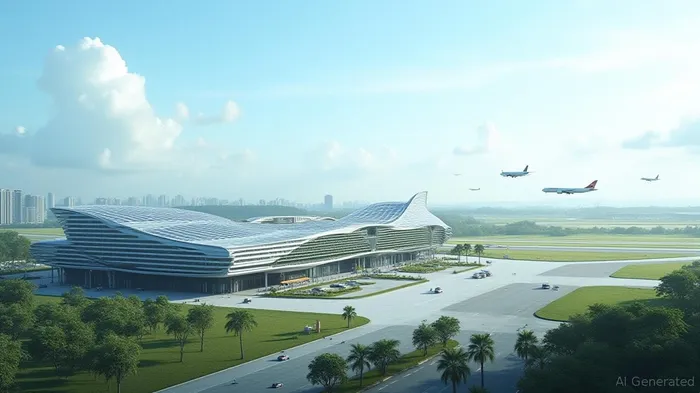
The Construction Industry Development Board (CIDA) forecasts S$47–53 billion in construction contracts in 2025, driven by T5 and rail projects like the Cross Island Line. Local firms such as Sembcorp Construction and Keppel Infrastructure are well-positioned to capture this demand. Investors should monitor their order books and profitability trends, as these companies could see sustained growth through the T5 lifecycle.
Sustainability and Tech: The New Infrastructure Imperatives
The T5 project is not just about scale—it's about redefining efficiency and sustainability. The government's S$50 million Aviation Sustainability Programme aims to fund green initiatives, such as energy-efficient systems and cleaner energy transitions. This aligns with Singapore's 2050 net-zero goals and opens doors for firms specializing in renewable energy integration, smart building technologies, and automation.
The terminal's design includes robotic baggage handling, biometric systems, and pandemic-ready sub-terminals, underscoring the role of technology-driven solutions in modern infrastructure. Investors in tech-enabled construction firms or sustainability-focused startups could benefit from these trends. For example, companies like ST Engineering—a leader in automation and robotics—may see increased demand for their services.
Economic Multipliers: Beyond Bricks and Mortar
The T5 project's impact extends beyond construction. By expanding connectivity to over 200 destinations, it will enhance Singapore's role as a logistics hub, boosting demand for air cargo facilities and maritime links. This synergy between air, sea, and land transport could create a ripple effect, supporting sectors from retail (via increased tourism) to IT (through data-driven airport management).
Moreover, the project's emphasis on job creation in emerging fields—robotics, data science, and sustainable engineering—aligns with Singapore's push to upskill its workforce. This reduces long-term labor risks for construction firms and positions the economy for higher-value industries.
Navigating the Risks
No large-scale project is without challenges. Global economic uncertainty and supply chain disruptions could delay timelines or inflate costs. The government's proactive measures—such as the CORENET X digital platform for regulatory streamlining—are mitigating these risks, but investors should remain vigilant. Monitor indicators like Singapore's construction cost index and global steel prices to gauge potential headwinds.
Investment Takeaways
- Construction Sector Plays: Firms with expertise in large-scale infrastructure, sustainability, and automation are prime candidates.
- ESG-Focused Opportunities: The Aviation Sustainability Programme signals a shift toward green investments. Look for companies involved in solar installations, energy-efficient systems, or carbon reduction tech.
- Long-Term Gains: While T5's completion is years away, its multi-phase development ensures steady demand. Investors with a 5–10 year horizon could benefit from sector ETFs like the FTSE Singapore Construction Index.
Conclusion
The Changi T5 project is more than an airport expansion—it's a blueprint for Singapore's economic resilience. By prioritizing sustainability, technology, and global connectivity, it sets a standard for future infrastructure investments. For investors, the key is to identify firms that can deliver on these pillars while navigating near-term risks. As Singapore's skies grow busier, so too will the opportunities for those positioned to soar.
This article is for informational purposes only and should not be construed as financial advice.

Delivering real-time insights and analysis on emerging financial trends and market movements.
Latest Articles
Stay ahead of the market.
Get curated U.S. market news, insights and key dates delivered to your inbox.


AInvest
PRO
AInvest
PRO



Comments
No comments yet