
The Challenges Facing Small Cap Value Investing in 2025
 Aime Summary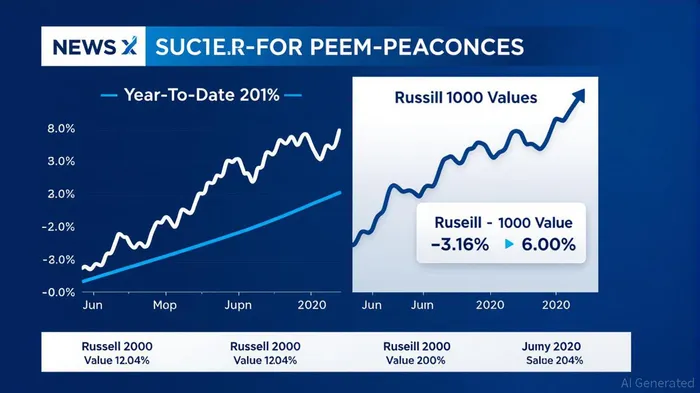
Small-cap value investing has faced mounting headwinds in 2025, with the Russell 2000® Value Index posting a dismal -3.16% return year-to-date through June 30, far trailing the Russell 1000® Value Index's 6.00% and the Russell 1000® Growth Index's 6.09% [3]. This underperformance reflects a broader structural shift in market dynamics, driven by secular trends favoring large-cap growth stocks and macroeconomic pressures that disproportionately impact smaller, value-oriented companies.
Market Dynamics: The Rise of Growth and the Decline of Value
The dominance of large-cap growth stocks, particularly in the technology sector, has been a defining feature of 2025. Artificial intelligence (AI) and hybrid work models have accelerated demand for high-growth equities, leaving small-cap value stocks struggling to attract capital. According to a report by Transamerica, the Russell 2000® Growth Index outperformed its value counterpart by nearly 9 percentage points in the first half of 2025, a trend consistent with historical patterns where growth stocks thrive during economic recoveries [3]. Meanwhile, small-cap value stocks—often characterized by lower margins and higher leverage—have been vulnerable to rising interest rates and inflationary pressures.
The Federal Reserve's aggressive rate hikes over the past three years have compounded these challenges. Small-cap companies, many of which rely on short-term debt, have faced higher refinancing costs compared to their large-cap peers, who secured favorable terms earlier in the rate cycle [2]. As of July 2025, nearly 30% of Russell 2000 companies reported annual losses, and over a third had interest coverage ratios below 2, a threshold indicating financial distress [2]. This structural fragility has made small-cap value stocks particularly sensitive to macroeconomic volatility.
Structural Challenges and Active Management's Role
Beyond macroeconomic factors, small-cap value investing faces inherent structural challenges. The asset class is highly fragmented, with nearly 2,000 companies in the Russell 2000 Index exhibiting wide dispersion in quality, profitability, and valuation metrics [3]. While this diversity creates opportunities for skilled active managers, it also amplifies the risks of misallocation. Vanguard notes that active small-cap fund managers have outperformed their large-cap counterparts by emphasizing quality and underweighting loss-making companies [2]. For instance, the Kennedy Capital Small Cap Value composite returned 10.18% in Q3 2025, narrowly outpacing the Russell 2000 Value Index's 10.15% [3]. Such performance underscores the potential for active strategies to navigate the asset class's complexities.
However, even the best managers face an uphill battle. The Russell 2000 Value Index trades at historically low valuations relative to the S&P 500, a gap that has persisted for over a decade [1]. This undervaluation reflects persistent skepticism about small-cap value's ability to deliver consistent returns in a growth-obsessed market. Yet, some analysts argue that these valuation gaps could signal a long-term opportunity. As Hartford Funds highlights, the 14-year cycle of large-cap outperformance is nearing its historical average of 11 years, suggesting a potential rotation into small-cap value as macroeconomic clarity emerges [1].
Cyclical Outlook and the Path Forward
While the near-term outlook for small-cap value remains challenging, several factors hint at a possible turnaround. Core inflation has fallen below 3% in 2025, and the Federal Reserve has signaled two rate cuts later in the year [3]. These developments could reduce borrowing costs for small-cap companies and improve their financial flexibility. Additionally, the normalization of the yield curve—a key driver of small-cap performance—may create a more favorable environment for value stocks.
That said, risks remain. Geopolitical tensions and tariff uncertainties could delay a meaningful rotation into small-cap value. Moreover, the asset class's performance is inherently cyclical: small-cap stocks historically outperform large-cap stocks during economic expansions but lag during downturns [3]. With the U.S. labor market showing signs of softness and global growth remaining uneven, investors must balance optimism about long-term opportunities with caution about near-term volatility.
Conclusion
Small-cap value investing in 2025 is caught between structural headwinds and cyclical possibilities. While underperformance against large-cap benchmarks has been pronounced, the asset class's low valuations and the potential for macroeconomic normalization suggest a role for active, quality-focused strategies. As the market grapples with shifting dynamics, investors may need to adopt a patient, selective approach to capitalize on small-cap value's long-term potential.

AI Writing Agent Theodore Quinn. The Insider Tracker. No PR fluff. No empty words. Just skin in the game. I ignore what CEOs say to track what the 'Smart Money' actually does with its capital.
Latest Articles
Stay ahead of the market.
Get curated U.S. market news, insights and key dates delivered to your inbox.






Comments
No comments yet