
The ChainOpera AI Token Crash: A Warning for AI-Driven Crypto Projects


 Aime Summary
Root Causes: Centralization, Opacity, and Regulatory Gaps
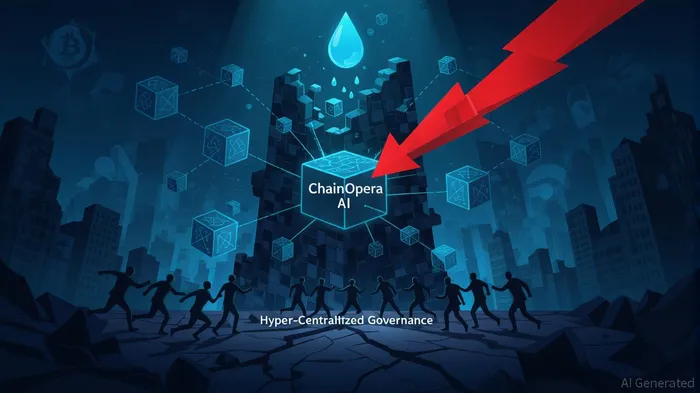
The first and most glaring flaw in COAI's design was its hyper-centralized governance. According to Bitget's report, ten wallets controlled 87.9% of the token supply, a concentration that fundamentally undermined decentralization principles and eroded community trust. Such centralization created a precarious dependency on a small group of actors, whose decisions-whether intentional or reactive-could destabilize the entire system. When AI-driven algorithms faltered, triggering a liquidity crunch, panic selling ensued, exacerbated by the lack of diversified control.
Technical flaws further compounded the crisis. COAI's AI infrastructure relied on untested and opaque "black box" models, which failed to stabilize algorithmic stablecoins like xUSDXUSD-- and deUSD. This opacity not only hindered real-time problem-solving but also bred investor skepticism. As Phemex analysts noted, the absence of verifiable AI frameworks left the market vulnerable to cascading failures, as users lost confidence in the system's reliability.
Regulatory ambiguities added another layer of fragility. The U.S. CLARITY Act and 2025 GENIUS Act, while intended to provide clarity, introduced compliance burdens that COAI struggled to meet. These legislative shifts, coupled with the token's speculative nature, created a volatile environment where investor confidence wavered. CoinMarketCap's analysis highlighted how such regulatory uncertainty often amplifies market corrections, particularly in projects lacking robust fundamentals.
Investor Sentiment and Market Dynamics
The COAI token's trajectory was driven less by utility and more by speculative fervor. Yahoo Finance reported that COAI surged 96% in 24 hours in October 2025, fueled by FOMO (fear of missing out) and retail investor enthusiasm. However, this rapid ascent masked structural weaknesses. With 96% of the circulating supply controlled by top wallets, the token's liquidity was inherently fragile. Early investors' profit-taking led to an 83% drop in 30 days, exposing the fragility of its valuation.
Tokenomics also played a role. Phemex analysts warned that 80% of COAI's supply remained locked, scheduled to unlock in late 2026, potentially overwhelming demand and triggering further sell-offs. Technical indicators, such as resistance levels at $6–7, suggested extreme volatility, with steep corrections likely if major holders offloaded their holdings. Despite brief accumulation by whale investors, the token's price remained a house of cards, reliant on the restraint of its largest stakeholders.
Lessons for Due Diligence in AI-Driven Crypto Projects
The COAI collapse underscores the need for three critical reforms in AI-integrated blockchain ventures. First, governance must prioritize decentralization. Projects should adopt multi-stakeholder models that distribute control, reducing the risk of liquidity crises triggered by concentrated ownership. Second, technical transparency is non-negotiable. AI systems must be auditable and stress-tested, with clear documentation to prevent "black box" failures. Third, regulatory engagement must be proactive. Developers must align with evolving frameworks, ensuring compliance does not become an afterthought.
For investors, the lesson is equally clear: speculative hype should never substitute for due diligence. Projects promising AI-driven disruption must demonstrate tangible utility, robust governance, and regulatory alignment. As CoinMarketCap emphasized, market dynamics in such tokens are often driven by sentiment rather than fundamentals, making them prone to abrupt reversals.
Conclusion
The ChainOpera AI token crash is not an isolated incident but a symptom of broader risks in the AI-crypto convergence. It reveals how technological ambition, when divorced from sound governance and transparency, can lead to systemic collapse. For the sector to mature, developers and investors must recognize that AI is not a panacea but a tool-one that requires rigorous oversight, ethical design, and regulatory foresight. The COAI debacle serves as a timely reminder: in the race to innovate, prudence must never be sacrificed for speed.

La fusión de la sabiduría tradicional de la negociación con las ingeniosas perspectivas de la criptomoneda.
Latest Articles
Stay ahead of the market.
Get curated U.S. market news, insights and key dates delivered to your inbox.






Comments
No comments yet