
ChainOpera AI Token Crash: A Wake-Up Call for AI-Driven Crypto Investments


 Aime Summary
A Perfect Storm: Leadership, Lawsuits, and Regulatory Uncertainty
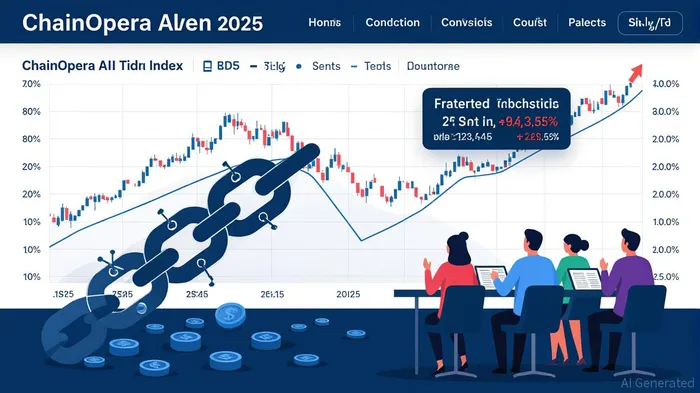
The COAI crash was catalyzed by the leadership turmoil at C3.ai, a key component of the index. The company's CEO transition and a class-action lawsuit accusing it of overstating growth and stability triggered a cascade of sell-offs. C3.ai's first-quarter loss of $116.8 million underscored the fragility of AI-driven business models reliant on speculative hype rather than tangible revenue.
Compounding these issues was the passage of the Digital Asset Market Clarity Act (CLARITY Act) in July 2025. While intended to resolve jurisdictional disputes between the SEC and CFTC, the Act's vague language left AI-based crypto projects in a legal gray area. For instance, the transition of digital assets from SEC-regulated securities to CFTC-commodities after fundraising created regulatory arbitrage risks, with critics warning of weakened investor protections. The Senate's competing Responsible Financial Innovation Act (RFIA) further muddied the waters, introducing the contentious concept of "ancillary assets" and delaying a coherent regulatory framework.
Structural Vulnerabilities: Technical, Governance, and Market Risks
Beyond regulatory headwinds, AI-driven crypto projects face inherent technical and governance flaws. Model Context Protocol vulnerabilities surged by 270% in Q3 2025, exposing critical interfaces between AI agents and backend systems to exploitation. Agentic AI systems, designed to operate autonomously, also saw a 67% rise in misconfigurations and logic flaws, raising concerns about their reliability in decentralized environments.
Governance frameworks lag behind technological innovation. A 2025 survey revealed that 77% of companies are prioritizing AI governance, yet 49% of high-severity vulnerabilities in bug bounty programs-such as broken authentication-remain undetected by traditional tools. This gap highlights the inadequacy of current governance models in addressing AI-specific risks.
Market instability, meanwhile, is exacerbated by regulatory crackdowns. The conviction of Qian Zhimin, dubbed the "Crypto Queen," for Bitcoin-related money laundering, and South Korea's suspension of non-compliant exchanges like Upbit, signal a global shift toward stricter oversight. These developments, while aimed at curbing illicit activity, have inadvertently chilled investor sentiment toward AI-driven crypto projects.
A Framework for Risk Assessment: Lessons from the COAI Collapse
The COAI crash demands a reevaluation of how investors assess AI-integrated crypto projects. Drawing from the "Crypto Evaluation 2.0" framework, four pillars emerge as critical for long-term viability:
- Real-World Utility and Adoption: Projects must demonstrate measurable adoption through metrics like daily active addresses and transaction volumes. For example, Worldcoin's use of iris-scanning for identity verification illustrates how AI can solve tangible problems, but its success hinges on user trust.
- Technological Moat: Scalability, security, and energy efficiency are non-negotiable. Active GitHub repositories and robust developer communities are indicators of sustainable innovation.
- Tokenomics and Economic Design: Token inflation rates, distribution mechanisms, and demand-generating features must align with long-term value creation. The COAI Index's collapse underscores the dangers of over-reliance on speculative tokenomics.
- Governance and Team Credibility: Transparent roadmaps, proven execution capabilities, and regulatory preparedness are essential. Projects must navigate the CLARITY Act's dual-jurisdiction framework without exploiting regulatory loopholes.
Implications for Investors: Caution and Diversification
The COAI crash serves as a stark reminder that AI-driven crypto assets are not immune to systemic risks. Investors must adopt a risk-adjusted approach, diversifying portfolios across layer-1 protocols, layer-2 solutions, and DeFi projects. Given the CFTC's limited experience in retail-facing markets, caution is warranted until a unified regulatory framework emerges.
In the short term, the Senate's RFIA and House's CLARITY Act will likely undergo revisions, prolonging regulatory uncertainty. Investors should monitor developments in South Korea and the U.S., where enforcement actions are reshaping market dynamics.
Conclusion
The ChainOpera AI token crash is more than a market correction-it is a wake-up call for the crypto-ai sector. Structural vulnerabilities in technical infrastructure, governance, and regulatory clarity have converged to create a volatile environment. By adopting a rigorous evaluation framework and prioritizing projects with real-world utility and robust governance, investors can navigate this turbulent landscape. As the CLARITY Act's fate remains unresolved, one thing is clear: the future of AI-driven crypto investments hinges on addressing these systemic risks head-on.

Blending traditional trading wisdom with cutting-edge cryptocurrency insights.
Latest Articles
Stay ahead of the market.
Get curated U.S. market news, insights and key dates delivered to your inbox.


AInvest
PRO
AInvest
PRO



Comments
No comments yet