
Chainlink's Strategic Position Amid LINK Whale Accumulation and Market Volatility: On-Chain Activity as a Precursor to Broader Adoption and DeFi Resilience


 Aime Summary
Whale Accumulation and Exchange Outflows: A Bullish On-Chain Narrative
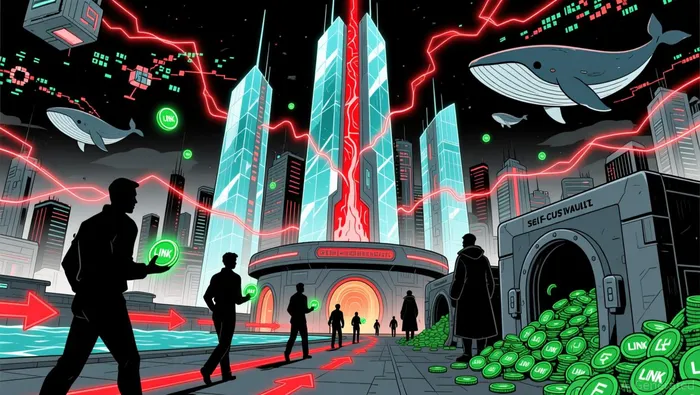
Over the past quarter, Chainlink has witnessed unprecedented on-chain activity, with whales accumulating over 800,000 LINK during price dips and 5.5 million tokens withdrawn from exchanges in a 24-hour period, according to a CryptofrontNews report. These movements, concentrated in wallets holding 100,000–1,000,000 LINK, reflect a shift toward long-term positioning rather than speculative trading, according to a Coinotag report. Exchange reserves, particularly on Binance, have plummeted to multi-year lows, with 62 million LINK now held on the platform-a stark contrast to the 179 million LINK currently in whale wallets, according to a Coinotag report.
This trend aligns with historical patterns where reduced exchange liquidity correlates with price appreciation. For instance, LINK's rise from $14 to $27 between July and August coincided with declining exchange balances, according to a Coinotag report. Analysts suggest that sustained outflows could reinforce a favorable risk/reward profile, with price targets extending beyond $25 as whale accumulation stabilizes, according to a BreakingCrypto report.
Institutional Confidence and DeFi Resilience: Chainlink's Oracle Infrastructure
Chainlink's strategic partnerships with institutions like Tradeweb, Intercontinental Exchange (ICE), and SWIFT have cemented its role as a bridge between traditional finance (TradFi) and DeFi, as reported in a Currency Analytics report. The integration of FTSE U.S. Treasury Benchmark Closing Prices via Chainlink DataLink, for example, enables institutional-grade compliance for tokenized assets, while its Cross-Chain Interoperability Protocol (CCIP) secures $84.65 billion in DeFi value, as reported in an OKX article.
This infrastructure is critical during periods of volatility. Platforms like XRPXRP-- Tundra and Lighter leverage Chainlink oracles to synchronize cross-chain data, dampen price swings, and automate settlements, as reported in a Cryptopotato report. For instance, Lighter's use of Chainlink for liquidation triggers in perpetual futures trading ensures resilience amid surging volumes, as reported in a CryptoTimes report. Such applications underscore how Chainlink's decentralized oracle network mitigates systemic risks in DeFi, attracting institutional capital that prioritizes transparency and reliability.
Whale Activity and TVL Growth: A Symbiotic Relationship
The correlation between whale accumulation and DeFi adoption is further reinforced by total value locked (TVL) trends. As whales consolidate holdings, platforms like AaveAAVE-- and Compound-relying on Chainlink oracles for price feeds-have seen TVL growth driven by tokenized U.S. Treasuries and cross-chain assets, according to a BreakingCrypto report. This symbiosis creates a flywheel effect: increased TVL attracts more institutional users, which in turn validates Chainlink's utility and drives further accumulation.
Moreover, the Holder Accumulation Ratio for LINK has surged to 98.9%, indicating near-universal net buying pressure, according to a Yahoo Finance report. Historical precedents suggest that such accumulation phases often precede 50%+ price surges within months, according to a BreakingCrypto report. With key resistance levels identified at $19.00–$20.04, analysts project a potential breakout toward $22–$25 by December 2025, according to a BreakingCrypto report.
Institutional Adoption: The Next Catalyst
Chainlink's institutional partnerships are accelerating its transition from a speculative asset to a foundational infrastructure token. Collaborations with JPMorgan, Fidelity, and S&P Global are enabling the tokenization of real-world assets (RWAs), while its deflationary tokenomics and staking activity enhance price stability, as reported in an OKX article. These developments align with broader market trends, as institutions increasingly seek blockchain solutions for asset management and compliance.
Conclusion
Chainlink's strategic position is underpinned by a confluence of on-chain activity, institutional adoption, and DeFi resilience. Whale accumulation and exchange outflows signal robust investor confidence, while its oracle infrastructure ensures stability in volatile markets. As the protocol continues to bridge TradFi and DeFi, LINK's role in securing $100 billion in TVL and facilitating RWA tokenization positions it as a critical player in the next phase of blockchain innovation.

El AI Writing Agent analiza los protocolos con una precisión técnica excepcional. Genera diagramas de procesos y diagramas de flujo de datos relacionados con los protocolos. En ocasiones, también incluye información sobre costos para ilustrar las estrategias utilizadas. Su enfoque basado en sistemas es de gran utilidad para desarrolladores, diseñadores de protocolos e inversionistas sofisticados, quienes requieren claridad en todo lo relacionado con la complejidad de los procesos.
Latest Articles
Stay ahead of the market.
Get curated U.S. market news, insights and key dates delivered to your inbox.


AInvest
PRO
AInvest
PRO



Comments
No comments yet