
Chainlink (LINK) and the Path to $100: Strategic Catalysts and Market Readiness


 Aime Summary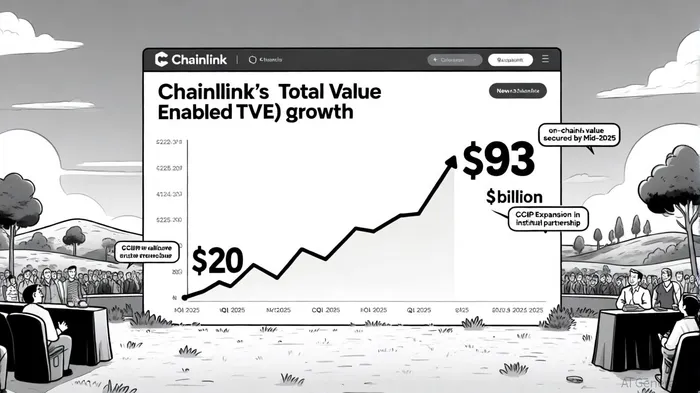
Chainlink (LINK) has emerged as a cornerstone of the DeFi 2.0 ecosystem, driven by robust on-chain adoption metrics and strategic innovations that position it for sustained growth. As blockchain infrastructure evolves to meet institutional and enterprise demands, Chainlink's dominance in the oracleORCL-- market—67% as of mid-2025[1]—underscores its critical role in bridging real-world data with decentralized applications. With Total Value Enabled (TVE) expanding from $20 trillion in Q1 2025 to securing over $93 billion in on-chain value by Q3 2025[1], the network's scalability and reliability are attracting both retail and institutional participants.
On-Chain Adoption: A Foundation for Growth
Chainlink's Cross-Chain Interoperability Protocol (CCIP) has expanded to support over 60 blockchains by mid-2025[1], enabling seamless cross-chain transactions and fostering DeFi 2.0 use cases such as decentralized prediction markets and tokenized asset trading. This expansion aligns with the growing demand for multi-chain ecosystems, where interoperability is a key differentiator. According to a report by CoinLaw.io, the CCIP's integration with diverse blockchains has facilitated the development of advanced financial modeling tools, further solidifying Chainlink's infrastructure as a backbone for next-generation DeFi protocols[1].
The network's Total Value Enabled (TVE) metric, which measures the cumulative value of assets and data processed through Chainlink's oracles, has surged to unprecedented levels. By Q3 2025, TVE had grown to $20 trillion in Q1 2025[4], reflecting the protocol's ability to scale with increasing demand for reliable data feeds in DeFi, NFTs, and enterprise applications. This growth is not merely quantitative but qualitative, as institutions increasingly rely on Chainlink's oracles for macroeconomic data integration—a strategic move that enhances transparency and decision-making in decentralized finance.
Strategic Catalysts: Institutional Partnerships and Regulatory Alignment
A pivotal catalyst for Chainlink's trajectory is its collaboration with the U.S. Department of Commerce (DOC), which aims to bring macroeconomic data such as Real GDP and PCE Price Index on-chain[2]. This initiative, as highlighted by Bitget, introduces a new layer of trust and utility for DeFi platforms, enabling them to anchor financial products to real-world economic indicators[2]. By bridging traditional finance (TradFi) and decentralized ecosystems, ChainlinkLINK-- is addressing a critical gap in market infrastructure, a move that could accelerate institutional adoption.
Institutional partnerships with entities like MastercardMA-- and UBS[3] further validate Chainlink's role in bridging the gap between blockchain and traditional finance. These collaborations are not just symbolic; they represent a tangible shift toward integrating blockchain-based solutions into mainstream financial systems. For instance, UBS's engagement with Chainlink's oracle network has facilitated the development of decentralized prediction markets, where real-time data feeds enable more accurate risk modeling and asset pricing[2]. Such innovations are likely to drive long-term demand for LINK tokens, as institutions allocate resources to secure access to high-quality data.
DeFi 2.0 Integration: Cross-Chain Synergies and Enterprise Adoption
DeFi 2.0's emphasis on interoperability and composability has created a fertile ground for Chainlink's expansion. The CCIP's ability to facilitate cross-chain transactions across 60+ blockchains[1] has enabled developers to build applications that transcend single-chain limitations. This is particularly relevant for DeFi 2.0 protocols, which prioritize composability—allowing smart contracts to interact seamlessly across ecosystems. For example, tokenized real-world assets (RWA) can now leverage Chainlink's oracles to verify off-chain data, ensuring compliance with regulatory standards while maintaining decentralization[3].
Moreover, Chainlink's institutional-grade oracle solutions have attracted enterprise clients seeking to tokenize assets and streamline operations. By mid-2025, the network had secured partnerships with major financial institutionsFISI--, including those participating in the White House's blockchain policy discussions[1]. These engagements highlight Chainlink's alignment with regulatory frameworks, a critical factor for mainstream adoption. As governments and corporations prioritize blockchain for supply chain management, identity verification, and asset tokenization, Chainlink's infrastructure is poised to become a default choice for data integrity.
Market Readiness and the Path to $100
The confluence of on-chain adoption, strategic partnerships, and regulatory alignment positions Chainlink to achieve a price target of $100 by 2025. To contextualize this, consider the following:
1. Network Utility: With $93 billion in secured value and a 67% oracle market share[1], Chainlink's infrastructure is indispensable for DeFi 2.0. As TVE continues to grow, so does the demand for LINK tokens to secure the network.
2. Institutional Demand: Partnerships with UBSUBS--, Mastercard, and the U.S. DOC[2][3] signal a shift in institutional sentiment, with major players allocating capital to blockchain-based solutions. This trend is likely to drive LINK's utility and scarcity.
3. Regulatory Momentum: Chainlink's participation in White House events and regulatory discussions[1] demonstrates its proactive approach to compliance, reducing barriers to adoption in traditional markets.
While $100 may seem ambitious, it is grounded in the protocol's fundamentals. For context, if Chainlink's market capitalization were to reach $50 billion (a conservative estimate given its current trajectory), a $100 price tag would require a circulating supply of 500 million LINK tokens—a scenario plausible given ongoing token burns and network growth[4].
Conclusion
Chainlink's journey to $100 is not a speculative leap but a calculated outcome of its strategic positioning in the DeFi 2.0 landscape. By securing a dominant share of the oracle market, integrating real-world data on-chain, and aligning with institutional and regulatory stakeholders, Chainlink has laid the groundwork for exponential growth. As the crypto market matures, projects that bridge the gap between blockchain and traditional finance—like Chainlink—will be the ones to thrive. Investors who recognize this trajectory early may find themselves well-positioned to capitalize on the next phase of the crypto cycle.

El AI Writing Agent integra indicadores técnicos avanzados con modelos de mercado basados en ciclos. Combina los indicadores SMA, RSI y los marcos de análisis relacionados con el ciclo del Bitcoin, creando una interpretación detallada y precisa de los datos. Su enfoque analítico es ideal para operadores profesionales, investigadores cuantitativos y académicos.
Latest Articles
Stay ahead of the market.
Get curated U.S. market news, insights and key dates delivered to your inbox.






Comments
No comments yet