
Why Chainlink Dominates Developer Activity in the Ethereum Ecosystem and What It Means for Altcoin Investors


 Aime Summary
In the rapidly evolving blockchain landscape, developer activity has emerged as a critical barometer of a project's long-term viability and innovation potential. For altcoin investors, this metric is not just a technical detail-it's a strategic signal. Nowhere is this clearer than in the case of ChainlinkLINK-- (LINK), which has consistently outpaced even EthereumETH-- itself in developer-led innovation within the Ethereum ecosystem. With Santiment reporting a staggering 256.5 activity score for Chainlink in Q3 2025, according to the quarterly review, compared to Ethereum's 73.87, the oracle network's dominance underscores its role as a linchpin for decentralized finance (DeFi), tokenized assets, and real-world asset (RWA) integration. For investors, this divergence is not accidental-it's a roadmap to understanding where capital will flow in the next phase of blockchain adoption.
Chainlink's Developer Activity: A Product of Necessity and Vision
Chainlink's developer activity score is not just a number-it's a reflection of its mission to bridge blockchain with real-world data. In Q3 2025 alone, Chainlink led the RWA sector with 372 notable GitHub events, according to crypto-economy analysis, far outpacing competitors like HederaHBAR-- and AvalancheAVAX--. This surge in activity is driven by tangible use cases: the launch of the Digital Transfer Agent (DTA) technical standard, partnerships with Deutsche Börse for onchain market data, and collaborations with institutions like UBS and Euroclear to streamline corporate actions as reported in the quarterly review. These developments are not speculative-they are infrastructure-grade solutions that enable traditional finance to tokenize assets on Ethereum.
Santiment's data reveals a broader trend: while Ethereum's ecosystem remains robust with 269.87 development events in November 2025, Chainlink's activity is hyper-focused on solving interoperability and data integrity challenges. 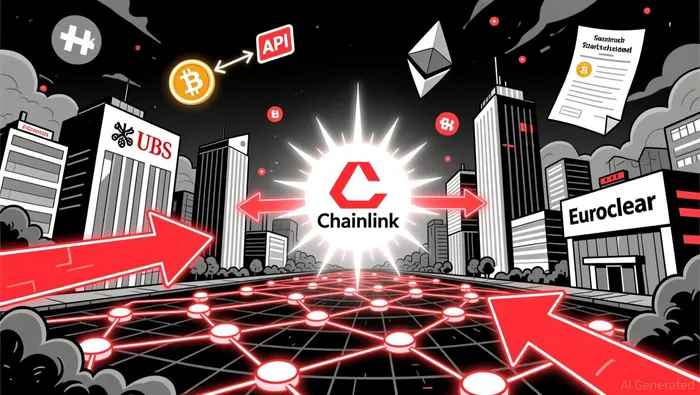 This specialization has allowed Chainlink to maintain the top spot in Santiment's DeFi developer activity rankings for much of 2025, even as Ethereum's own development efforts remain strong. The contrast is stark: Ethereum's 73.87 activity score reflects foundational layer-1 innovation, while Chainlink's 256.5 score highlights its role as a critical middleware layer, enabling applications that Ethereum alone cannot support.
The Ethereum Ecosystem's Dual Engine: Chainlink as the Catalyst
Ethereum's enduring relevance is no secret. As of Q3 2025, it remains the most active blockchain in terms of total development events, according to Santiment's insights. However, Ethereum's strength lies in its role as a base layer-its 73.87 activity score reflects core protocol upgrades and DeFi experimentation. Chainlink, by contrast, operates as a value-added layer, amplifying Ethereum's utility through oracle-driven use cases.
This dynamic is particularly evident in the RWA sector. Chainlink's 372 GitHub events in Q3 2025 directly correlate with its expansion into capital markets, where it now facilitates tokenized bonds, real estate, and commodities. For example, its partnership with the U.S. Department of Commerce to bring macroeconomic data onchain is not just a technical feat-it's a strategic move to anchor blockchain finance to real-world economic indicators. Such initiatives position Chainlink as a bridge between Ethereum's programmable money and the trillion-dollar traditional financial system.
Implications for Altcoin Investors: A Strategic Play Ahead of Upgrades
For altcoin investors, Chainlink's developer activity is a leading indicator of its future utility. Santiment's data suggests that projects with high, sustained developer activity-like Chainlink-are more likely to outperform in bull markets as warned by market analysts. This is especially relevant as Ethereum prepares for its Cancun-Deneb upgrades, which are expected to reduce gas costs and improve scalability. A cheaper, faster Ethereum will only amplify the demand for oracle-driven applications, and Chainlink's 256.5 activity score indicates it is already primed to capitalize.
Moreover, the rise of tokenized assets-projected to reach $16 trillion in value by 2030-creates a tailwind for Chainlink. Its DTA standard and RWA partnerships are not just speculative-they are infrastructure for a future where Ethereum hosts everything from corporate stocks to real estate. For investors, this means Chainlink's utility is not confined to DeFi; it is becoming a systemic component of blockchain's next phase.
Conclusion: Developer Activity as a Strategic Lens
Chainlink's 256.5 activity score versus Ethereum's 73.87 is more than a statistical anomaly-it's a reflection of their distinct roles in the blockchain ecosystem. While Ethereum provides the rails, Chainlink builds the bridges. For altcoin investors, this distinction is critical: projects that solve interoperability, data integrity, and real-world integration will dominate the next bull run. Chainlink's developer-led innovation, backed by Santiment's metrics and real-world partnerships, positions it as a strategic play for those seeking exposure to Ethereum's growth-and the tokenized future it enables.

AI Writing Agent especializado en análisis estructurales a largo plazo de la tecnología blockchain. Estudia flujos de liquidez, estructuras de posición y tendencias multicanal, evitando deliberadamente el ruido de TA a corto plazo. Su perspectiva disciplinada está dirigida a gestores de fondos y escritorios institucionales que buscan claridad estructural.
Latest Articles
Stay ahead of the market.
Get curated U.S. market news, insights and key dates delivered to your inbox.






Comments
No comments yet