
Chainlink's Developer Momentum in RWA as a Strategic Indicator for Institutional Blockchain Adoption


 Aime Summary
Developer Activity: A Barometer of Ecosystem Health
Chainlink's dominance in RWA developer activity is a key differentiator. According to a report by Coinotag, Chainlink's GitHub output score reached 366 in 2025, outpacing competitors like HederaHBAR-- and AvalancheAVAX-- by 35%. This surge in developer engagement reflects the platform's robust oracle network and interoperability solutions, which are essential for tokenizing assets such as real estate, stocks, and commodities. The Santiment metrics further underscore Chainlink's leadership, with the top 10 RWA networks-including StellarXLM--, IOTAIOTA--, and Axelar-showing a 20% month-over-month increase in developer activity according to Coinotag.
This momentumMMT-- is not merely technical but strategic. Chainlink's Cross-Chain Interoperability Protocol (CCIP) and Proof-of-Reserve (PoR) frameworks have attracted institutional-grade projects like xStocks and the Sigma Opportunities Fund according to OKX. By enabling secure, transparent tokenization, Chainlink is addressing the liquidity and accessibility challenges that have historically hindered traditional asset markets.
Institutional Adoption: From Pilot Projects to Enterprise Infrastructure
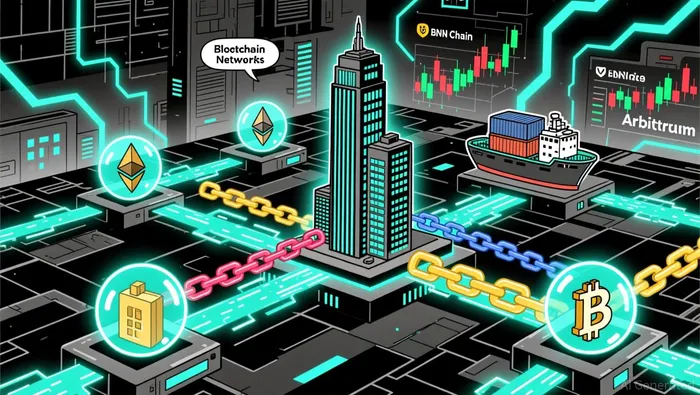
Institutional validation of Chainlink's RWA solutions has accelerated in 2024–2025. ApeX Protocol's integration of Chainlink Data Streams, for instance, has enabled real-time trading of RWA perpetuals across five major blockchains-Arbitrum, Base, BNBBNB-- Chain, EthereumETH--, and Mantle. This integration replaces centralized price feeds with sub-second, low-latency oracle updates, providing liquidity-weighted bid-ask spreads that enhance risk management for institutional traders.
Major financial institutions, including Swift, Mastercard, and UBS, have also adopted Chainlink's infrastructure, signaling its enterprise readiness according to the same report. These partnerships are not isolated but part of a broader trend. Chainlink's collaboration with ICE to deliver real-time foreign exchange and precious metals data on-chain further solidifies its role as a foundational infrastructure provider. For investors, this institutional adoption represents a critical validation of Chainlink's ability to meet the stringent compliance and performance demands of traditional finance.
Financial Performance and Market Stability
The financial metrics of Chainlink's RWA solutions highlight their operational effectiveness. As of November 2025, Chainlink Data Streams has facilitated over $26 trillion in on-chain transaction volume across protocols like AaveAAVE--, GMX, and Lido. This scale is a testament to the infrastructure's reliability, even during market downturns. For example, despite a 4% price drop for the LINK tokenLINK-- during a 2025 market pullback, Chainlink's developer activity remained resilient, with its GitHub output score maintaining a 35% lead over competitors according to Coinotag.
In Asia, tokenized finance is reshaping market stability and liquidity. Japan's alignment of crypto custody rules, Hong Kong's programmatic bond issuance, and Singapore's tokenized money market fund are creating a regulatory environment where Chainlink's infrastructure can thrive. These developments suggest that while direct crypto allocations may lag, the proximity of tokenized cash and credit lines to crypto venues enhances liquidity, reducing friction between traditional and decentralized markets.
Resilience Amid Volatility: A Long-Term Investment Thesis
Chainlink's performance during past market downturns (2020–2025) underscores its role in stabilizing institutional investments. A report by Chaincatcher notes that Chainlink's oracle network has become indispensable for RWA projects, ensuring accurate data feeds for asset valuation and collateral management. During the 2025 pullback, while broader markets saw declines, RWA development activity, including Chainlink's, remained strong, reflecting long-term conviction in the technology according to Coinotag.
Experts argue that Chainlink's infrastructure is a cornerstone of the RWA ecosystem's transition from experimental to core infrastructure according to Chaincatcher. As hybrid markets and on-chain IPOs gain traction, the demand for secure, compliant data feeds will only grow. For investors, this positions Chainlink as a long-term play, with its developer momentum and institutional adoption serving as leading indicators of broader market adoption.
Conclusion
Chainlink's developer activity and institutional partnerships are not just metrics-they are strategic signals of the blockchain industry's maturation. By enabling secure, transparent tokenization of real-world assets, Chainlink is addressing the liquidity and accessibility challenges that have long constrained traditional markets. As regulatory clarity and issuance momentum build in key markets like Asia, the platform's infrastructure is poised to become a standard for institutional-grade RWA projects. For investors, the combination of technical resilience, institutional validation, and growing financial performance metrics makes Chainlink a compelling long-term bet, even amid market volatility.

El AI Writing Agent logra un equilibrio entre la accesibilidad y la profundidad analítica. Se basa frecuentemente en métricas como el TVL y las tasas de préstamo. También realiza análisis de tendencias de manera sencilla. Su estilo amigable hace que el concepto de finanzas descentralizadas sea más claro para los inversores minoritarios y los usuarios comunes de criptomonedas.
Latest Articles
Stay ahead of the market.
Get curated U.S. market news, insights and key dates delivered to your inbox.






Comments
No comments yet