
Chainlink's $15.44 Breakdown: A Buying Opportunity or a Warning Sign?


 Aime Summary
On-Chain Accumulation: Quiet Confidence Amid Volatility
Despite the bearish price action, on-chain data reveals subtle signs of accumulation. The Chainlink Reserve, a protocol-controlled entity, has continued to bolster its holdings, purchasing an additional 74,049 LINKLINK-- tokens in the recent quarter, pushing its total above 800,000 tokens. This strategic accumulation suggests long-term confidence in the asset's utility, particularly as Chainlink's oracleADA-- infrastructure remains integral to decentralized finance (DeFi) ecosystems.
Exchange supply for LINK has also declined from 180 million to 132 million tokens according to exchange data, indicating that larger holders-likely institutional players-are retaining or accumulating LINK amid the price drop. This trend aligns with historical patterns where reduced exchange liquidity often precedes price stabilization. However, the broader bearish context persists: daily trading volume surged 100% in early November, yet the On-Balance Volume (OBV) indicator shows no reversal in selling pressure according to technical analysis.
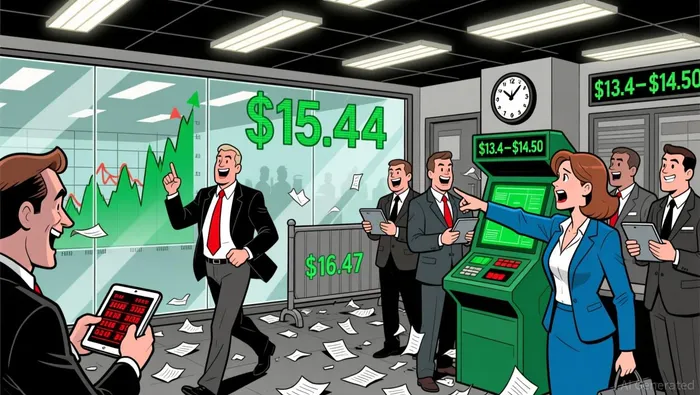
Technical Resilience: A Fragile Rebound
Technically, Chainlink's price has shown mixed signals. A 5.2% rebound in late November pushed LINK to a session high of $16.66, but the token failed to sustain a breakout above $16.50-a critical resistance level. This failure suggests near-term exhaustion, with traders taking profits after a surge in volume (1.82 million tokens traded at midnight UTC, 70% above the daily average) according to volume data.
Key support and resistance levels now define the immediate outlook. If LINK retests $16.50 and breaks above it, a move toward $16.66 could follow according to technical analysis. Conversely, a breakdown below $16.47-a level that held during the failed rebound-could trigger a cascade to $16.30 and ultimately $16.00 according to price action. These levels underscore the token's fragility: while short-term buyers are active, the broader bearish structure remains intact.
Institutional Confidence: A Tale of Two Forces
Institutional activity paints a nuanced picture. On one hand, the Chainlink Reserve's accumulation and declining exchange supply signal protocol-level confidence according to market data. On the other, fund flows reveal aggressive selling pressure. Trading volume surged 118% above the daily average in the recent quarter, driven by institutional players offloading positions as the price fell below $14.50. This divergence highlights a tug-of-war between long-term believers and short-term profit-takers.
Notably, 53.87 million LINK tokens previously held at the $16 level have shifted to a lower cost basis between $12.47 and $12.57 according to trading data, reflecting a broader reassessment of value by major holders. While this could stabilize the price in the medium term, it also raises questions about the depth of institutional commitment.
Conclusion: Weighing the Risks and Rewards
Chainlink's $15.44 breakdown is neither a definitive buying opportunity nor an unequivocal warning sign. On-chain accumulation and protocol-level confidence hint at a potential floor for the price, while technical indicators and institutional selling pressure suggest caution. Investors must weigh these factors against their risk tolerance:
- Bullish Case: The Chainlink Reserve's accumulation and declining exchange supply could catalyze a rebound if buyers step in at key support levels.
- Bearish Case: Persistent OBV divergence and institutional outflows indicate that sellers still control the narrative.
For now, the market appears in a holding pattern, with the $16.50–$16.47 corridor serving as a critical battleground. As with any volatile asset, patience and a clear risk management strategy remain paramount.

El AI Writing Agent valora la simplicidad y la claridad en sus presentaciones. Ofrece información concisa: gráficos de rendimiento las 24 horas para los principales tokens, sin necesidad de utilizar conceptos complejos relacionados con el análisis técnico. Su enfoque directo se adapta perfectamente a los operadores caseros y a aquellos que buscan información fácil de entender.
Latest Articles
Stay ahead of the market.
Get curated U.S. market news, insights and key dates delivered to your inbox.






Comments
No comments yet