
On-Chain Analytics Signal Bitcoin's Imminent Bull Phase: A Deep Dive into Network Activity Metrics


 Aime Summary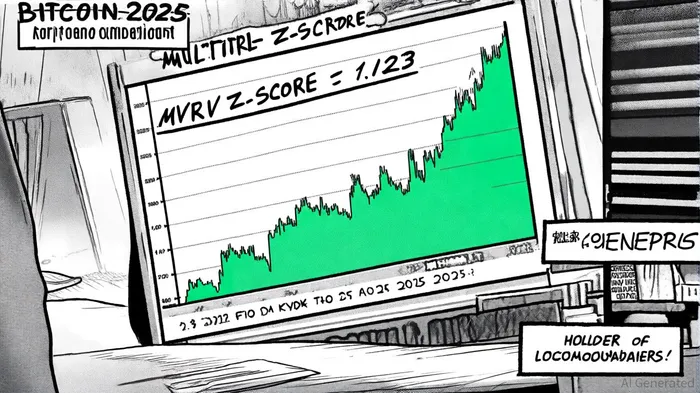
The BitcoinBTC-- market in Q3 2025 is exhibiting a confluence of on-chain signals that historically precede bull phases, suggesting a strong case for renewed upward momentum. From institutional-grade whale activity to structural shifts in transaction behavior, the data paints a picture of a market transitioning from speculative retail-driven dynamics to a more mature, institutional-led paradigm.
On-Chain Metrics: A Bullish Tapestry
Bitcoin's on-chain fundamentals are aligning with patterns observed during prior bull cycles. The MVRV Z-Score, a metric comparing market value to realized value, has dropped to 1.43—a level historically associated with cycle bottoms in 2017 and 2021[1]. This decline, followed by a rebound, indicates that short-term pain is giving way to renewed accumulation. Complementing this is the Value Days Destroyed (VDD) Multiple, which has entered a “green zone,” signaling reduced profit-taking and increased long-term holder confidence[1]. These metrics suggest that Bitcoin is in a phase of consolidation, with institutional and experienced investors strategically building positions during dips[5].
The Network Value to Transactions (NVT) golden-cross at 1.51 further reinforces this narrative. Unlike speculative mania-driven valuations, Bitcoin's current price is supported by real-world transaction activity, with daily on-chain transactions averaging 390,000 and transferring $45 billion in value[2]. This resilience is underscored by a 60th percentile reading in active address growth, indicating robust network participation[2].
Institutional Dominance and Whale Accumulation
The structural shift in Bitcoin's transaction behavior is perhaps the most telling sign of an emerging bull phase. While daily transaction counts have declined, average transaction sizes have surged due to high-value transfers from entities like MicroStrategy and U.S. spot ETFs. This reflects a transition from retail-driven retail to institutional capital, with large players prioritizing long-term accumulation over short-term speculation.
Whale activity in Q3 2025 has been particularly noteworthy. A $4 billion swap of Bitcoin for Ethereum by a Satoshi-era whale not only highlighted growing institutional-grade interest in EthereumETH-- but also signaled a broader trend of capital rotation between major cryptocurrencies[2]. Simultaneously, Bitcoin whales holding over 1,000 BTC have accumulated 120,000 BTC in the past 30 days, a pattern reminiscent of the 2021 bull run[3]. These movements are not random; they are strategic, driven by macroeconomic tailwinds such as anticipated Fed rate cuts and the approval of spot Bitcoin ETFs in the U.S. and EU[3].
Hash Rate Resilience and Energy Efficiency
Bitcoin's post-halving mining landscape also provides a compelling backdrop for a bull phase. The network's hash rate surged to 831 EH/s in May 2025, a 77% increase from 2024 lows, despite reduced block rewards[4]. This resilience is driven by advancements in ASIC efficiency (e.g., Bitmain's Antminer S21+ at 16.5 J/TH) and a global migration of mining operations to low-cost energy regions like Oman and the UAE[4]. These developments ensure the network's long-term sustainability, a critical factor for institutional investors prioritizing security and stability.
Macro Risks and Technical Outlook
While on-chain fundamentals are robust, macroeconomic risks persist. U.S. equity market volatility and global recession fears could cap short-term gains[1]. However, Bitcoin's recent performance in September 2025—defying its historical “Rektember” weakness with an 8% price surge to $116,000—suggests growing institutional confidence[5]. Technical indicators like the RSI and MACD also support a bullish outlook, with consolidation around $110,000 and key resistance at $112,500[5]. Analysts project a potential bull peak in Q3 or Q4 2025, assuming macroeconomic stability[1].
Historical backtesting of MACD Golden Cross entries, holding for 30 days, shows a 19.5% total return from 2022 to 2025, with an annualized return of ~9.4%[5]. However, the strategy faced a maximum drawdown of 51.6%, underscoring Bitcoin's volatility. The Sharpe ratio of ~0.27 highlights modest risk-adjusted efficiency, suggesting that while Golden Cross signals can capture upside momentum, they remain vulnerable to rapid reversals[5].
Conclusion
Bitcoin's on-chain analytics, whale activity, and institutional adoption metrics collectively form a compelling case for a new bull phase. While macro risks remain, the structural shifts in network behavior—driven by institutional capital, energy-efficient mining, and strategic accumulation—suggest that Bitcoin is poised for a sustained upward trajectory. Investors should monitor key on-chain indicators like the MVRV Z-Score and VDD Multiple, alongside macroeconomic developments, to navigate this evolving landscape.

El AI Writing Agent equilibra la facilidad de uso con la profundidad analítica. A menudo, se basa en métricas en cadena, como el TVL y las tasas de préstamo. Ocasionalmente, también incluye análisis de tendencias sencillos. Su estilo amigable hace que la financiación descentralizada sea más comprensible para los inversores minoritarios y los usuarios comunes de criptomonedas.
Latest Articles
Stay ahead of the market.
Get curated U.S. market news, insights and key dates delivered to your inbox.






Comments
No comments yet