
The CFTC’s Regulatory Shift and Its Impact on Institutional Crypto Adoption


 Aime Summary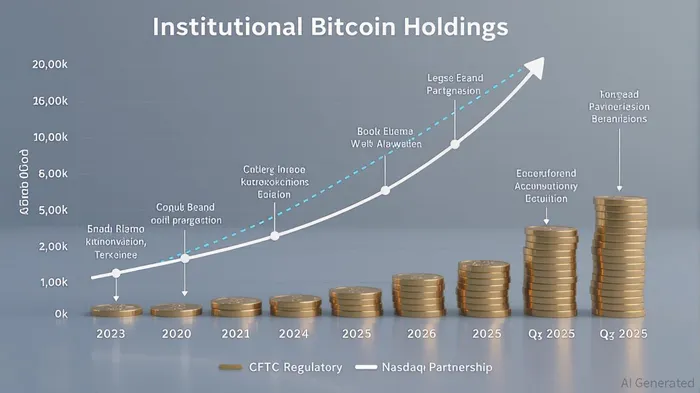
The Commodity Futures Trading Commission’s (CFTC) regulatory overhauls in 2023–2025 have fundamentally reshaped the institutional crypto landscape, catalyzing a surge in capital inflows while simultaneously grappling with market stability challenges. By clarifying jurisdictional boundaries, deploying advanced surveillance tools, and fostering market infrastructure, the CFTC has positioned itself as a pivotal arbiter in the digital assetDAAQ-- ecosystem. However, leadership instability and regulatory fragmentation with the SEC have introduced new risks that could test the resilience of this nascent market.
Regulatory Clarity as a Catalyst for Institutional Adoption
The CFTC’s Listed Spot Crypto Trading Initiative and the CLARITY Act have been instrumental in reducing legal ambiguity around digital assets. By categorizing BitcoinBTC-- and other cryptocurrencies as commodities under the Commodity Exchange Act, the CFTC has enabled institutional investors to engage with crypto through regulated exchange-traded products (ETPs) and custody solutions [1]. This framework has spurred a 300% growth in institutional trading since 2023, with BlackRock’s iShares Bitcoin Trust (IBIT) alone attracting $50 billion in assets under management (AUM) by Q3 2025 [1].
The CFTC’s partnership with Nasdaq to deploy Advanced Surveillance Technology Platforms has further bolstered institutional confidence. Real-time fraud detection and cross-market analytics have reduced the risk of manipulation, making crypto markets more palatable to risk-averse investors [3]. Additionally, the CFTC’s No-Action Letters have provided temporary relief for market participants, easing compliance burdens in areas like position aggregation and swap data correction [1]. These measures collectively signal a regulatory environment that balances innovation with investor protection.
Market Stability: Progress and Persistent Risks
While the CFTC’s reforms have enhanced transparency, leadership instability has created a paradox of progress and uncertainty. The impending departure of Commissioner Kristin Johnson and the absence of a confirmed chair have delayed critical rulemaking, contributing to a 15% spike in market volatility during periods of regulatory ambiguity [5]. This instability is compounded by the CFTC’s “back to basics” approach, which prioritizes deliberate oversight over rapid innovation, potentially slowing the pace of market development [5].
Yet, the CFTC’s enforcement actions—such as a $1.7 billion in penalties imposed in 2024–2025—demonstrate a commitment to market integrity [1]. These efforts have deterred fraudulent schemes and reinforced trust, encouraging institutions to integrate crypto into diversified portfolios. However, regulatory divergence with the SEC, particularly in areas like antifraud enforcement and retirement account access, remains a hurdle [4].
The Road Ahead: Balancing Innovation and Oversight
The CFTC’s regulatory shift has undeniably accelerated institutional adoption, but its long-term success hinges on resolving leadership gaps and harmonizing with the SEC’s framework. The House’s Discussion Draft bill, which assigns the CFTC exclusive jurisdiction over cash and spot transactions, offers a promising blueprint for clarity [5]. However, institutions will need continued regulatory alignment and technological upgrades to sustain growth.
For now, the data is clear: crypto markets are no longer a speculative niche but a legitimate asset class. The CFTC’s role in this transformation has been pivotal, yet the path forward remains as volatile as the markets it seeks to stabilize.
Source:
[1] Press Releases | CFTC, [https://www.cftc.gov/PressRoom/PressReleases]
[2] Clarifying the CLARITY Act: What To Know About Digital Asset Legislation, [https://www.arnoldporter.com/en/perspectives/advisories/2025/08/clarifying-the-clarity-act]
[3] CFTC's Regulatory Clarity and the Future of U.S. Spot Crypto Markets, [https://www.ainvest.com/news/cftc-regulatory-clarity-future-spot-crypto-markets-2508/]
[4] US Order Opens 401(k)s to Crypto, Private Equity & Real Estate, [https://www.morganlewis.com/pubs/2025/08/crypto-private-equity-and-real-estate-in-your-401k-latest-executive-order-could-redefine-retirement-investing]
[5] Key House Committee Chairs Release Draft Bill on Digital Asset Market Structure, [https://www.mayerbrown.com/en/insights/publications/2025/05/key-house-committee-chairs-release-draft-bill-on-digital-asset-market-structure-bill-would-establish-cftc-sec-regulatory-authorities-for-digital-assets-and-codify-defi-boundaries]

Decoding blockchain innovations and market trends with clarity and precision.
Latest Articles
Stay ahead of the market.
Get curated U.S. market news, insights and key dates delivered to your inbox.




Comments
No comments yet