
CEVA's Q3 2025 Earnings Call: Contradictions Emerge on NPU Time-to-Market, Bluetooth Growth, AI Integration, ADAS Impact, and Wi-Fi 7 ASPs
 Aime Summary
Date of Call: None provided
Financials Results
- Revenue: $28.4M, up 4% YOY and up 11% sequentially
- EPS: $0.11 non-GAAP EPS (down from $0.14 a year ago); GAAP diluted loss per share $0.10
- Gross Margin: 88% GAAP and 89% non-GAAP, compared to 85% GAAP and 87% non-GAAP a year ago
- Operating Margin: Non-GAAP operating margin 11% of revenue (up from 8% a year ago); GAAP operating loss of $2.1M (improved from $2.6M loss a year ago)
Guidance:
- Q4 revenue expected to be $29–$33 million; maintaining full-year revenue guidance aligned with street.
- Gross margin expected ~88% GAAP and ~89% non-GAAP (in line with Q3).
- GAAP OpEx expected $27–$28M; non-GAAP OpEx expected $22–$23M.
- Net interest income ~ $1.5M; taxes ~ $1.8M; share count ~25.8M.
- Expect continued seasonal momentum from US OEM smartphone share gains and ramps in Wi‑Fi and cellular IoT.
Business Commentary:
* Revenue Growth and AI Integration: - CEVA reportedrevenue of $28.4 million for Q3 2025, up 4% year-over-year and 11% sequentially. - The growth was driven by strong execution across its core pillars, particularly in AI, with licensing revenue from AI processor deals contributing roughly one-third of the total licensing revenue.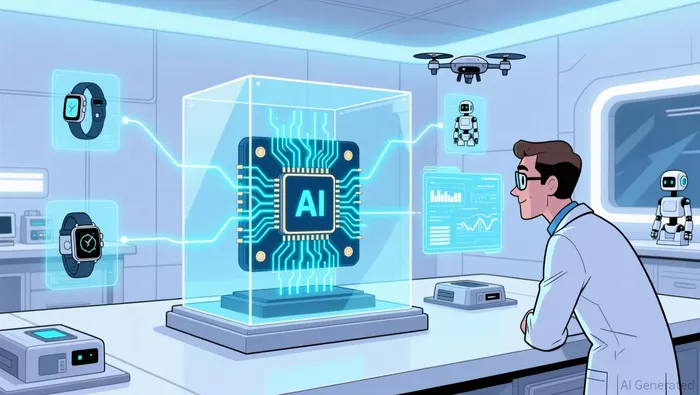
- Wireless Connectivity and IP Expansion:
- CEVA's wireless IP portfolio, including Bluetooth, Wi-Fi, UWB, and cellular IoT, achieved its strongest royalty revenue quarter on record.
This was supported by the adoption of next-generation connectivity standards, such as Wi-Fi 7 and Bluetooth 5, which are enabling AI-embedded devices and positioning CEVA for multi-year royalty growth.
AI and IoT Market Success:
- CEVA's AI processor licensing has become a significant part of its business, contributing roughly one-third of the licensing revenue in Q2 and Q3 2025.
This success is attributed to the growing demand for AI interfacing and the embedding of AI capabilities across customer product lines, as major MCU and semiconductor vendors are integrating AI capabilities into their offerings.
Microchip NPU Agreement:
- Microchip, a leading microcontroller and connectivity provider, adopted CEVA's full NPU portfolio for its future roadmap.
- This win is a proof point of a broader industry trend, reflecting the strategic importance of embedding AI capabilities across various product lines to enhance performance, user experience, privacy, and cost efficiency.
Sentiment Analysis:
Overall Tone: Positive
- Management: "We are pleased to report a third quarter that exceeded our expectations... Revenue of $28.4 million and non‑GAAP EPS of $0.11." CFO: "Royalties up 6% year over year and 16% sequentially." CEO: "AI processor licensing contributed roughly one‑third of the licensing revenue" — indicating strong, broad-based momentum and strategic AI wins.
Q&A:
- Question from Chris Reimer (Barclays): Can you describe other segments driving royalties and any near-term ramp-ups?
Response: Royalties growth is broad-based: US OEM mobile (including low‑tier recovery), strong Wi‑Fi (Wi‑Fi6 transition with higher ASPs), record cellular IoT, automotive ADAS ramps and V2X—these combined drive sequential and multi‑quarter royalty growth.
- Question from Chris Reimer (Barclays): Any change in the timeline to development or types of products for the Microchip NPU deals?
Response: Time‑to‑market similar to prior IP designs—roughly 18–24 months to production; Microchip licensed CEVA's full NPU portfolio spanning MCU‑level to higher‑end inference use cases.
- Question from Madison DePaulo (William Blair): When will Microchip NPU shipments hit CEVA royalty revenue and what is the license timeframe?
Response: License is multi‑year; typical design cycle 1–2 years plus productization/ramp so royalties typically appear within ~2–3 years for successful programs; AI deals may lead to frequent renewals/upsells.
- Question from Martin Yang (Oppenheimer): Which Microchip product families or verticals will be prioritized and how attractive are those end markets?
Response: Deal covers full spectrum—expect multiple programs across embedded MCUs and higher‑end infrastructure/data center lines; company won't disclose customer timing but sees attractive opportunities across industrial, automotive, consumer and compute.
- Question from Martin Yang (Oppenheimer): Is there strong customer interest in integrating NeuPro with CEVA connectivity IPs and what is productization/mass‑production status?
Response: Yes—strong synergy; customers often license both connectivity and NPU IP for embedded systems to optimize time‑to‑market, cost and power; prior deals show NPU+connectivity integration trend continuing.
- Question from David O'Connor (BNP Paribas): What was the competitive landscape for the Microchip win, why now, and is the AI pipeline sustainable?
Response: Win driven by CEVA's three advantages—complete NPU portfolio, unified software stack, and architecture efficiency (power/cost/performance); momentum has grown over recent quarters and the pipeline supports continued AI/NPU licensing, though quarter‑to‑quarter timing may vary.
- Question from David O'Connor (BNP Paribas): Given NeuPro traction, will optics/R&D need to step up to support growth?
Response: For Q4 no major change in spend—company remains disciplined; potential incremental investment will be evaluated and planned for 2026, with decisions early next year based on ROI and opportunity.
Contradiction Point 1
Time-to-Market for NPU Products
It involves differing statements about the time it takes for CEVA's customers to bring NPU products to market, which could impact revenue timing and investor expectations.
Has the timeline for product development and market launch with Microchip changed? - [Chris Reimer](Barclays)
2025Q3: The time to market is similar to our other technologies, typically between 18 and 24 months from design start until customer production and ramp-up. - [Amir Panush](CEO)
Does increased licensing in NPUs indicate higher IC value, leading to accelerated royalty revenue growth? - [Kevin Edward Cassidy](Rosenblatt Securities)
2025Q2: The time for our customer to take it into production is similar. In consumer, it can be even shorter than 24 months, it can be 18 months. - [Amir Panush](CEO)
Contradiction Point 2
Bluetooth Market Growth
It involves differing statements about the growth of CEVA's Bluetooth technology, which is a key aspect of their business model.
Are there other segments driving royalties besides the smartphone segment? - [Chris Reimer](Barclays)
2025Q3: We see growth momentum in terms of our royalty from multiple different opportunities. These include the continued sequential growth in low-tier mobile customers. - [Amir Panush](CEO)
Given the annual guidance, do you expect Bluetooth to drive year-over-year unit growth? - [Zhihua Yang](Oppenheimer & Co. Inc., Research Division)
2025Q2: The first half of the year for '25 was a growth over '24. So first half, the Bluetooth volume growth is already there. - [Yaniv Arieli](CFO)
Contradiction Point 3
AI Integration Opportunities
It involves the potential integration opportunities for NPUs in OEM MCUs, which could have implications for CEVA's market positioning and business expansion.
How will NeuPro integrate with your connectivity IPs? - [Martin Yang](Oppenheimer)
2025Q3: We see strong interest in both connectivity technology and NPU technology, especially in embedded systems. This integration provides advantages in time-to-market, cost, and power efficiency. - [Amir Panush](CEO)
Can NPUs be integrated into OEM MCUs as AI shifts to the Edge? - [Kevin Cassidy](Rosenblatt Securities)
2024Q4: Yes, there is definitely an opportunity for NPUs to be integrated into OEM MCUs. We licensed our NeuPro-Nano MCUs alongside our wireless connectivity and sensor technology to MCU players, enabling them to add more AI capabilities. - [Amir Panush](CEO)
Contradiction Point 4
ADAS Market and Customer Impact
It highlights differing perspectives on the impact of an ADAS design win on the company's customer base and market penetration, which could affect investor perceptions of revenue and market strategy.
Are there other segments driving royalties beyond smartphone customer momentum? - [Chris Reimer](Barclays)
2025Q3: We see growth momentum in terms of our royalty from multiple different opportunities. These include the continued sequential growth in low-tier mobile customers, the transition from Wi-Fi 4.5 to the latest standard Wi-Fi 6, the growth in cellular IoT, and increased market share in automotive, including in ADAS systems. - [Amir Panush](CEO)
Was the ADAS win with a Tier 1 supplier or does the supplier have a secured program at an automotive OEM? - [Kevin Cassidy](Rosenblatt Securities)
2025Q1: This design win with an automotive semiconductor manufacturer is significant and validates our technology in the ADAS market. While the customer already has secured OEMs, the design will be part of next-generation platforms going into multiple OEMs. - [Amir Panush](CEO)
Contradiction Point 5
Wi-Fi 7 ASP Expectations
It involves differing expectations regarding the impact of Wi-Fi 7 on average selling prices (ASPs), which could influence financial forecasts and investor expectations.
Has the timeline for development and product launch with the Microchip partnership changed? - [Martin Yang](Oppenheimer)
2025Q3: The transition to Wi-Fi 6 showed a major uplift in ASP as customers shifted from Wi-Fi 4. While Wi-Fi 6 volume is ramping, we expect further ASP growth with Wi-Fi 7, although the full impact will come later. - [Amir Panush](CEO)
Did ASPs increase similarly with Wi-Fi 7 as when transitioning from Wi-Fi 5 to 6? - [Kevin Cassidy](Rosenblatt Securities)
2025Q1: The transition to Wi-Fi 6 showed a major uplift in ASP as customers shifted from Wi-Fi 4. While Wi-Fi 6 volume is ramping, we expect further ASP growth with Wi-Fi 7, although the full impact will come later. - [Amir Panush](CEO)

Discover what executives don't want to reveal in conference calls
Latest Articles
Stay ahead of the market.
Get curated U.S. market news, insights and key dates delivered to your inbox.
AInvest
PRO
AInvest
PRO



Comments
No comments yet