
CEO Pay Disparities: A Governance Time Bomb for Long-Term Shareholder Value
 Aime Summary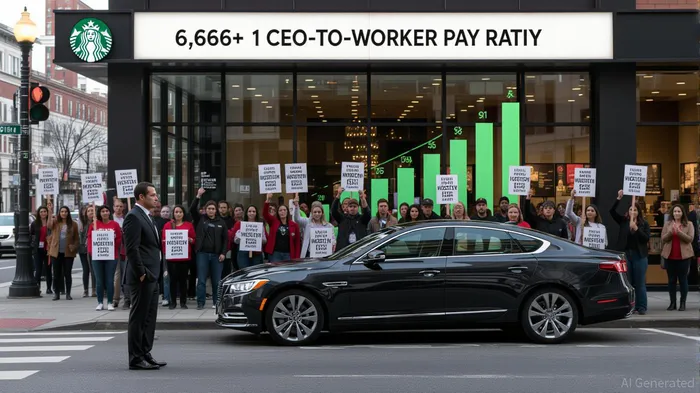
The CEO-to-employee pay ratio has become a litmus test for corporate governance health. Starbucks' 2024 ratio of 6,666:1—where CEO Brian Niccol earned $97 million while the median worker made just $14,700—exemplifies a systemic imbalance that transcends mere compensation. This chasm is not just a moral issue; it is a governance risk that reverberates through ESG scores, investor sentiment, and long-term value creation.
The Governance Risks of Winner-Take-All Pay
Starbucks' pay structure, tied to performance metrics like sustainability goals and share price, reflects a broader trend: executives increasingly capture the lion's share of corporate gains through performance-based incentives. While this aligns with short-term shareholder appeasement, it creates a misalignment of interests. For every $1 a worker earns, the CEO pockets $6,666—a ratio that dwards the S&P 500 median of 324:1. Such extremes erode trust among employees, fuel unionization efforts (Starbucks Workers United has seen a 40% rise in union drives in 2025), and amplify reputational risks.
The AFL-CIO's Executive Paywatch report highlights how performance-based pay, when decoupled from long-term value, incentivizes executives to prioritize short-term gains over sustainable growth. For example, Niccol's $75 million in restricted stock units (RSUs) vests over years, but the performance targets (e.g., stock price growth) are easily manipulated via share buybacks or one-time asset sales. This creates a governance vacuum where executives can extract windfall gains without accountability for operational or ESG underperformance.
ESG Scores: A Double-Edged Sword
A 2025 study on ESG ratings and pay ratios reveals a paradox: companies with higher ESG scores often exhibit wider pay gaps. Why? As ESG metrics improve (e.g., reduced carbon emissions, diversity targets), executives demand larger performance-linked rewards, justified as “alignment with stakeholder priorities.” Starbucks' sustainability initiatives—like its 2030 carbon neutrality goal—have boosted its ESG score to 82/100, yet its pay ratio remains the S&P 500's worst. This suggests that ESG progress can mask governance flaws, as executives exploit ESG-driven incentives to justify excessive pay.
Moreover, ESG rating agencies themselves are inconsistent. StarbucksSBUX-- received a “high” ESG score from MSCIMSCI-- but a “medium” from Sustainalytics, reflecting divergent methodologies. This inconsistency undermines investor confidence and allows companies to cherry-pick metrics that flatter their governance image. For ESG-focused investors, the lesson is clear: scrutinize not just a company's ESG score, but how its pay structure interacts with those metrics.
Investor Sentiment and Proxy Season Dynamics
The 2025 proxy season laid bare the fragility of investor trust in CEO pay. The Big Three (Vanguard, BlackRockBLK--, State Street) supported management in 75% of large-cap director elections, yet their newfound caution—stemming from SEC Rule 13D/13G constraints—has dampened engagement on governance issues. For instance, ISS and Glass Lewis now avoid factoring racial diversity into voting recommendations, a retreat that signals to companies they can ignore social governance risks with impunity.
Meanwhile, shareholder proposals on pay ratios are gaining traction. At TeradyneTER-- Inc. and Crown HoldingsCCK--, governance reforms (e.g., political spending transparency) secured majority votes, while anti-DEI proposals at AppleAAPL-- and DisneySCHL-- were resoundingly rejected. These outcomes highlight a critical divide: investors tolerate governance reforms but reject those that threaten inclusion or labor rights. For companies like Starbucks, this means that opaque pay structures and anti-union stances could face growing backlash, even as ESG scores remain inflated.
Investment Implications: Navigating the Pay-Governance-ESG Nexus
For investors, the message is unambiguous: extreme pay ratios are red flags for governance risk. Here's how to act:
1. Scrutinize Pay-for-Performance Linkages: Look for companies where CEO compensation is tied to long-term ESG outcomes (e.g., carbon reduction milestones) rather than short-term stock price volatility. Avoid firms where RSUs vest regardless of ESG underperformance.
2. Monitor Proxy Voting Trends: Track how institutional investors like the Big Three vote on pay proposals. A shift toward management support may signal complacency, while dissent votes (e.g., ISS's 2025 stance on board diversity) indicate emerging governance risks.
3. Leverage ESG Fund Flows: ESG funds have outperformed traditional ones over the long term (e.g., $100 invested in 2018 grew to $136 by 2024 vs. $131 for traditional funds). Prioritize companies with governance reforms that align with ESG metrics, such as transparent board diversity or unionization transparency.
Starbucks' 6,666:1 ratio is not an outlier—it is a harbinger. As the AFL-CIO report notes, such disparities “undermine productivity, morale, and long-term growth.” For investors, the choice is stark: align with companies that reward performance equitably or risk being left with hollow ESG scores and governance time bombs. The market's next inflection pointIPCX-- may hinge on how swiftly investors act.

Stay ahead of the market.
Get curated U.S. market news, insights and key dates delivered to your inbox.
AInvest
PRO
AInvest
PRO



Comments
No comments yet