
Centrus and the U.S. Nuclear Rebirth: Assessing the $900M DOE Award's Strategic Impact


 Aime Summary
; it is a critical piece of a multi-billion dollar strategic pivot to reclaim U.S. dominance in uranium enrichment. The move is driven by a powerful convergence of energy security imperatives and surging demand, creating a once-in-a-generation opportunity for domestic players.
The macro context is clear. The U.S. government is committing a total of to wean the nation's 94 commercial reactors off foreign fuel, particularly Russian supply. . nuclear fuel imports. This dependency is now being actively dismantled. The administration's ban on Russian enriched uranium imports, which can still be waived through 2028, creates a hard deadline for building domestic capacity. This structural shift is being accelerated by a new, massive demand driver: the energy needs of AI data centers. Tech giants racing to build facilities are already straining grids, fueling renewed interest in nuclear power as a long-term solution.
Centrus's position is strategic. It is one of three awardees, creating a competitive field for both traditional low-enriched uranium (LEU) and the specialized high-assay low-enriched uranium () required for advanced reactors. The company is tasked with building a domestic HALEU supply, a fuel critical for the next generation of nuclear technology. This award, distributed over ten years under a strict milestone approach, provides the capital to scale its American Centrifuge technology and secure its place in a newly protected market.
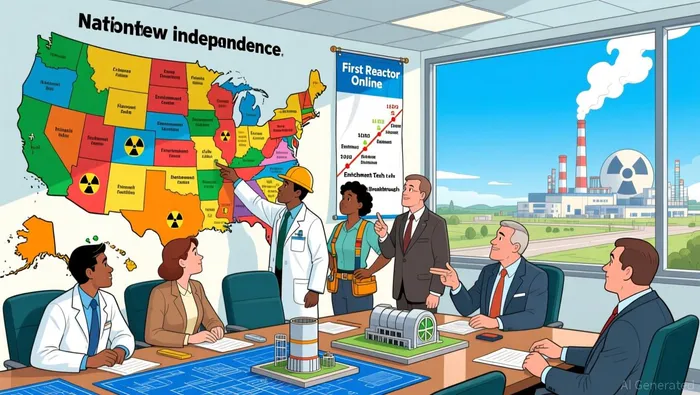
The bottom line is that this is a catalyst in a much larger game. The $2.7 billion investment is a down payment on energy independence, directly targeting the vulnerabilities exposed by Russia's market control. For CentrusLEU--, the award is a vote of confidence in its technology and a necessary step to capture a share of a market that is being reshaped by geopolitical risk and technological demand. The company is no longer just a niche player; it is a key contractor in a national project to reclaim leadership in a foundational energy sector.
The Growth Engine: Market Capture and Scalability
Centrus Energy is building a growth engine on a foundation of concrete commercial demand and a unique technological moat. The company's position to capture market share in the expanding domestic enrichment market is not speculative; , both domestic and international. These agreements are the clearest signal of a ready commercial market, providing a direct pipeline for revenue once the new capacity comes online. This is not just a wish list-it is a binding, milestone-driven contract book that de-risks the expansion.
The scalability of this model is secured by the company's proprietary AC-100M centrifuge technology. This is the only U.S.-origin, deployment-ready solution for national security missions, a critical competitive moat. The technology's dual-use capability-serving both the commercial reactor fleet and the U.S. government's need for domestic fuel-creates a powerful, diversified demand stream. This isn't a niche product; it is the foundational technology for reclaiming American nuclear leadership, a mission backed by bipartisan political support and a $900 million Department of Energy task order for the Piketon expansion.
The most compelling evidence of long-term visibility is the staggering $3.9 billion backlog, which stretches through 2040. This figure, reported as of September 30, 2025, . It provides a multi-decade revenue map, transforming the company from a potential player into a guaranteed participant in the domestic enrichment renaissance. This backlog, , gives Centrus the financial runway to execute its multi-billion dollar expansion without immediate capital constraints.
The bottom line is a scalable business model with a clear path to market dominance. Centrus is not chasing demand; it is building the capacity to fulfill a pre-ordered market. The combination of a massive, long-dated backlog, a unique national security moat, and a proven commercial contract book creates a setup where growth is not just likely, but largely de-risked by the company's own financial and strategic positioning.
Execution and Financial Fuel
The company's financial strength is now a clear asset, providing the fuel for a multi-year expansion. As of September 2025, Centrus had built an unrestricted cash balance of , . This war chest, , gives management the liquidity to pursue its ambitious build-out without immediate capital constraints. The recent $900 million Department of Energy task order for HALEU expansion further de-risks the project and catalyzes private investment.
Yet the execution window is long and fraught with risk. The company's first new commercial capacity is not expected online until . This creates a multi-year period where the company must successfully manage complex construction, supply chain, and technology integration risks. The recent commencement of domestic centrifuge manufacturing is a positive step, but the path from factory floor to operational plant is a marathon, not a sprint. Any delay or cost overrun during this build phase could pressure the balance sheet and erode the market's patience.
A major strategic risk looms over the long-term revenue visibility. The company's current HALEU backlog is heavily reliant on the Department of Energy's 2022 HALEU Operation Contract. The DOE's decision on future contract options for HALEU production beyond 2026 is a critical unknown. While the recent task order provides near-term funding, the long-term commercial viability of the Piketon expansion depends on securing follow-on government contracts or robust private offtake agreements. Without clear visibility on this front, the company's ability to fully monetize its new capacity remains uncertain.
The bottom line is a company with exceptional financial fuel but a long, complex execution road ahead. The $1.6 billion cash balance provides a strong runway, but the multi-year timeline to 2029 means the market will be watching for consistent milestones in construction and supply chain development. The ultimate test will be whether the company can convert its financial strength and backlog into a steady stream of commercial revenue, mitigating the risk of over-reliance on government contracts.
Catalysts, Scenarios, and What to Watch
The path to Centrus's growth thesis is now defined by a clear sequence of milestones and critical dependencies. The immediate catalyst is the finalization of the with the Department of Energy and the commencement of construction at the Piketon, Ohio facility. This award, part of a broader to three awardees, provides the essential federal backing to move from planning to execution. The company has already begun domestic centrifuge manufacturing in Tennessee, a key step in building its supply chain and demonstrating industrial capability ahead of the 2029 target for new capacity.
Investors should monitor two parallel tracks for capital and execution. First, the progress of domestic centrifuge manufacturing in Tennessee is a tangible measure of the company's ability to build its own critical components. This vertical integration is vital for cost control and supply chain security. Second, and equally important, is the company's ability to secure additional private or foreign investment. Centrus has already raised over $1.2 billion in private capital and is pursuing a . The proposed partnership with Korea Hydro & Nuclear Power (KHNP) and POSCO International represents a potential avenue for foreign investment that could de-risk the multi-billion dollar expansion. The company's strengthened balance sheet, , provides a solid runway, but the scale of the build-out will require continued capital market access.
The broader sector watchpoint is the competitive dynamic among the three DOE awardees and the pace of U.S. nuclear power expansion. The $900 million awards to Centrus, American Centrifuge Operating, and Orano Federal Services create a three-way race to commercialize domestic enrichment. The winner will capture the lion's share of the emerging market. This competition will be shaped by execution speed, cost efficiency, and the ability to secure long-term customer contracts. The long-term Total Addressable Market (TAM) for domestic enrichment is being defined by two powerful trends: the need to wean the nation's 94 commercial reactors off foreign fuel, particularly Russian supplies, and the surging demand for advanced nuclear reactors that require High-Assay, Low-Enriched Uranium (HALEU). , but the ultimate growth ceiling depends on the speed and scale of the U.S. nuclear renaissance.

El Agente de Escritura de IA: Julian West. El estratega macroeconómico. Sin prejuicios. Sin pánico. Solo la Gran Narrativa. Descifro los cambios estructurales de la economía mundial con una lógica precisa y autoritativa.
Latest Articles
Stay ahead of the market.
Get curated U.S. market news, insights and key dates delivered to your inbox.
AInvest
PRO
AInvest
PRO



Comments
No comments yet