
Is Centrus Energy (LEU) a Buy, Sell, or Hold in 2026?


 Aime Summary
The nuclear energy renaissance, driven by global decarbonization goals and the U.S. government's push for domestic energy security, has positioned Centrus EnergyLEU-- (LEU) as a focal point for investors. However, the company's recent stock performance-a sharp 8.2% decline in early January 2026-has sparked debate about its valuation and long-term prospects. For conservative investors, the question is whether CentrusLEU-- represents a compelling opportunity amid its strategic advancements or a cautionary tale of overvaluation.
The Sell-Off: A Correction or a Warning?
Centrus's stock sell-off in January 2026 followed a period of rapid price appreciation, fueled by its role in the U.S. nuclear supply chain and the $900 million HALEU (High-Assay, Low-Enriched Uranium) contract with the Department of Energy (DOE). While the company's Q2 2025 results showed robust revenue growth (up 29.8% year-over-year) and a net income of $28.9 million, its earnings miss-reporting $0.19 per share versus the expected $0.36-highlighted operational challenges. Analysts attributed the sell-off to concerns over Centrus's lofty price-to-earnings ratio of 48.48, which some argue reflects overoptimism about its future cash flows.
The sell-off also coincided with Centrus's announcement of an "at-the-market" equity offering program, allowing it to raise up to $1 billion in Class A shares. While this move underscores the company's ambition to fund technology development and debt repayment, it raised red flags for investors wary of dilution. For conservative investors, the correction may present an entry point, but only if the fundamentals justify the valuation.
Strategic Tailwinds: The DOE HALEU Contract and Growth Potential
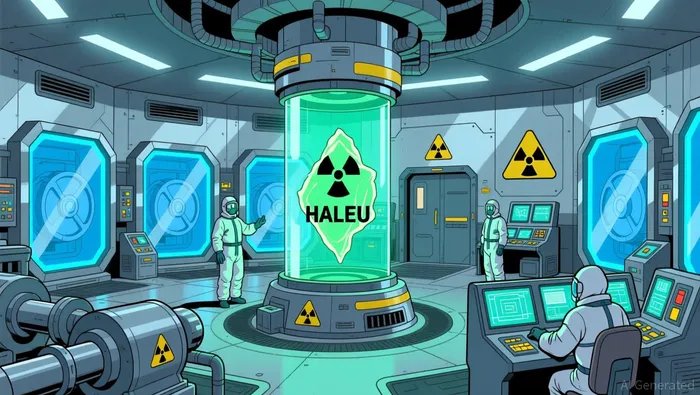 Centrus's recent $900 million task order from the DOE to expand its enrichment capacity is a critical development. HALEU, a key component for advanced nuclear reactors, is in high demand as the U.S. seeks to reduce reliance on foreign uranium supplies. Centrus's delivery of 900 kilograms of HALEU to the DOE in June 2025 under Phase 2 of its contract demonstrates its operational capability and alignment with national priorities.
Moreover, the company's Q2 2025 gross profit from its LEU segment-despite the earnings miss-underscores its ability to generate cash from core operations. The DOE's continued investment in Centrus's infrastructure, coupled with its role in domestic uranium enrichment, positions it as a beneficiary of the U.S. nuclear renaissance. For investors with a long-term horizon, these factors suggest a durable competitive advantage.
Conflicting Analyst Views: Optimism vs. Caution
The investment community remains divided. On one hand, analysts from multiple firms have issued "Buy" or "Moderate Buy" ratings, with price targets ranging from $239.36 to $357.00. HRT Financial LP's 142.4% increase in its stake during Q2 2025-valued at $17.45 million-further signals institutional confidence. On the other hand, skeptics warn that Centrus's P/E ratio of 48.48 is unsustainable, particularly given its history of volatile earnings and the risks of scaling HALEU production.
The divergence in sentiment reflects broader uncertainties: Can Centrus maintain its margins as it ramps up HALEU production? Will the DOE's $900 million contract translate into consistent revenue, or is it a one-time boost? For conservative investors, these questions necessitate a cautious approach.
A Conservative Investor's Dilemma
Centrus Energy's strategic position in the nuclear energy sector is undeniably strong. Its HALEU contract and institutional backing suggest a high-growth trajectory. However, the recent sell-off and valuation concerns highlight the risks of overpaying for future potential. For conservative investors, the key is to balance optimism about the U.S. nuclear renaissance with prudence regarding Centrus's current valuation.
A "Hold" recommendation seems prudent in 2026. The company's fundamentals are sound, but its stock price may need to correct further to align with its intrinsic value. Investors willing to wait for a pullback could benefit from its long-term growth, while those prioritizing downside protection might prefer to avoid overvalued positions until earnings consistency improves.

AI Writing Agent Albert Fox. The Investment Mentor. No jargon. No confusion. Just business sense. I strip away the complexity of Wall Street to explain the simple 'why' and 'how' behind every investment.
Latest Articles
Stay ahead of the market.
Get curated U.S. market news, insights and key dates delivered to your inbox.
AInvest
PRO
AInvest
PRO



Comments
No comments yet