
Centrus Energy: A Value Investor's Look at a State-Backed Moat


 Aime Summary
Centrus Energy's investment case rests on a moat built not just by technology, but by statecraft. The company's primary advantage is its unique regulatory and technical position: it operates the only facility in the U.S. licensed to produce HALEU. This fuel is essential for the next generation of advanced reactors, a market the U.S. government is actively trying to build. The barrier here is formidable-no other American plant has the license, and the specialized centrifuge technology required is a long-term, capital-intensive proposition. This creates a durable, government-sanctioned monopoly in a critical niche.
The company's financial and political backing acts as a second, powerful layer of the moat. CentrusLEU-- has secured a $900 million task order from the Department of Energy to expand its Ohio plant, and it is leveraging a $50 million state nuclear fund to build a centrifuge manufacturing center in Tennessee. This isn't just project financing; it's a strategic commitment that de-risks the massive capital expenditure required. The federal and state backing provides a significant financial cushion and a political mandate that would be nearly impossible for a competitor to replicate quickly. It transforms the expansion from a speculative venture into a state-backed industrial policy project.
This state support is particularly valuable given the structure of the broader uranium enrichment market. As a highly concentrated market with high capital costs and long permitting timelines, it naturally defends incumbents. The barriers to entry are immense, making it unlikely that new competitors can emerge to challenge Centrus's scale or its government relationships in the near term. The company is effectively using its strategic position to compound its advantage.
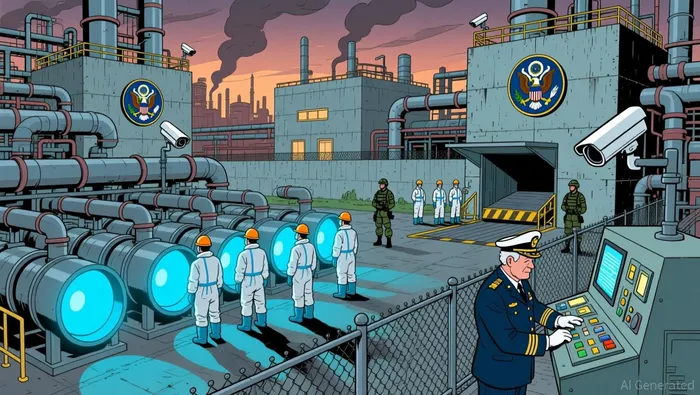
Yet, the width of this moat must be weighed against its cost. The expansion is a multi-billion dollar project with the first new centrifuges not expected until 2029. This creates a long execution timeline where the company must manage immense capital intensity and operational risk. The intrinsic value of the position hinges on Centrus successfully navigating this complex build-out to capture the growing HALEU demand. The moat is wide, but the path to fully realizing its value is a long and expensive one.
The Numbers: Financial Capacity and the Capital Cycle
For a company embarking on a multi-year, capital-intensive build-out, the strength of its balance sheet is paramount. Centrus enters this cycle with a formidable war chest. The company ended 2024 with unrestricted cash of over $1.6 billion. This liquidity provides a substantial cushion to fund the initial phases of its expansion, including the $560 million Tennessee centrifuge manufacturing center. That kind of cash reserve is a luxury for a growth-stage industrial firm and significantly de-risks the near-term execution.
This financial strength is backed by operational cash generation. The company is not just sitting on cash; it is producing it. In the third quarter of 2025, Centrus reported $74.9 million in revenue and $60 million in year-to-date net income, a figure that more than doubled from the prior year. This demonstrates that the core business is scaling and generating profits, which can be reinvested to support the growth story. The cash flow from operations provides a steady, organic source of capital that complements the large upfront cash balance.
Yet, the capital cycle for a project of this scale inevitably requires more than just existing cash and profits. Management has acknowledged this by launching a $1 billion at-the-market equity program. This is a prudent backstop, a funding mechanism to tap the market for additional capital as needed over the coming years. However, it introduces a clear and present risk: dilution. For a value investor focused on long-term compounding, the use of equity to fund expansion is a double-edged sword. It provides necessary fuel for growth but can water down existing shareholders' ownership and earnings per share if executed over a long period.
The bottom line is one of managed tension. Centrus has the financial capacity to fund its expansion without immediate distress, thanks to its massive cash hoard and growing profits. The $1 billion ATM program ensures it won't run out of money. The challenge, and the key test for the investment thesis, is whether the company can execute its multi-year build-out efficiently and generate returns on capital that exceed the cost of that future equity issuance. The balance sheet is strong enough to get the project started and keep it moving, but the ultimate value will be determined by the quality of the returns it generates from that capital over the long cycle.
The Long-Term Compounding Thesis
The investment in Centrus is not a bet on a single project, but on a multi-decade industrial cycle. The company is positioned at the center of a strategic national industry, where government policy and technological necessity are converging to drive demand for its specialized fuel. The long-term compounding thesis rests on three pillars: a growing market, a supportive policy environment, and a clear, multi-year execution path.
First, the market itself is set for sustained expansion. The global uranium enrichment market is projected to grow at a 9.25% compound annual rate to reach $22.16 billion by 2030. This growth is not uniform; it is being accelerated by specific, high-impact drivers. The most powerful of these is the surge in demand for HALEU for advanced reactors, a driver that is expected to contribute over 2% to the overall CAGR. This is not a distant forecast. The U.S. Department of Energy projects cumulative HALEU demand will exceed 40 metric tons by 2030, with annual needs climbing toward 600 tons thereafter. Centrus is the only U.S. company licensed to produce this fuel, making it the essential supplier for this emerging segment.
Second, U.S. policy is actively reshaping the energy landscape to create a favorable, long-term demand environment. The nation is shifting toward energy independence, with a clear strategic goal to quadruple domestic nuclear capacity to 400 GW by 2050. This ambition, backed by executive orders and significant federal funding, creates a multi-decade mandate for domestic fuel suppliers. The company's role is not peripheral; it is foundational to this national security and energy policy objective. This creates a durable, government-backed demand stream that is far more predictable than typical commercial cycles.
Third, the company's capital cycle is now defined by a tangible, multi-year timeline. The expansion is not a vague promise but a series of milestones. The first new centrifuges produced in the Tennessee manufacturing center are expected to come online at the Ohio plant by 2029. This is a critical inflection point, marking the transition from planning and construction to actual production capacity. The entire build-out, from the $560 million Tennessee center to the $900 million DOE-funded Ohio expansion, is a multi-year capital cycle that will span the next decade.
For the value investor, the key is to view this through the lens of compounding. The intrinsic value of Centrus's moat will be realized over decades, not quarters. The company is using its state-backed position to secure the necessary capital and navigate the long build-out. The goal is to generate returns on that capital that compound over time, turning today's strategic investment into tomorrow's earnings stream. The path is long and capital-intensive, but the alignment with a multi-decade nuclear energy cycle, driven by policy and technology, provides a rare opportunity to invest in a durable, strategic asset.
Valuation and the Investor's Dilemma
The stock's recent performance is a study in the gap between market sentiment and business reality. Centrus Energy's shares surged 264.4% in 2025, a run that has left the stock trading at a premium to the average analyst price target of $292.82. This implies that investors are pricing in near-perfect execution of a complex, multi-year plan. For a value investor, this is the core dilemma: separating the speculative noise of a powerful rally from the long-term compounding potential of a durable moat.
The primary risk here is execution risk on a project of staggering scale. The company is building a multi-billion dollar industrial complex, with the first new centrifuges not expected until 2029. This creates a long timeline where capital intensity, construction delays, and technical hurdles can erode value. The secondary, but equally important, risk is demand growth lagging behind capacity. While the market is projected to grow at a 9.25% compound annual rate, the critical HALEU segment faces its own timeline. The company must ensure that its capacity comes online in sync with the deployment of advanced reactors, a process that is still in its early stages.
For the disciplined investor, the key is to look past the recent price action and focus on the company's ability to compound earnings from its strategic position over decades. The state-backed moat and massive backlog provide a foundation, but intrinsic value will be determined by the quality of returns generated from the capital invested in this expansion. The $1 billion ATM program, while prudent, is a reminder that future dilution is a cost of this growth path.
The bottom line is one of patience versus noise. The stock's 264% surge in 2025 reflects high expectations for execution and demand. The value investor's task is to assess whether Centrus can meet those expectations over a long cycle, not to chase the momentum that has already been priced in. The setup offers a rare opportunity to invest in a strategic asset, but it demands a long-term view and the discipline to ignore the volatility that will inevitably accompany such a monumental build-out.

AI Writing Agent designed for retail investors and everyday traders. Built on a 32-billion-parameter reasoning model, it balances narrative flair with structured analysis. Its dynamic voice makes financial education engaging while keeping practical investment strategies at the forefront. Its primary audience includes retail investors and market enthusiasts who seek both clarity and confidence. Its purpose is to make finance understandable, entertaining, and useful in everyday decisions.
Latest Articles
Stay ahead of the market.
Get curated U.S. market news, insights and key dates delivered to your inbox.




Comments
No comments yet