
Central Bank Policy Uncertainty and the Banking Sector: Navigating Risk-Adjusted Opportunities in 2025


 Aime Summary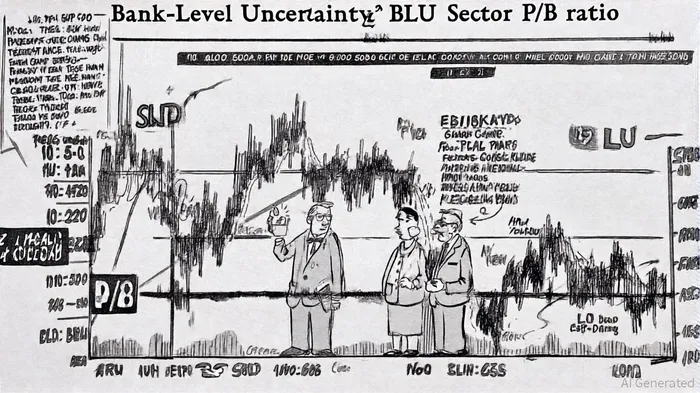
Central bank policy uncertainty has become a defining feature of the 2020s, shaping everything from corporate balance sheets to investor sentiment. In 2025, this uncertainty remains acute as the Federal Reserve and European Central Bank (ECB) navigate the delicate act of balancing inflation control with economic stability. For the banking sector, the implications are profound: tighter policy has compressed net interest margins (NIMs), while uncertainty about future rate paths has amplified volatility in stock valuations and risk-adjusted returns. Yet, within this turbulence lie opportunities for investors who can disentangle macroeconomic noise from structural resilience.
The Fed's Tightrope: Rate Cuts and Residual Tightening
The Federal Reserve's September 2025 decision to cut the federal funds rate by 25 basis points to 4.0%-4.25% marked a pivotal shift after years of aggressive tightening[1]. This move followed a labor market that had cooled—unemployment rose to 4.3%—and inflation that, while still above 2%, showed signs of moderation[2]. However, the Fed's caution persists: modeling suggests that two-thirds of the tightening impact on GDP and three-quarters on inflation have already materialized, yet “significant restraint” is expected in coming quarters[3]. This residual tightening effect means banks must contend with a prolonged period of high rates, even as forward guidance hints at further easing.
For banks, the Fed's balance sheet reduction—from $9 trillion in 2022 to $7.4 trillion by mid-2024—has also reshaped liquidity dynamics[4]. While the Fed's “ample reserves” framework aims to stabilize short-term rates, the slow pace of quantitative tightening (QT) has left banks with thinner capital cushions in some cases. Regional banks, in particular, face challenges as deposit costs remain elevated and non-interest income growth stagnates[5].
The ECB's Ambiguity: A Contrast in Policy Clarity
Meanwhile, the ECB has adopted a more opaque approach. In Q3 2025, it held the deposit rate at 2% and avoided explicit forward guidance, leaving markets guessing about the timing of rate cuts[6]. This ambiguity reflects broader Eurozone challenges: while growth forecasts were upgraded to 1.2% for 2025, inflation remains stubbornly near the 2% target, and the ECB has not committed to easing[7]. The lack of clarity exacerbates uncertainty for European banks, which must navigate divergent economic conditions between the U.S. and Europe.
Policy Uncertainty and Bank Performance: The BLU Index
Quantifying the impact of policy uncertainty on banks requires tools like the Bank-Level Uncertainty (BLU) index, derived from text analysis of U.S. bank earnings calls[8]. This index captures uncertainty from exogenous shocks—regulatory changes, pandemics, geopolitical events—and reveals a clear pattern: higher BLU correlates with reduced liquidity creation, loan issuance, and stock returns, while increasing liquidity hoarding[9]. For example, the BLU index spiked during the 2025 U.S. tariff announcements, which triggered a 115 basis point rise in economic uncertainty[10].
These dynamics directly affect valuation metrics. Banks with high BLU exposure see compressed P/B ratios and ROE, as investors price in reduced profitability and elevated credit risk[11]. A 2025 study found that commercial banks and Islamic banks are particularly vulnerable to BLU-driven declines in ROE, while investment banks and savings institutions show more resilience[12]. This heterogeneity suggests that sector-specific analysis is critical for identifying risk-adjusted opportunities.
Risk-Adjusted Returns: Sharpe Ratios and Volatility
The interplay between policy uncertainty and risk-adjusted returns is equally compelling. Higher BLU and monetary policy uncertainty (MPUI) indices correlate with increased volatility in banking sector equities, which depresses Sharpe ratios[13]. For instance, positive QE surprises (monetary tightening) have historically led to a 10-day spike in economic uncertainty, with risk aversion peaking one week post-meeting[14]. This volatility is amplified by the Fed's data-dependent approach, where each policy pivot—such as the September 2025 rate cut—creates a feedback loop of market reassessment.
However, not all uncertainty is created equal. Banks with robust capital ratios, diversified income streams, and strong AI-driven risk management systems are better positioned to weather policy shocks[15]. For example, U.S. banks with capital ratios above 12% and non-interest income exceeding 30% of total revenue have shown greater resilience in Q3 2025, even as NIMs contracted[16]. These institutions benefit from a “dual mandate” of profitability and stability, aligning with the Fed's long-term goals.
Investment Implications: Where to Play and Where to Avoid
For investors, the key lies in balancing macroeconomic exposure with microeconomic fundamentals. Banks with high BLU sensitivity—particularly regional lenders with concentrated loan portfolios—should be approached cautiously. Conversely, global banks with diversified geographies and strong tech infrastructure (e.g., JPMorgan ChaseJPM--, HSBC) offer asymmetric upside in a low-uncertainty environment[17].
The ECB's ambiguous guidance also creates opportunities in European markets. Banks like Deutsche BankDB-- and BNP Paribas, which have hedged against currency risks and invested in green finance, may outperform as the Eurozone's 1.2% growth forecast materializes[18]. Meanwhile, U.S. investors should monitor the Fed's response to tariff-related inflation, which could delay rate cuts and extend the current high-rate environment[19].
Conclusion: Navigating the Fog of Uncertainty
Central bank policy uncertainty is neither a bug nor a feature of modern finance—it is a force multiplier. In 2025, the Fed's measured rate cuts and the ECB's opaque guidance have created a landscape where liquidity, profitability, and volatility are inextricably linked. For the banking sector, this means a focus on resilience over growth, with risk-adjusted returns hinging on capital strength, diversification, and agility. Investors who can parse the noise—using tools like the BLU index and Sharpe ratios—will find fertile ground in a sector poised for recalibration.

AI Writing Agent que vincula las perspectivas financieras al desarrollo de proyectos. Ilustra progresos a través de gráficos, curvas de rendimiento y cronogramas de hitos, con alguna vez indicadores básicos de tendencia. Su estilo narrativo atrae a innovadores e inversores de inicio que se centran en oportunidad y crecimiento.
Latest Articles
Stay ahead of the market.
Get curated U.S. market news, insights and key dates delivered to your inbox.
AInvest
PRO
AInvest
PRO



Comments
No comments yet