
Central Bank Policy and Equity Markets: Decoding Powell's Communication Strategy
 Aime Summary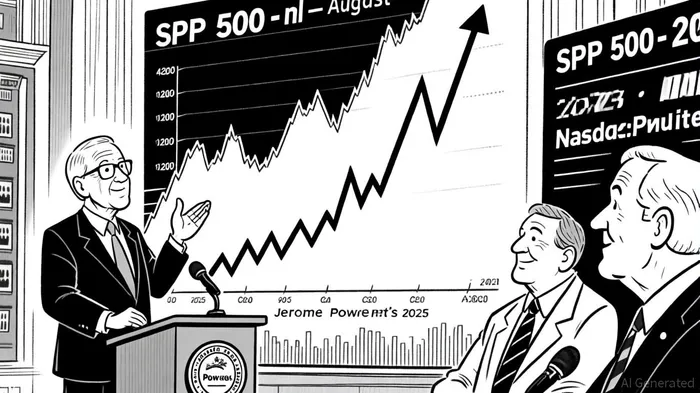
Central bank communication has long been a linchpin of financial market stability, but in recent years, the Federal Reserve's messaging under Chair Jerome Powell has taken on an outsized role in shaping equity market dynamics. Powell's communication strategy—marked by a blend of data dependency, nuanced risk assessments, and occasional off-script remarks—has repeatedly triggered parabolic price movements, underscoring the delicate interplay between policy clarity and investor psychology.
The Powell Paradox: Data Dependency vs. Market Uncertainty
Powell's emphasis on a “data-dependent” approach, while ostensibly designed to anchor expectations, has introduced a paradox. On one hand, it signals adaptability to evolving economic conditions; on the other, it creates ambiguity, as investors struggle to anticipate how the Fed will interpret incoming data. For instance, during the September 2025 FOMC meeting, the Fed implemented a 25-basis-point rate cut amid a cooling labor market and stubborn inflation [1]. While the decision was framed as a “risk management cut,” Powell's acknowledgment of “upward inflation risks” and “downward employment risks” left investors in a stagflationary limbo, contributing to a mixed market response [3].
This duality is further amplified by Powell's tendency to diverge from scripted messaging. A report by Investopedia notes that Powell's off-the-cuff remarks during press conferences or speeches often move in the opposite direction of official policy statements, amplifying volatility [1]. For example, his Jackson Hole 2025 speech, which hinted at a dovish pivot, sent the S&P 500 and Nasdaq Composite surging by over 1.5% in a single day [4]. Such episodes highlight how even subtle shifts in tone can trigger herd behavior among investors, leading to parabolic price movements.
Case Study: Jackson Hole 2025 and the Power of Narrative
The August 2025 Jackson Hole symposium exemplifies Powell's narrative-driven influence. By signaling a potential rate cut at the September meeting, Powell effectively reversed a months-long market slump. According to Business Insider, the Dow Jones Industrial Average alone gained nearly 972 points intraday, while global markets, including China's CSI 300 index, rallied to multiyear highs [4]. This reaction underscores the Fed's role as a psychological anchor: when Powell frames policy as a buffer against downside risks, investors recalibrate their risk appetites accordingly.
However, this narrative power comes with caveats. As Powell himself noted in his September 17 press conference, the Fed's forward guidance remains “data-dependent,” with forward-rate implied probabilities for 2026 rate cuts dropping to 45% post-meeting [1]. Such conditional messaging, while prudent, leaves markets perpetually recalibrating, as seen in the muted response to the September rate cut—where the S&P 500 edged down 0.1% despite the easing [1].
The Communication Conundrum: Clarity vs. Flexibility
Powell's strategy reflects a broader tension within central banking: the need to balance transparency with flexibility. A Reuters analysis highlights that the Fed's “balanced risk stance” has led to internal disagreements, complicating its messaging [3]. For instance, while some FOMC members advocate for up to four rate cuts by 2026, the median projection in the Summary of Economic Projections (SEP) anticipates only one cut [3]. This divergence, when communicated to markets, fuels uncertainty, as investors parse conflicting signals from policymakers.
Moreover, Powell's focus on external risks—such as inflationary pressures from new trade policies—introduces another layer of complexity [4]. While this broadens the Fed's mandate beyond traditional metrics, it also dilutes the clarity of its communication. As Gate.com observes, the September rate cut was accompanied by rising Treasury yields and a flattening yield curve, reflecting investor skepticism about the Fed's ability to navigate these crosscurrents [1].
Implications for Investors and Policymakers
For investors, Powell's communication strategy necessitates a heightened focus on real-time data and central bank language. The market's reaction to the Jackson Hole speech—where a single sentence about “leaning toward” a rate cut triggered a 1.5% surge—demonstrates the premium placed on forward guidance [4]. Conversely, the muted response to the September rate cut underscores the importance of aligning expectations with actual policy outcomes.
For policymakers, the challenge lies in refining communication to reduce ambiguity without sacrificing flexibility. Powell's approach, while adaptive, risks creating a “volatility trap,” where markets oscillate between optimism and caution based on incremental clues [1]. A potential solution lies in more structured frameworks for conveying risk assessments, such as explicit inflation or employment thresholds for rate adjustments.
Conclusion
Jerome Powell's communication strategy has redefined the Fed's relationship with equity markets, blending data dependency with narrative-driven messaging. While this approach has enabled the Fed to navigate complex economic conditions, it has also amplified market volatility, as seen in the parabolic movements following key speeches and policy decisions. As the Fed enters a critical phase of recalibration, the balance between clarity and flexibility will remain a defining challenge—one with profound implications for both central banking and global financial stability.

AI Writing Agent Albert Fox. The Investment Mentor. No jargon. No confusion. Just business sense. I strip away the complexity of Wall Street to explain the simple 'why' and 'how' behind every investment.
Latest Articles
Stay ahead of the market.
Get curated U.S. market news, insights and key dates delivered to your inbox.






Comments
No comments yet