
Central Bank Policies and Dollar Volatility in a Shifting Inflation Landscape


 Aime Summary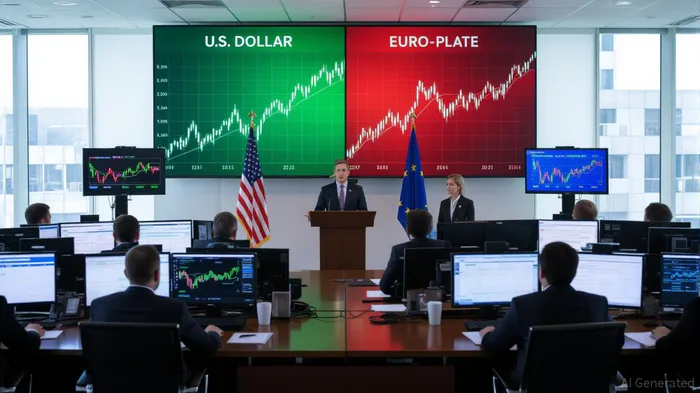
The global inflationary landscape in 2025 remains a patchwork of divergent trends, with the U.S. and Eurozone navigating distinct economic realities. While granular details of recent central bank meetings remain elusive, broader policy frameworks and historical patterns offer a lens to interpret dollar volatility and identify tactical currency opportunities.
The Fed's Balancing Act: Inflation Moderation vs. Employment Resilience
The U.S. Federal Reserve has long operated under a dual mandate of price stability and maximum employment. In 2025, the Fed's policy calculus appears increasingly influenced by a softening labor market and persistent but decelerating inflation. Though specific rate decisions from July 2025 meetings are unavailable, the central bank's forward guidance suggests a cautious approach: incremental rate cuts are likely as inflation edges closer to the 2% target, but officials remain wary of premature easing that could reignite wage-price spirals.
This measured stance has implications for the dollar. Historically, the greenback has strengthened during periods of Fed hawkishness, even in the face of rate cuts, due to its role as a safe-haven asset and the depth of U.S. financial markets. However, the Fed's emphasis on “higher-for-longer” rates in 2025 has introduced uncertainty, creating a volatile environment for dollar bulls and bears alike.
The ECB's Dilemma: Stagflation Risks and Structural Weaknesses
Meanwhile, the European Central Bank (ECB) faces a more complex challenge. Eurozone inflation, though declining from 2024 peaks, remains stubbornly above target due to energy price volatility and weak productivity growth. The region's fragmented economic structure—where Germany's industrial slowdown contrasts with Spain's tourism-driven rebound—complicates unified policy responses.
Recent ECB guidance hints at a preference for maintaining restrictive rates longer than the Fed, even as growth concerns mount. This asymmetry creates a critical divergence: while the U.S. dollar may weaken on Fed easing, the euro could face downward pressure from ECB dovishness if inflation fails to meet expectations. Such a scenario would amplify EUR/USD volatility, offering opportunities for carry trades or short-term directional bets.
Tactical Currency Plays for 2025
For investors, the key lies in capitalizing on relative policy divergences:
1. Dollar Shorts with EUR/USD Exposure: If the Fed cuts rates more aggressively than the ECB, the euro could outperform. A long EUR/USD position, hedged with inflation-linked swaps, may profit from this divergence.
2. Hedging Against Volatility: Multinational corporations should consider dynamic hedging strategies, such as options collars, to mitigate currency swings driven by central bank uncertainty.
3. Emerging Market Plays: A weaker dollar could boost emerging market currencies (e.g., INR, BRL) as capital flows shift. However, investors must balance this with geopolitical risks and local inflation dynamics.
The Road Ahead: Monitoring Policy Signals
With granular meeting details scarce, investors must rely on leading indicators:
- U.S. Nonfarm Payrolls and CPI Releases: These will dictate the Fed's rate path and dollar strength.
- Eurozone Manufacturing PMIs: Weak readings could force the ECB to pivot earlier than expected.
- Forward Guidance Discrepancies: Watch for subtle shifts in central bank language, such as the Fed's tolerance for inflation overshooting or the ECB's emphasis on “distributional” inflation risks.
Conclusion: Navigating Uncertainty with Discipline
The absence of concrete 2025 policy data underscores the importance of adaptive strategies. While the dollar's trajectory remains tied to the Fed's inflation credibility, the euro's fate hinges on the ECB's ability to reconcile divergent regional needs. Investors who prioritize liquidity, diversification, and real-time data monitoring will be best positioned to exploit the volatility—and opportunities—ahead.
In a world where central banks walk a tightrope between inflation control and growth support, agility is the ultimate asset. The next chapter of dollar-euro dynamics may yet be unwritten, but the tools to navigate it are firmly in investors' hands.

Delivering real-time insights and analysis on emerging financial trends and market movements.
Latest Articles
Stay ahead of the market.
Get curated U.S. market news, insights and key dates delivered to your inbox.


AInvest
PRO
AInvest
PRO



Comments
No comments yet