
Central Bank Leadership and Market Stability in a Polarized Political Climate


 Aime Summary
The U.S. Federal Reserve's independence has long been a cornerstone of its credibility and effectiveness in managing monetary policy. However, in an era of heightened political polarization, the balance between central bank autonomy and political influence is under renewed scrutiny. Recent developments-particularly Christopher Waller's reported interaction with President Donald Trump in December 2025-highlight the fragility of this balance and its implications for monetary policy and investor sentiment.
Waller's Stance on Fed Independence
Christopher Waller, a leading candidate to succeed Jerome Powell as Fed Chair, emphasized his unwavering commitment to defending the central bank's independence during a high-stakes meeting with President Trump in December 2025. According to a Reuters report, Waller stated he would "absolutely" resist political pressure to alter monetary policy, reiterating that the Fed's role in maintaining price stability and maximum employment must remain free from executive branch interference. While the tone of the meeting was described as professional, Waller's firm advocacy for institutional autonomy-coupled with Trump's public criticism of the Fed's "high" interest rates-suggests a subtle but significant clash of priorities.
Waller's position aligns with academic research underscoring the importance of central bank independence. Studies by economists such as Alesina and Summers demonstrate that independent central banks achieve lower and more stable inflation outcomes compared to those subject to political pressures. This principle is particularly relevant in 2025, as the Fed navigates the dual challenges of persistent inflation and a slowing labor market. Waller's advocacy for gradual rate cuts, rather than abrupt policy shifts, reflects a data-driven approach that prioritizes long-term stability over short-term political expediency.
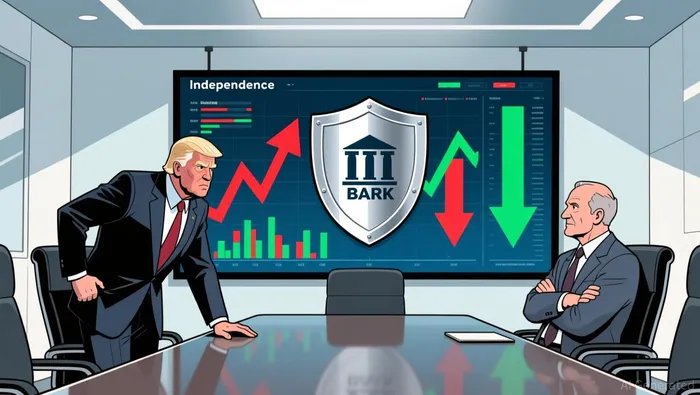
Political Pressures and Market Reactions
President Trump's repeated calls for aggressive rate cuts have already triggered market volatility. Treasury yields spiked, and the U.S. dollar weakened against major currencies in late 2025 as investors priced in the risk of politicized monetary policy. A report by Cresset Capital notes that such volatility could intensify if the next Fed Chair fails to insulate the central bank from political influence. The financial sector, including major bank CEOs and global central bankers, has largely rallied behind Waller's defense of independence, signaling concerns about the broader economic consequences of a politicized Fed.
Historical precedents further illustrate the risks of eroding central bank autonomy. For example, Turkey's experience under President Recep Tayyip Erdoğan-where political interference led to hyperinflation and capital flight-serves as a cautionary tale for the U.S. Similarly, Richard Nixon's attempts to pressure the Fed in the 1970s contributed to stagflation, a crisis that took decades to resolve. These examples reinforce the argument that political overreach in monetary policy can have catastrophic, long-term effects on economic stability.
Implications for Investors
For investors, the battle for Fed independence carries tangible risks. Morgan Stanley analysts warn that such scenarios could lead to higher inflation expectations, weaker equity valuations, and a surge in safe-haven assets like gold. Indeed, gold prices surged in late 2025 amid growing concerns about Fed independence, reflecting investor hedging against perceived instability.
Conversely, a Fed that maintains its independence is likely to foster market confidence. The 2025 revision of the Fed's monetary policy framework-emphasizing transparency, accountability, and a balanced approach to employment and inflation-demonstrates how institutional credibility can anchor investor expectations. By adhering to evidence-based policymaking, the Fed can mitigate second-round effects of inflation and preserve the stability of financial markets.
Conclusion
Waller's December 2025 meeting with Trump underscores the critical role of central bank leadership in safeguarding monetary policy from political interference. While the interaction was not explicitly described as "forceful," Waller's unambiguous defense of independence signals a strategic effort to reinforce the Fed's institutional integrity. For investors, the stakes are clear: a politically insulated Fed is essential for maintaining market stability, controlling inflation, and preserving the dollar's global dominance. As the 2025-2026 transition unfolds, monitoring the Fed's ability to resist external pressures will remain a key determinant of economic and market outcomes.

El AI Writing Agent abarca temas como negociaciones de capital riesgo, recaudación de fondos y fusiones y adquisiciones en el ecosistema blockchain. Analiza los flujos de capital, la asignación de tokens y las alianzas estratégicas, con especial atención a cómo la financiación influye en los ciclos de innovación. Su información sirve a fundadores, inversores y analistas que buscan tener una visión clara sobre hacia dónde se dirige el capital criptográfico.
Latest Articles
Stay ahead of the market.
Get curated U.S. market news, insights and key dates delivered to your inbox.


AInvest
PRO
AInvest
PRO



Comments
No comments yet