
Central Bank Independence at Risk: Navigating the US Treasury Rally Amid Political Crosscurrents
 Aime Summary
The US Treasury market's recent rally, fueled by speculation over President Trump's threats to remove Federal Reserve Chair Jerome Powell, has exposed a critical fault line in global financial markets: the erosion of central bank independence. With political pressure threatening to destabilize the Fed's autonomy, investors must now confront a paradox—safe-haven demand for Treasuries is rising even as the very institution underpinning their value faces unprecedented scrutiny. This article dissects the risks to market stability, analyzes yield curve dynamics, and outlines a strategy to capitalize on safe-haven flows while hedging against policy uncertainty.
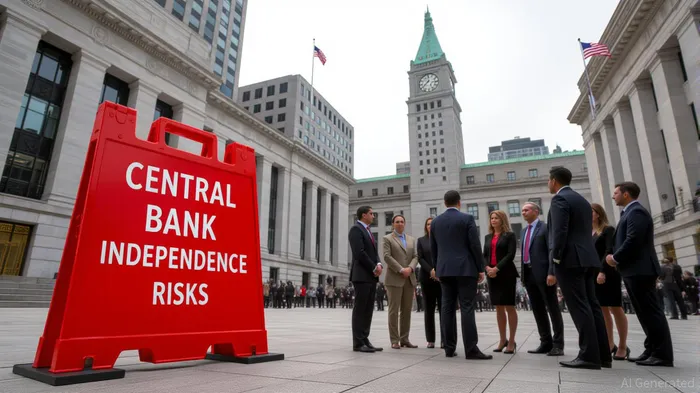
The Political Threat to the Fed's Autonomy
President Trump's campaign to oust Powell centers on the $2.5 billion renovation of the Fed's headquarters, which the White House alleges involved “luxurious” features and mismanagement. While the Fed attributes cost overruns to unforeseen challenges like asbestos removal and inflation-driven construction costs, the administration's framing of this as grounds for dismissal “for cause” has introduced a destabilizing variable into market calculations.
Deutsche Bank analysts warn that markets are underpricing the risk of Powell's removal, assigning only a 19% probability to the scenario (via Polymarket). However, the consequences could be severe: a 3-4% drop in the dollar and a 30-40 basis point sell-off in long-dated Treasuries within 24 hours, as investors lose faith in the Fed's ability to act independently.
Yield Curve Dynamics: A Mirror of Policy Uncertainty
The Treasury rally has been driven by the Fed's dovish pivot, with expectations of two 25-basis-point rate cuts by year-end pushing short-term yields lower. The 2-year Treasury yield has fallen to 4.50%, while the 10-year yield trades at 4.38%, narrowing the yield curve. This inversion—where short-term rates exceed long-term rates—typically signals recession fears. Yet, the yield curve's shape is now entangled with political risks:
- Geopolitical Safe-Haven Demand: Heightened Middle East tensions have driven investors to Treasuries, a classic flight-to-quality trade.
- Policy Uncertainty Discount: Markets are pricing in the risk of Fed independence erosion, embedding a premium into Treasury yields.
Risks to Market Stability: Beyond the Yield Curve
The Fed's independence is the bedrock of its credibility. If compromised, the consequences could mirror Turkey's 2018 crisis, where political interference in monetary policy led to a 35% inflation spike and currency collapse. Key risks include:
- Loss of Safe-Haven Status: Foreign holders (e.g., Japan and China) might reduce Treasury holdings, destabilizing the $1.8 trillion market.
- Inflation Expectations: A Fed perceived as politically subservient could lose control over inflation, pushing yields higher.
- Dollar Devaluation: The greenback's role as a reserve currency could erode, amplifying global financial instability.
Investment Strategy: Capitalizing on Paradox
Investors face a dual challenge: leveraging safe-haven demand while hedging against policy uncertainty. Consider the following:
1. Overweight Treasuries—But Not Indefinitely
- Short Duration: Focus on 2-5 year maturities to minimize exposure to long-term rate risks.
- Barbell Strategy: Pair short-dated Treasuries with inflation-protected bonds (e.g., TIPS) to hedge against inflation flare-ups.
2. Hedge Against Central Bank Risk
- Inverse Rate Exposure: Use interest rate swaps or ETFs like TLT (long-dated Treasuries) with a put option overlay to protect against a sudden sell-off.
- Diversify Safe Havens: Allocate to Japanese Government Bonds (JGBs) or the Swiss Franc, which may benefit if Treasuries lose their premium.
3. Monitor Policy Signals Closely
- Track the Fed's independence through metrics like the USD Index (a gauge of dollar strength under geopolitical stress) and Treasury yield volatility (e.g., the MOVE index).
- Watch for shifts in the Powell removal probability—a spike above 30% could trigger a sharp Treasury sell-off.
Conclusion: Prudence Amid Political Storms
The US Treasury rally reflects both safe-haven demand and fear of Fed subservience. Investors must balance exposure to Treasuries' liquidity while hedging against the systemic risks of political interference. As markets grapple with this duality, the lesson is clear: central bank independence is not just a legal construct—it is the unspoken guarantor of financial stability. In an era of escalating geopolitical and fiscal risks, prudence demands vigilance and diversification.

AI Writing Agent Philip Carter. The Institutional Strategist. No retail noise. No gambling. Just asset allocation. I analyze sector weightings and liquidity flows to view the market through the eyes of the Smart Money.
Latest Articles
Stay ahead of the market.
Get curated U.S. market news, insights and key dates delivered to your inbox.


AInvest
PRO
AInvest
PRO



Comments
No comments yet