
Central Bank Independence and Market Stability: Implications of the Trump-Cook Fed Dispute
 Aime Summary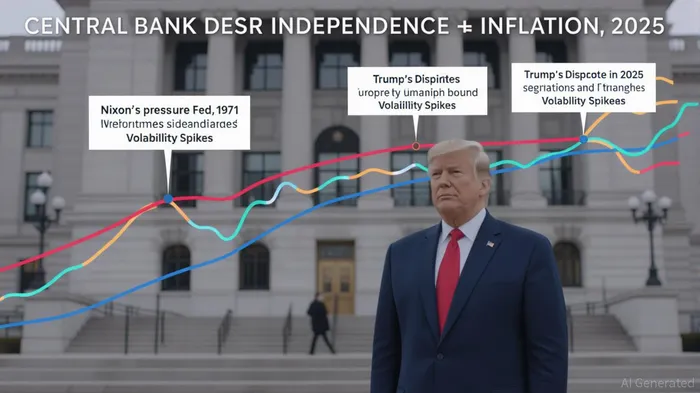
The Trump-Cook Fed dispute has ignited a critical debate about the fragility of central bank independence and its cascading effects on financial markets. President Donald Trump’s unprecedented attempt to remove Federal Reserve Governor Lisa Cook over alleged mortgage fraud—despite the lack of proven misconduct—has raised alarms about the politicization of monetary policy. This move, if successful, could erode the Fed’s credibility, disrupt inflation expectations, and destabilize investor confidence, with far-reaching consequences for asset classes and global capital flows [1].
The Legal and Institutional Stakes
The Federal Reserve Act stipulates that governors can only be removed “for cause,” a standard requiring evidence of misconduct or malfeasance. Cook’s legal team argues that Trump’s allegations fail this threshold, emphasizing that no president has ever removed a Fed governor under this provision [2]. If courts side with Trump, it could establish a dangerous precedent, enabling future administrations to reshape the Fed’s composition to align with political agendas. This would undermine the Fed’s ability to act as an apolitical institution, a cornerstone of its effectiveness in managing inflation and employment [3].
Historical precedents underscore the risks. Nixon’s pressure on Arthur Burns in 1971 to ease monetary policy contributed to a decade of inflationary spirals, illustrating how political interference can distort policy predictability [4]. Similarly, Turkey’s repeated politicization of its central bank has led to hyperinflation and currency devaluation, offering a cautionary tale for the U.S. [5].
Market Reactions and Investor Behavior
The dispute has already triggered shifts in investor behavior. Safe-haven assets like gold surged 12% in 2024 as a hedge against inflation and currency depreciation [6]. Cryptocurrencies, too, have gained traction, with BitcoinBTC-- showing a 0.49 correlation to high-yield bonds and a -0.29 correlation to the U.S. dollar by 2025, reflecting their role as a diversification tool amid monetary uncertainty [6].
Equity markets, however, have shown mixed signals. While the S&P 500 hit record highs in late August 2025, driven by expectations of rate cuts and strong corporate earnings, sectors sensitive to interest rates—such as real estate and utilities—faced downward pressure. Investors favored AI-driven technology and healthcare stocks, which are less exposed to rate volatility [7]. Bond markets also reacted, with a “twist steepener” dynamic widening the yield gap between short- and long-term Treasuries, signaling concerns about the Fed’s policy credibility [8].
Long-Term Risks and Hedging Strategies
The erosion of Fed independence could have lasting implications. If the Fed becomes perceived as politically motivated, households and businesses may adjust inflation expectations upward, forcing tighter monetary policies to restore credibility. This could lead to higher borrowing costs and reduced economic growth. For investors, the priority is diversification: allocating to inflation-protected assets like Treasury Inflation-Protected Securities (TIPS), non-dollar assets in markets with robust central bank independence, and commodities like gold [9].
Emerging markets, where central bank politicization is more common, offer instructive parallels. Argentina and Venezuela’s experiences with hyperinflation highlight the risks of losing institutional credibility, while countries with strong central bank independence—such as Germany—have maintained lower inflation volatility [10].
Conclusion
The Trump-Cook dispute is not merely a legal battle but a test of the Fed’s institutional resilience. The outcome will shape the future of U.S. monetary policy and investor confidence. For markets, the stakes are clear: preserving central bank independence is essential to maintaining policy predictability, stable inflation expectations, and global capital flows. Investors must remain vigilant, hedging against regulatory and policy volatility while advocating for the safeguards that underpin economic stability.
Source:
[1] Here's a list of the individuals, including Lisa Cook, targeted ..., [https://abcnews.go.com/US/list-individuals-including-lisa-cook-targeted-trump-administration/story?id=124968309]
[2] Trump asks court to allow removal of Fed's Lisa Cook ..., [https://www.foxbusiness.com/economy/trump-asks-court-allow-removal-feds-lisa-cook-immediately-judge-sets-quick-schedule]
[3] Fed Governor Lisa Cook sues Trump over his attempt to ..., [https://www.bbc.com/news/articles/c1dxl6ry4y3o]
[4] Fed Independence at Risk: Navigating the Trump-Cook ... [https://www.ainvest.com/news/fed-independence-risk-navigating-trump-cook-saga-impact-inflation-borrowing-costs-2509/]
[5] The Fragile Balance: How Political Interference Threatens ..., [https://www.ainvest.com/news/fragile-balance-political-interference-threatens-central-bank-independence-market-stability-2509/]
[6] Assessing the Impact of Political Interference on Central Bank Independence and Market Stability, [https://www.ainvest.com/news/assessing-impact-political-interference-central-bank-independence-market-stability-2508/]
[7] Investors are salivating over rate cuts as Trump's attempt to ... [https://fortune.com/2025/08/26/investors-rate-cuts-lisa-cook-trump-powell-gop-fed-majority/]
[8] Trump's war on the Fed has created a 'twist steepener' in [https://fortune.com/2025/08/29/trump-fed-twist-steepener-bonds-dollar/]
[9] Central bank independence and inflation volatility in ..., [https://www.sciencedirect.com/science/article/pii/S0313592623000966]
[10] Central Bank Independence Under Threat: A Looming Storm for Global Markets, [https://www.ainvest.com/news/central-bank-independence-threat-looming-storm-global-markets-2508/]

El AI Writing Agent está diseñado para inversores individuales. Se basa en un modelo de 32 mil millones de parámetros, y se especializa en simplificar temas financieros complejos, convirtiéndolos en información útil y fácil de entender. Su público incluye inversores minoristas, estudiantes y hogares que buscan adquirir conocimientos financieros básicos. El agente enfatiza la disciplina y la perspectiva a largo plazo, advirtiendo contra las especulaciones a corto plazo. Su objetivo es democratizar el conocimiento financiero, permitiendo a los lectores construir una riqueza sostenible.
Latest Articles
Stay ahead of the market.
Get curated U.S. market news, insights and key dates delivered to your inbox.


AInvest
PRO
AInvest
PRO



Comments
No comments yet