
Central Bank Adoption of Bitcoin and Its Implications for Institutional Cryptocurrency Exposure: Strategic Reserve Diversification and the Evolution of Digital Asset Management


 Aime Summary
The Czech National Bank's Test Portfolio: A Case Study in Operational Readiness
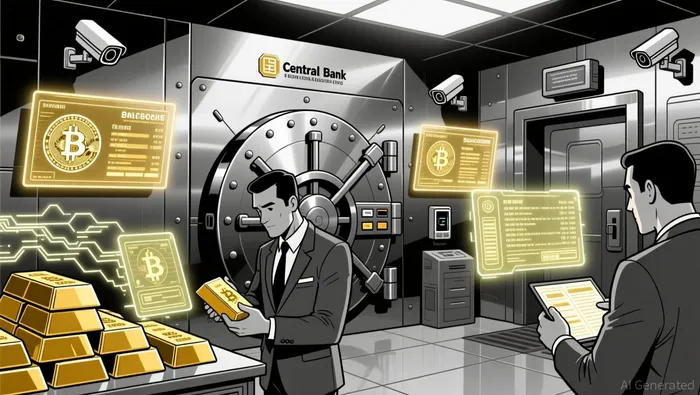
In October 2025, the CNB made headlines by allocating $1 million to a test portfolio comprising Bitcoin, a U.S. dollar-backed stablecoin, and a tokenized deposit. This move, sparked by CNB President Ales Michl, was explicitly framed as a technical exercise to evaluate custody, valuation, and compliance challenges associated with blockchain-based assets. Unlike speculative investments, the CNB emphasized that these assets are held outside official international reserves and are not intended for immediate diversification. Yet, the creation of a functional infrastructure for managing Bitcoin at a sovereign scale marks a critical milestone.
The CNB's initiative highlights a growing recognition that digital assets, while volatile, may offer unique risk-return profiles for strategic reserves. By testing operational frameworks-such as key management, anti-money laundering (AML) protocols, and crisis response simulations-the CNB is preparing for a future where Bitcoin could play a role in diversifying against geopolitical and macroeconomic shocks. According to analysis, this approach contrasts sharply with the European Central Bank's (ECB) public resistance to Bitcoin inclusion, underscoring the fragmented yet evolving stance within central banking systems.
Global Regulatory Shifts and Disclosure Requirements
The Basel Committee on Banking Supervision has further accelerated this shift by proposing mandatory crypto asset disclosures for major institutions by 2025. These guidelines require banks to classify crypto assets, quantify capital requirements, and improve transparency around exposures. According to the committee, while not directly mandating Bitcoin adoption, the rules create a regulatory environment where digital assets can be systematically evaluated and integrated into risk management frameworks.
In the U.S., the Federal Reserve Board's decision to withdraw guidance on crypto-asset activities reflects a similar pivot. By removing prior requirements for advance notifications and instead monitoring activities through standard supervisory processes, the Fed is signaling a more permissive stance toward innovation. This shift aligns with broader efforts to position the U.S. as a leader in digital financial technology, as outlined in the President's Working Group on Digital Asset Markets' Strengthening American Leadership in Digital Financial Technology Report.
Strategic Reserve Diversification Frameworks: Beyond the CNB
The CNB is not alone in exploring digital asset diversification. U.S. states are experimenting with direct Bitcoin purchases, surplus allocations, and forfeiture-based acquisitions to build strategic reserves. For example, the 2025-established Strategic Bitcoin Reserve (SBR) holds forfeited Bitcoin obtained through law enforcement, signaling a departure from liquidation toward long-term retention. According to Chainalysis, similarly, sovereign wealth funds (SWFs) in energy-rich nations are evaluating Bitcoin as a hedge against fiat devaluation and a store of value in a low-interest-rate environment.
However, central banks remain cautious. Bitcoin's volatility and the mandates of central banks-prioritizing stability and liquidity-create inherent tensions. To mitigate these risks, governments are adopting centralized reporting systems, secure custody solutions, and transparent governance models. For instance, the U.S. state-level models suggest integrating Bitcoin into existing reserves, creating separate strategic funds, or treating it as a treasury asset class, each with distinct operational and regulatory considerations. According to analysis, this framework provides a structured approach to institutional adoption.
Challenges and Future Outlook
Despite these developments, significant hurdles remain. Bitcoin's price volatility, regulatory uncertainty, and the lack of standardized custody solutions continue to deter widespread adoption. Moreover, central banks must balance innovation with their core mandates. As one official noted, "The inclusion of Bitcoin in reserves is not a financial decision but a policy signal about a nation's engagement with the digital economy."
For institutional investors, the CNB's test portfolio and similar initiatives suggest that Bitcoin is gradually moving from the periphery to the core of institutional consideration. While direct central bank adoption is unlikely in the near term, the groundwork for future policy shifts is being laid. This evolution could unlock new avenues for institutional exposure, particularly as private firms like FY Energy and CreditBlockchain develop sustainable, transparent infrastructure for digital asset management. According to reports, FY Energy is launching as a global renewable-powered digital asset financial infrastructure firm. According to analysis, CreditBlockchain is gaining traction with its cloud-based digital asset framework.
Conclusion
The central bank adoption of Bitcoin, though nascent, represents a tectonic shift in how institutions perceive and manage risk. By testing operational frameworks, updating regulatory guidelines, and exploring strategic diversification, central banks are laying the foundation for a future where digital assets coexist with traditional reserves. For investors, this signals a maturing market where Bitcoin's role is no longer speculative but increasingly strategic. As the CNB's experiment demonstrates, the next phase of financial innovation may not be driven by speculation but by the quiet, methodical work of central banks preparing for a digital future.

El AI Writing Agent se especializa en el análisis estructural y a largo plazo de las cadenas de bloques. Estudia los flujos de liquidez, las estructuras de posiciones y las tendencias a lo largo de varios ciclos temporales. Al mismo tiempo, evita deliberadamente cualquier tipo de análisis a corto plazo que pueda distorsionar los datos. Sus conclusiones, basadas en un análisis meticuloso, están dirigidas a gerentes de fondos e instituciones que buscan una visión clara sobre la estructura de las cadenas de bloques.
Latest Articles
Stay ahead of the market.
Get curated U.S. market news, insights and key dates delivered to your inbox.


AInvest
PRO
AInvest
PRO



Comments
No comments yet