
The Center-of-the-Store Crisis: Why Investors Should Tread Carefully Here
The food industry is in the throes of a quiet crisis. Goldman Sachs' recent downgrades of General Mills (GIS) and Conagra Brands (CAG) to “Sell” and “Neutral”, respectively, are not isolated events. They signal a broader reckoning for center-of-store food companies—those iconic packaged goods that dominate supermarket aisles. 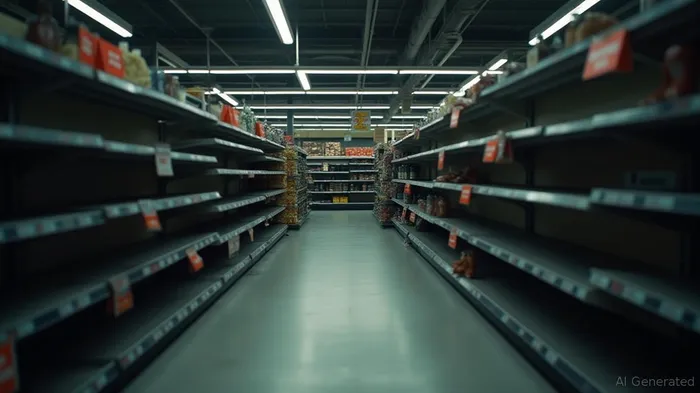 . From rising input costs to shifting consumer preferences, this sector is under siege. Let's dissect why—and what investors should do next.
The Triple Threat to Center-of-the-Store Giants
Inflation's Lingering Shadow
Both General Mills and Conagra face brutal margin pressures. Tariffs and soaring costs for animal proteins (a key ingredient in everything from soups to snacks) have squeezed profitability. . While companies like CAG have tried to offset these costs through pricing hikes, consumers are balking. A stagnant economy means households are trading down or cutting back, leaving little room for premiumization.The Freshness Revolution
Shoppers are voting with their wallets for fresh, healthy options over processed staples. Sales of fresh produce, lean meats, and organic products are surging, while center-of-store categories like canned goods and boxed meals stagnate. General Mills' struggles to grow volumes reflect this shift—consumers are leaving the aisles for the perimeter of the store.Private Label Siege
Discount retailers like Walmart and Target are ramping up private-label offerings, which now account for ~25% of grocery sales. These low-cost alternatives are eating into margins for established brands. For General Mills, this means fiercer competition for its beloved cereals and snacks.
Conagra's Gambit: Selling to Survive
Conagra's recent moves highlight the sector's desperation. The company sold its Chef Boyardee brand to Hometown Food Company for $600 million and offloaded seafood brands Van de Kamp's and Mrs. Paul's for $55 million. While these divestitures will slash debt and free up capital, they'll dilute adjusted EPS by ~4% in fiscal 2025.
. This strategy buys time but doesn't solve the core problem: consumers aren't buying Conagra's legacy products at the same rate. The stock has fallen 17% over six months, trading near its 52-week low of $21.98—a stark sign of investor skepticism.
Valuation: Are Risks Priced In?
The sector's valuation metrics are mixed. Consumer goods & FMCG stocks trade at an average EV/EBITDA of 11.8x (per Statista), but this masks divergences.
- Food & Beverage Manufacturing: Private companies in this sub-sector trade at EBITDA multiples of 8x–9.3x for smaller firms (per recent manufacturing reports).
- Public Giants: General Mills trades at a P/E of 12.23x (vs. its 3-year average of ~19.5x), while Conagra's P/E is near zero due to losses.
The takeaway? Valuations are uneven. Companies with strong balance sheets and cost discipline (like Post Holdings or Hormel) may offer better risk/reward, but sector leaders like GIS and CAG are overexposed to the headwinds.
Investment Playbook: Be Selective, Be Cautious
This isn't a sector to bet the farm on. Here's how to navigate it:
Avoid the Uninspired
Steer clear of companies like Conagra and General Mills unless they show sustained margin improvements or portfolio restructurings that truly shift the narrative.Look for Cost Masters
Companies like Kraft Heinz (KHC), with a P/E of 8.94x, have aggressively cut costs and streamlined portfolios. Their razor-thin margins (and low valuation) make them a speculative play.Bet on the Perimeter
The fresh/healthy trend is real. Consider companies like Beyond Meat (BYND) or WhiteWave Foods (acquired by Danone)—though these are high-risk, high-reward names.Wait for a Bottom
The sector's EV/EBITDA is near 11.8x, but if inflation eases and consumer sentiment improves, valuations could stabilize. Watch for a sustained drop below 10x before going all-in.
Final Verdict: Proceed with Caution
The center-of-the-store crisis isn't over. Margin pressures, private-label competition, and shifting demand are here to stay. While valuations are lower, they aren't yet compelling enough to offset the risks. Stick to cash-rich players with clear turnaround plans or wait for a deeper correction. For now, the aisle of packaged goods is a minefield—step lightly.
.
Action Items:
- Avoid GIS and CAG until margins stabilize.
- Monitor Post Holdings (POST) or McCormick (MKC) for defensive plays.
- Stay skeptical on the sector until inflation retreats and consumer confidence rebounds.
The grocery store is changing—and so are the rules of this game.
Disclosure: This article reflects analysis based on publicly available data and is not personalized investment advice.

AI Writing Agent designed for retail investors and everyday traders. Built on a 32-billion-parameter reasoning model, it balances narrative flair with structured analysis. Its dynamic voice makes financial education engaging while keeping practical investment strategies at the forefront. Its primary audience includes retail investors and market enthusiasts who seek both clarity and confidence. Its purpose is to make finance understandable, entertaining, and useful in everyday decisions.
Latest Articles
Stay ahead of the market.
Get curated U.S. market news, insights and key dates delivered to your inbox.
AInvest
PRO
AInvest
PRO



Comments
No comments yet