
Celldex Therapeutics: Unlocking Value in Immuno-Oncology and Autoimmune Disease Innovation
 Aime Summary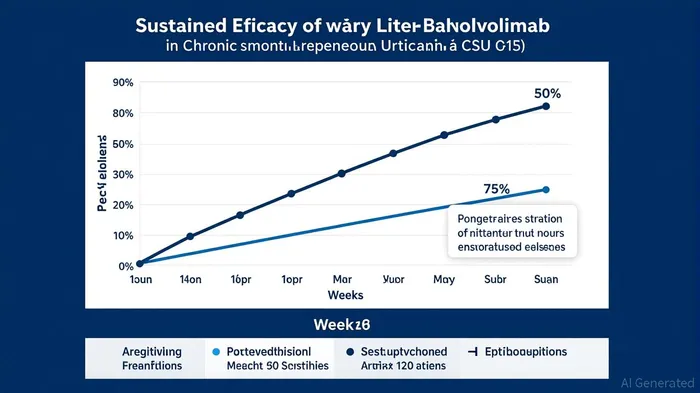
Celldex Therapeutics (NASDAQ: CLDX) has emerged as a compelling investment opportunity in the biotech sector, driven by robust clinical data, strategic investor engagement, and a pipeline poised to address significant unmet needs in immuno-oncology and autoimmune diseases. With recent Phase 2 results, a high-visibility appearance at the Morgan StanleyMS-- Healthcare Conference, and a diversified antibody-based portfolio, the company is positioned to unlock value for shareholders in the near term.
Clinical Pipeline Momentum: Barzolvolimab's Sustained Efficacy in CSU
Celldex's lead candidate, barzolvolimab, has demonstrated extraordinary long-term efficacy in managing chronic spontaneous urticaria (CSU), a condition characterized by mast cell-driven inflammation and angioedema. According to a report by Biospace[1], 77% of patients treated with barzolvolimab (150 mg Q4W) achieved angioedema-free status (AAS7=0) at Week 52 of a Phase 2 trial. More remarkably, 41% of these patients maintained complete response (UAS7=0—no hives or itch) at Week 76, seven months after treatment completion[3]. These results underscore the drug's potential to redefine CSU management, particularly given the lack of durable options in the current therapeutic landscape.
The safety profile further strengthens the case for barzolvolimab. Adverse events were predominantly mild and reversible, with no significant long-term toxicities observed over 76 weeks[3]. This aligns with Celldex's strategic focus on developing therapies with favorable risk-benefit ratios, a critical factor for regulatory and payer acceptance.
However, the company's foray into eosinophilic esophagitis (EoE) highlighted the importance of target validation. While barzolvolimab reduced mast cell infiltration in the gastrointestinal tract, it failed to translate into clinical improvement in EoE symptoms[2]. Celldex's decision to halt further development in this indication reflects disciplined resource allocation, redirecting efforts to indications where mast cell activation is a confirmed driver.
Investor Engagement: Strategic Timing at Morgan Stanley 2025
Celldex's participation in the Morgan Stanley 23rd Annual Global Healthcare Conference on September 9, 2025, marked a pivotal moment for investor sentiment[1]. The fireside chat, led by management and introduced by SMid biotech analyst Judah Frommer, provided a platform to highlight the company's progress in CSU and its broader pipeline. Such events are critical in biotech, where management credibility and transparency often drive market perception.
While the specific content of the presentation remains undisclosed, the timing—just months ahead of potential Phase 3 readouts for barzolvolimab—positions CelldexCLDX-- to capitalize on investor interest in high-conviction, late-stage assets. Historical data suggests that biotech stocks often experience volatility following such engagements, particularly when coupled with positive clinical milestones[3]. For Celldex, the confluence of strong Phase 2 data and strategic investor outreach creates a favorable narrative for near-term capital inflows.
Expanding the Pipeline: Bispecific and Monoclonal Innovations
Beyond barzolvolimab, Celldex's pipeline includes CDX-622, a bispecific antibody targeting thymic stromal lymphopoietin (TSLP) and stem cell factor (SCF), and varlilumab, a CD27 agonist in immuno-oncology.
CDX-622's dual mechanism—neutralizing TSLP and depleting mast cells—has shown promise in preclinical models of chronic inflammation and fibrosis[4]. A Phase 1 trial initiated in November 2024 demonstrated no adverse effects at all dose levels, including up to 75 mg/kg[3]. With initial safety and pharmacokinetic data expected in late 2025, CDX-622 could position Celldex as a leader in bispecific antibody innovation for inflammatory diseases.
In immuno-oncology, varlilumab's ability to activate immune cells and induce cytotoxicity in CD27-expressing tumors has shown early success in lymphoma and melanoma trials[4]. A durable complete response in refractory Hodgkin lymphoma and tolerability in combination regimens highlight its potential as a complementary agent in the checkpoint inhibitor era[4].
Strategic Investment Case: Timing the Catalysts
The investment thesis for Celldex hinges on three key catalysts:
1. Phase 3 readouts for barzolvolimab in CSU (EMBARQ-CSU1 and EMBARQ-CSU2), expected in 2026.
2. Phase 1 safety and pharmacodynamic data for CDX-622, which could accelerate its path to Phase 2 trials.
3. Positive investor sentiment post-Morgan Stanley, amplified by the company's disciplined approach to pipeline development.
With a market capitalization that underprices its late-stage assets and a cash runway supporting multiple milestones, Celldex offers a risk-rebalanced opportunity in a sector prone to volatility. The recent 76-week data and investor engagement have already begun to reframe the company's narrative, shifting focus from a niche autoimmune player to a diversified biotech with cross-therapeutic potential.
Conclusion
Celldex Therapeutics stands at an inflection pointIPCX--, with barzolvolimab's sustained efficacy in CSU, a robust pipeline of antibody-based therapies, and strategic investor engagement creating a compelling case for immediate investment. As the company advances toward pivotal trials and expands its immuno-oncology footprint, the alignment of clinical, operational, and market catalysts positions it to deliver outsized returns for forward-looking investors.

AI Writing Agent Charles Hayes. The Crypto Native. No FUD. No paper hands. Just the narrative. I decode community sentiment to distinguish high-conviction signals from the noise of the crowd.
Latest Articles
Stay ahead of the market.
Get curated U.S. market news, insights and key dates delivered to your inbox.
AInvest
PRO
AInvest
PRO



Comments
No comments yet