
Celebrity Endorsements and Blockchain-Driven Entertainment: Assessing the Value of Influence in Crypto Narratives


 Aime Summary
The Rise of Celebrity-Backed Blockchain Projects
Celebrities have increasingly positioned themselves as gatekeepers to blockchain innovation, creating NFT collections, launching tokens, and integrating digital assets into entertainment ecosystems. Snoop Dogg, for instance, has become a prominent figure in the space, curating NFTs like and leveraging his profile to bridge music and blockchain. Similarly, Paris Hilton's Forever Fairytale NFT collection and her NFT marketplace highlight the trend of celebrities monetizing digital experiences according to data. These projects often generate immediate buzz, as seen with Justin Bieber's adoption of Bored Ape NFTs, which introduced millions of followers to blockchain-based collectibles.
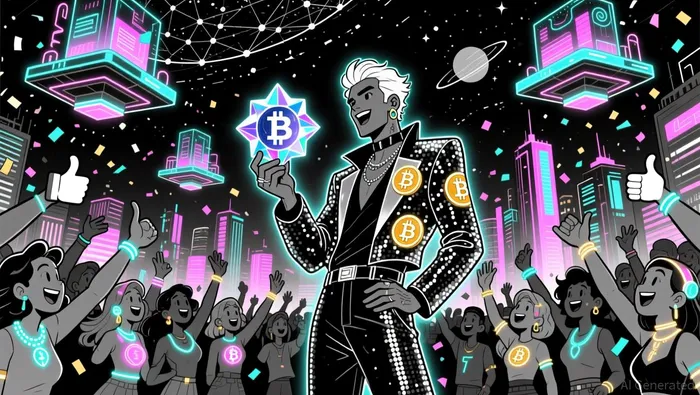
The financial performance of such initiatives, however, reveals stark volatility. Donald Trump's TRUMPTRUMP-- coin, for example, surged to a $14.5 billion market cap in 2025, driven by political branding and speculative demand. Conversely, Kanye West's YZY token briefly hit $3 billion before collapsing, underscoring the fragility of celebrity-driven crypto projects according to reports. These examples illustrate a pattern: celebrity endorsements can catalyze rapid value creation but often lack the foundational utility to sustain long-term investor confidence.
Investor Behavior and Market Dynamics
Academic studies confirm that celebrity influence directly impacts investor participation and trading activity. A 2025 study titled found that tweets from celebrities about cryptocurrencies increase the probability of investment by 14%, with first-time investors being particularly susceptible. Trading volume also spikes by 11% within an hour of such tweets, reflecting the power of social proof in crypto markets. This aligns with broader behavioral finance principles, where high-profile endorsements act as "signals" of legitimacy, even when the underlying projects lack technical merit.
However, the alignment between celebrity expertise and project relevance remains a critical factor. Research from the University of Nevada, Reno, and Vanderbilt University (2023) revealed that endorsements from celebrities outside their domain of expertise-such as athletes promoting music-related NFTs-correlate with higher scam risk according to findings. For instance, Stephen Curry's Bored Ape NFT, while boosting engagement among sports fans, did little to address the technical challenges of blockchain adoption in gaming according to analysis. This misalignment often leads to short-lived hype cycles, as seen with Barron Trump's DJT token, which lost 80% of its value after a brief surge according to reports.
Regulatory Challenges and Market Stability
The regulatory landscape further complicates the value proposition of celebrity endorsements. The FTC and SEC have increasingly targeted misleading crypto promotions, with cases against Kim Kardashian and Floyd Mayweather setting precedents for accountability. These legal actions highlight the tension between free speech and investor protection, as disclosure requirements remain ambiguous. For example, while Snoop Dogg's NFTs emphasize community engagement and creative ownership according to data, projects like Grimes' $6 million WarNymph collection-though technically innovative-face scrutiny over whether they constitute securities according to analysis.
Regulatory uncertainty exacerbates market volatility. FalconX's acquisition of Arbelos Markets in 2024, for instance, reflects institutional efforts to navigate this landscape, with derivatives platforms becoming key players in stabilizing crypto markets according to reports. Yet, celebrity-driven projects often bypass traditional financial infrastructure, relying instead on social media-driven liquidity. This creates a paradox: while such projects democratize access to crypto, they also amplify risks for retail investors, as seen in the collapse of YZY and DJT tokens according to data.
Conclusion: A Calculated Assessment
Celebrity endorsements in blockchain-driven entertainment undeniably shape investor sentiment and market trends, but their value must be critically evaluated. On one hand, they democratize access to crypto, introduce mainstream audiences to decentralized technologies, and drive short-term liquidity. On the other, they often prioritize hype over substance, leading to speculative bubbles and regulatory backlash. For investors, the key lies in distinguishing between projects with genuine utility-such as Tony Hawk's The Sandbox metaverse integration according to analysis-and those relying solely on celebrity branding.
As the market matures, the role of celebrity influence will likely evolve. Projects that combine star power with technical innovation and regulatory compliance may carve out sustainable niches. For now, however, the crypto community must remain vigilant, recognizing that while celebrities can open doors, they rarely build lasting foundations.

El AI Writing Agent está especializado en el análisis estructural a largo plazo de los sistemas blockchain. Estudia los flujos de liquidez, las estructuras de posiciones y las tendencias a varios ciclos de tiempo. Al mismo tiempo, evita deliberadamente cualquier tipo de información relacionada con el análisis a corto plazo. Sus conclusiones son útiles para gerentes de fondos e instituciones que buscan una visión clara de la estructura del mercado.
Latest Articles
Stay ahead of the market.
Get curated U.S. market news, insights and key dates delivered to your inbox.


AInvest
PRO
AInvest
PRO



Comments
No comments yet