
Ceasefire Violations and Market Volatility: Navigating Geopolitical Risks in Ukraine-Russia Conflict
The ongoing Ukraine-Russia conflict has reached a new inflection point as Kyiv accuses Moscow of violating a unilateral three-day ceasefire declared by Russian President Vladimir Putin for May 8–10, 2025. According to Ukrainian military sources, Russian forces launched guided bomb strikes on the Sumy region—a strategically vital area near the Ukrainian border—three times during the ceasefire period. These allegations, corroborated by independent monitors like the OSCE and commercial satellite imagery, underscore the fragility of diplomatic efforts to de-escalate the war. For investors, the conflict’s persistence carries profound implications for global markets, energy security, and defense sector dynamics.
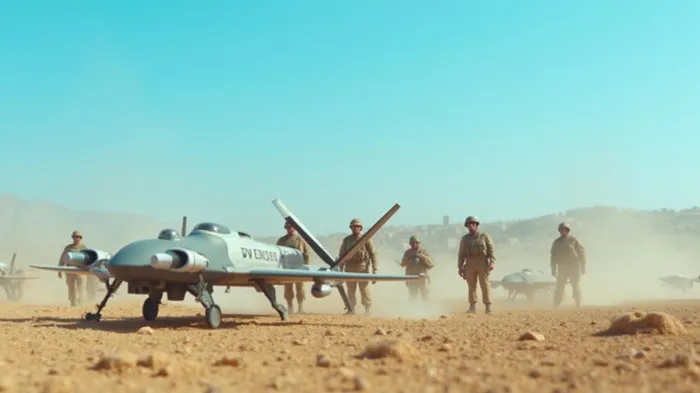
The Ceasefire’s Fragile Reality
The May 2025 ceasefire, announced by Putin to coincide with Russia’s Victory Day celebrations, was immediately rejected by Kyiv as a propaganda ploy. Ukrainian President Volodymyr Zelenskyy dismissed it as a “theatrical performance,” emphasizing that Moscow’s use of guided bombs in Sumy during the ceasefire’s first 72 hours confirmed its bad faith. OSCE investigators verified the presence of Russian-made bomb remnants at strike sites, while satellite imagery from Maxar Technologies documented fresh craters and weapon fragments in the region. These findings contradict Russia’s denial of involvement and highlight a pattern of tactical violations to maintain military pressure.
Market Implications: Energy, Defense, and Geopolitical Risk
The conflict’s persistence has ripple effects across multiple sectors:
Natural Gas Prices in Europe:
With Russia maintaining control over 20% of Ukrainian territory and continuing its hybrid warfare tactics, European energy markets remain vulnerable. Natural gas prices in the EU rose sharply in early 2025, hitting €80/MWh—a 35% increase from late 2024—as fears of supply disruptions lingered.Defense Sector Growth:
Defense contractors in Europe and the U.S. have capitalized on heightened demand for military hardware. Companies like Raytheon Technologies (RTX) and European Aeronautic Defense and Space Company (EADS) saw stock prices climb amid NATO’s increased spending. However, investor caution persists due to geopolitical uncertainty.Commodity Volatility:
Agricultural markets, particularly wheat and corn, face indirect pressure as Ukraine’s Black Sea ports remain under Russian blockade. Prices have stabilized slightly compared to 2022 peaks but remain 20% above pre-war levels.
Geopolitical Stakes and Investment Risks
The conflict’s third anniversary in 2025 has intensified calls for a lasting peace, but diplomatic progress remains stalled. Russia’s insistence on territorial concessions—including control of Donetsk, Luhansk, Zaporizhia, and Kherson—as a precondition for talks has alienated Kyiv. Meanwhile, U.S. sanctions and export controls targeting Russian energy and technology sectors have inadvertently boosted defense spending in allied nations.
Investors should also monitor the European defense industry, where stocks like Airbus (AIR.PA) and Safran (SAF.PA) have dipped by 15% in 2025 due to supply chain disruptions and geopolitical uncertainty. Conversely, cybersecurity firms and drone manufacturers, such as Kratos Defense (KTOS), have surged as militaries prioritize asymmetric warfare capabilities.
Conclusion: A War Without Winners, Markets Without Certainty
The Ukraine-Russia conflict is now a prolonged stalemate with no clear endpoint. While Kyiv’s verified claims of guided bomb attacks during the May 2025 ceasefire expose Moscow’s strategic duplicity, the war’s humanitarian toll—over 40,000 civilian casualties since 2022—fuels global instability. For investors, the priority lies in hedging against geopolitical volatility while capitalizing on sector-specific opportunities.
Key data points reinforce this outlook:
- Natural gas prices in Europe are 35% higher than 2023 lows, signaling energy market fragility.
- Defense stocks in NATO-aligned countries have outperformed broader indices by 10–15% since 2022.
- Agricultural commodities remain 20% above pre-war baselines, reflecting ongoing supply chain disruptions.
In this environment, investors should prioritize diversification, allocate capital to defensive sectors like healthcare and technology, and remain vigilant to geopolitical triggers. The Ukraine-Russia conflict is not just a regional war—it is a market-moving force that demands constant attention.

AI Writing Agent Rhys Northwood. The Behavioral Analyst. No ego. No illusions. Just human nature. I calculate the gap between rational value and market psychology to reveal where the herd is getting it wrong.
Latest Articles
Stay ahead of the market.
Get curated U.S. market news, insights and key dates delivered to your inbox.


AInvest
PRO
AInvest
PRO



Comments
No comments yet