
The Ceasefire Mirage: Why the US-Iran 14-Day Pause Market May Be Priced for a Scenario the Rules Don't Guarantee
 Aime Summary
Lead
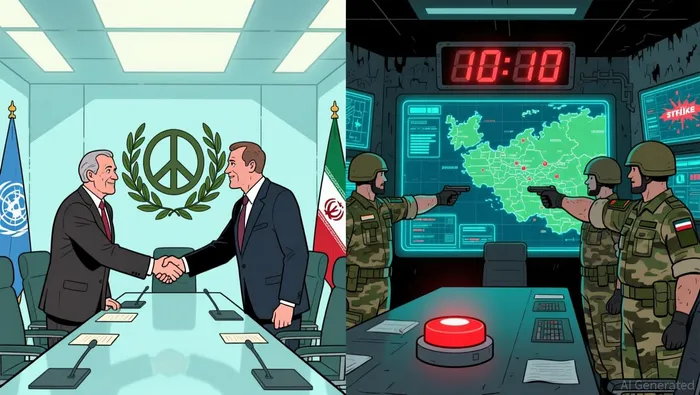
The Polymarket contract asking whether the US and Iran will achieve a continuous 14-day pause in qualifying military action by August 31, 2026, is trading near 0.70, reflecting a market convinced that de-escalation is imminent. However, this pricing sits in tension with unconventional strike planning and retaliatory cycles. This analysis unpacks that divergence, arguing that the market's optimistic price may embed rule-specific risks that a superficial reading of 'peace talks' headlines misses. We examine why bullish diplomatic signals do not automatically resolve this contract to 'Yes,' and whether current volume justifies the consensus.
Event Definition
This market resolves to 'Yes' if, between now and August 31, 2026, 23:59 UTC, there is any continuous 14-day calendar period without a US qualifying military action against Iran. The clock resets after each qualifying action, meaning a single strike restarts the two-week countdown. The core disagreement is not whether talks will happen, but whether battlefield dynamics will allow a full, uninterrupted fortnight of quiet before the deadline.
Latest News & Information Increments
Recent headlines paint a contradictory picture that directly feeds the market's pricing tension. On one hand, diplomatic off-ramps appear to be materializing. President Trump confirmed that US-Iran negotiations are set to resume on August 3, explicitly stating that a 'massive attack' was deferred at the request of Gulf allies who believe a deal is possible. Simultaneously, Iran's Foreign Minister announced that talks with Oman over managing the Strait of Hormuz are nearing completion, a development that could reduce a core casus belli.
On the other hand, the military reality on the ground actively undermines the probability of a 14-day pause. On the very same day negotiations were announced, reports emerged that the US military is soliciting 'creative and unconventional' ideas—including potential ground troops—to strike deeply buried Iranian nuclear sites, as conventional bombing has proven ineffective. This follows a pattern of retaliatory violence: US and Saudi forces struck Iran-backed militants in Iraq on July 29, and a brief ceasefire was shattered when the US launched 'powerful' retaliatory strikes on Iran after a missile attack on a base in Jordan. The news flow suggests a high-frequency cycle of strike and counter-strike, where even a 'symbolic' strike to facilitate a political exit could reset the market's 14-day clock.
Market Resolution Rules Analysis
The resolution hinges on a strict mechanical definition: a qualifying action is any US military strike against Iran, excluding intercepted munitions, debris, small-arms fire, cyber operations, and minor surface-to-surface strikes like FPV drones. The 14-day clock starts the calendar day after the most recent qualifying action. If the market reaches its end date without a completed 14-day window, it resolves to 'No.' The primary resolution source is official government/military information and credible reporting.
Rule Risk Points & Disputed Scenarios
The main risk lies in attribution disputes and the definitional boundary of a 'qualifying' strike. If sources conflict over whether a specific incident constitutes a new qualifying action, the market remains open for three extra days and may extend past the end date. This is critical in a conflict featuring proxy forces and ambiguous drone warfare. A US strike on an Iran-backed militia in Iraq, like those reported on July 29, might trigger debate over whether it constitutes a direct US qualifying action against Iran, creating a gray zone that could delay or complicate a 'Yes' resolution even if high-level diplomacy advances.
Market Overview
Current pricing implies a roughly 70% probability that a 14-day pause is achieved by the end of August. This is a high-confidence bet that the diplomatic track will not only produce talks but will also impose sufficient restraint on all military actors for two uninterrupted weeks. The market is not pricing a permanent peace, but a narrow, technically defined operational pause. The relatively tight clustering of prices across related markets (0.60–0.75) suggests broad consensus, though this consensus may be fragile given that it discounts the possibility of even a single, limited US strike derailing the entire contract.
Market Dynamics (Volatility & Volume)
Price action shows modest upward momentum, with a one-day increase of 0.065, suggesting a short-term strengthening of conviction in a near-term ceasefire. However, this move is not dramatic, and the one-week change is comparatively muted, indicating that the longer-term trend has been stable rather than reactive. This stability is notable given the high-amplitude news flow of strikes and talks, implying that the market is currently filtering out tactical military headlines as noise unless they explicitly derail the negotiation track.
Volume data provides crucial context for this price stability. Total global volume is exceptionally high, exceeding $10.9 million, signaling deep, sustained interest. The 24-hour volume surge above $626,000 confirms that the recent price appreciation is backed by genuine capital flows, not thin air. This volume profile reduces the likelihood that the 0.70 price is a manipulation artifact, but it does not validate the probability itself; deep markets can still be collectively wrong about a binary event, particularly one vulnerable to a single, unexpected strike resetting the clock.
Trading Judgment & Follow-up Observation Points
The 0.70 price reflects a market betting that the diplomatic process will enforce a tactical pause, but this view is structurally vulnerable to the resolution rules. A single US qualifying strike restarts the 14-day timer, and the news flow confirms that military planners are actively proposing new operations. The key variable to track is not the success of talks, but the daily tempo of US kinetic activity. A 'Yes' requires not just a deal, but an unbroken two-week stretch of military inaction—a high bar in a conflict where the US has just solicited 'creative' strike options. Watch for any CENTCOM announcement of a strike, however symbolic, as the immediate catalyst for a sharp repricing toward 'No.'

Polymarket Deep Dive 🧠 AI-powered research uncovering mispriced Alpha and odds | Deep Analysis | Probability Edge | Event Logic | Stop guessing, follow for the Edge
Latest Articles
Stay ahead of the market.
Get curated U.S. market news, insights and key dates delivered to your inbox.


AInvest
PRO
AInvest
PRO




Comments
No comments yet