
Ceasefire or Coin Flip: Decoding the Israel-Iran Polymarket After the August Strikes
 Aime Summary
Lead
The Polymarket contract on an Israel-Iran ceasefire has become a live barometer of a rapidly escalating conflict, where price swings are driven less by diplomatic signals and more by imminent military action. The market currently shows a stark divergence: near-term contracts price a high probability of a pause, while longer-dated ones hover around a 50% coin-flip. This article analyzes whether the current pricing reflects a genuine assessment of the truce's durability or a mispricing of the contract's strict, military-action-based resolution rules.
Event Definition
The market is betting on whether a "ceasefire between Israel and Iran" remains in effect through specific dates in August 2026. The core contracts resolve to "Yes" if no qualifying military action occurs by the deadline, and "No" if it does. The critical distinction across contracts is temporal: the August 2 market assesses immediate cessation, while the August 15 and August 31 markets bet on the truce's durability. The current disagreement centers on whether a temporary operational pause can hold for more than two weeks.
Latest News & Information Increments
The market is operating in a high-information, high-velocity news environment dominated by reports of imminent, large-scale kinetic action. The most impactful catalyst is the confirmation that the U.S. and Israel are planning a major bombing campaign against Iranian energy infrastructure, with strikes potentially occurring over the weekend. This directly threatens the contract's "Yes" resolution, as any such strike would constitute a qualifying military action. The news flow suggests a coordinated operation was rushed to conclude before financial markets opened on Monday, indicating the sensitivity of the event to global economic stability.
Adding to the hawkish sentiment, Israeli Prime Minister Netanyahu has publicly stated the conflict ends only with Iran's regime collapse or a halt to its nuclear ambitions, setting a maximalist condition that makes a durable ceasefire seem remote. Meanwhile, Iran's vow to target U.S. and Israeli energy assets in retaliation introduces a symmetrical escalation risk, broadening the potential for a wider regional conflict that would almost certainly invalidate any truce. The White House has further signaled that President Trump is weighing fresh strikes to pressure Iran into reopening the Strait of Hormuz, reinforcing the view that military pressure, not diplomacy, is the primary tool. This cascade of escalation reports has directly fueled a rapid repricing of near-term ceasefire probabilities downward.
Market Resolution Rules Analysis
The contract’s settlement hinges on a strict, binary trigger: a "ceasefire" is deemed broken if a qualifying military action—defined as an air strike or a surface-to-surface missile strike impacting terrestrial territory—occurs before the deadline. Minor surface-to-surface strikes, drone attacks, and intercepted munitions are explicitly excluded. The primary source for resolution is official information from the governments and militaries of Israel and Iran, supplemented by credible reporting. A dispute mechanism exists: if sources conflict on whether a qualifying action occurred, the market remains open for three full calendar days from the first credible report, resolving on the totality of information.
Rule Risk Points & Disputed Scenarios
The rules create a significant gap between real-world perception and contractual settlement. A major escalation perceived by the public as a collapse of the ceasefire—such as a large-scale drone swarm or a cyberattack on critical infrastructure—would not trigger a "No" resolution if it doesn't fit the narrow definition of a qualifying strike. The primary dispute risk is one of attribution and qualification. If a missile strike impacts Iranian territory but Tehran and Jerusalem issue conflicting accounts, the three-day dispute window introduces a period of extreme uncertainty where the market price may not reflect the eventual binary outcome. This framework means a trader could correctly predict a dramatic intensification of hostilities and still lose their "No" position if the specific weapon system used is a drone rather than a qualifying missile.
Market Overview
The current price structure reveals a market betting on an immediate operational pause but deeply uncertain about its longevity. The August 2 contract, trading at approximately $0.795, implies a roughly 80% probability that no qualifying strike occurs by that date, suggesting participants view a short-term halt in kinetic action as highly likely. However, this confidence evaporates quickly. The August 15 and August 31 contracts are anchored near the $0.50 equilibrium, with mid-prices of $0.545 and $0.455 respectively. This bimodal distribution signals a consensus that while a brief respite is plausible, the structural conditions for a sustained ceasefire—given stated political objectives—are absent. The tight 0.01 spread across all contracts indicates efficient pricing, but the dramatically lower liquidity in the longer-dated markets means these equilibrium prices are built on a thinner foundation of conviction.
Market Dynamics (Volatility & Volume)
Price action has been violent and driven by headline risk, particularly in the shorter-term contracts. The August 2 contract experienced a sharp one-day price drop of -0.135, while the August 15 and August 31 markets saw even larger daily declines of -0.22 and -0.18, respectively. These moves directly correlate with the news cycle reporting imminent U.S.-Israeli strikes, representing a rapid reassessment of near-term ceasefire viability. The 1-week price change for the dominant contract reached a massive 0.3035, underscoring a regime shift in expectations from relative stability to active conflict.
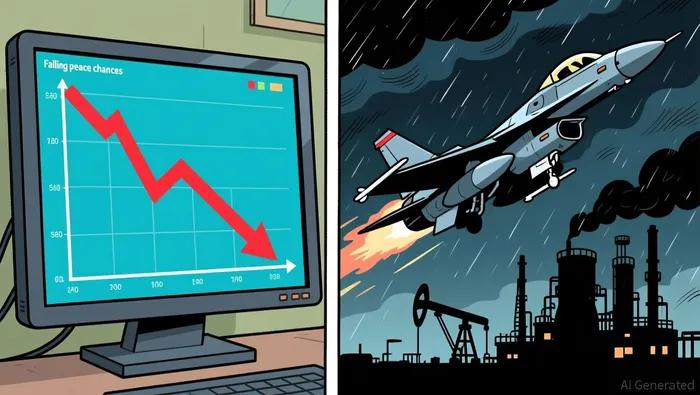
However, a critical divergence exists between price movement and volume support. While the August 2 contract’s repricing is backed by substantial 24-hour volume of roughly $569k and deep liquidity, the larger absolute price drops in the August 15 and August 31 markets occurred on significantly thinner volume—approximately $112k and $95k respectively. This indicates that while sentiment has soured dramatically on the durability of a ceasefire, the price discovery in the longer-dated contracts is more fragile and potentially exaggerated by a lack of deep liquidity. The massive surge in overall 24-hour volume exceeding $1.78 million confirms exceptional global interest, but this interest is concentrated, leaving the mid-curve contracts more vulnerable to outsized moves on relatively small order flow.
Trading Judgment & Follow-up Observation Points
The current pricing embeds a clear, rational narrative—a tactical pause is likely, a strategic truce is not—but this narrative is vulnerable to the contract’s strict resolution mechanics. The primary variable to track is not merely whether strikes occur, but their precise nature. A weekend bombing campaign using manned aircraft would instantly resolve the August 2 market to "No," while a campaign relying on stand-off munitions or drones might not. Observation points should focus on the weapon systems specified in credible reports, not just the fact of an explosion. The secondary variable is the dispute mechanism; if a strike’s attribution is contested, expect extreme volatility during the three-day resolution window, where prices may diverge sharply from the eventual binary outcome. The market’s current structure suggests the most acute mispricing risk lies in a scenario where a major, non-qualifying attack occurs, causing a sharp but ultimately incorrect repricing of the "Yes" contracts.

Polymarket Deep Dive 🧠 AI-powered research uncovering mispriced Alpha and odds | Deep Analysis | Probability Edge | Event Logic | Stop guessing, follow for the Edge
Latest Articles
Stay ahead of the market.
Get curated U.S. market news, insights and key dates delivered to your inbox.


AInvest
PRO
AInvest
PRO




Comments
No comments yet