
Ceasefire Calculus: Why the Israel-Iran Market Is Pricing Continuity Into Late August
 Aime Summary
Lead
The Polymarket contract asking whether the Israel-Iran ceasefire will continue through August 31, 2026, has surged to a mid-price near $0.80, reflecting a market that is heavily positioned for the status quo. Yet this confidence sits atop a geopolitical landscape defined by Houthi escalation, Israeli strikes on Hezbollah, and Iran’s proposal to bar U.S. and Israeli ships from the Strait of Hormuz. This article examines the information increments, resolution mechanics, and liquidity dynamics that shape the current price, separating what the market is betting on from what it might be mispricing.
Event Definition
The market asks: will the ceasefire between Israel and Iran remain in effect through 11:59 PM IRST on August 31, 2026? A “Yes” outcome requires the ceasefire to hold continuously through that time boundary. A “No” outcome is triggered by any qualifying military action before the deadline. The core disagreement is not whether tensions are rising — they are — but whether any escalation will cross the resolution threshold before the end of August.
Latest News & Information Increments
The past week has delivered a cluster of escalatory signals, yet none has fundamentally broken the market’s conviction that the ceasefire will survive the near term. Iran-backed Houthi rebels killed at least 58 Saudi-backed Yemeni government troops in missile and drone attacks, an action the Joint Forces Command described as a flagrant violation of international humanitarian law. This escalation draws Yemen deeper into the U.S.-Israeli confrontation with Iran, but the market has largely treated it as a peripheral theater that does not directly trigger the binary contract.
Meanwhile, Israel intensified attacks on Hezbollah infrastructure in southern Lebanon, accusing the militia of violating a ceasefire after two soldiers were killed. These strikes complicate U.S.-brokered diplomatic talks in Rome, though Israeli military officials acknowledge that force alone cannot achieve disarmament without a political agreement. The market’s muted response suggests participants distinguish between Israeli-Hezbollah clashes and a direct Israel-Iran military event.
On the diplomatic front, Iran proposed barring U.S. and Israeli ships from the Strait of Hormuz as part of a peace accord, a demand that would require approval from Iran’s Supreme Leader. President Trump claimed the Strait is “sort of open right now” and under U.S. control, while also asserting the U.S. has “literally massive amounts of ammunition” and an “unlimited supply” of certain munitions. These statements form part of a broader pattern: Trump’s threats and backtracks against Iran underscores the administration’s oscillation between maximum pressure and de-escalation. Senator Ted Cruz’s call to arm Iranian protesters for regime collapse further highlights the divergence between hawkish rhetoric and ongoing negotiations.
The net effect is a low-information regime for the specific binary outcome. Escalation news is abundant, but none of it constitutes a clear, attributable military action between Israel and Iran that would unambiguously resolve the contract to “No.” The market is pricing continuity precisely because the recent catalysts, while alarming, fall short of the resolution criteria.
Market Resolution Rules Analysis
The contract settles based on whether a ceasefire between Israel and Iran remains in effect through the specified time boundary. Resolution relies on official information from the governments and militaries of both countries, supplemented by credible reporting. Critically, the market does not close instantly upon a reported military action; it remains open until a consensus emerges or three full calendar days elapse from the first credible report. This delay mechanism is designed to filter out false or unverified claims, but it also introduces a window where price and ultimate settlement may diverge.
Rule Risk Points & Disputed Scenarios
Two main risks complicate straightforward interpretation of real-world events. First, conflicting reports on military actions can delay resolution, forcing the market to remain open while consensus crystallizes. A rapid exchange of strikes followed by contradictory claims could leave the contract in limbo, with price reflecting uncertainty rather than the factual state of the ceasefire. Second, ambiguity in attributing military actions to specific state actors introduces a layer of interpretation. If a strike occurs but responsibility is contested — for example, a proxy attack that Israel attributes to Iran but Iran denies — the market settles based on the consensus of available information, not on any single government’s statement. This means a real-world escalation could occur without immediately triggering a “No” resolution, creating a gap between geopolitical reality and contractual outcome.
Market Overview
At a mid-price of $0.795, the market implies roughly an 80% probability that the ceasefire holds through August 31, 2026. This is not a market hovering near maximum uncertainty; it reflects a strong directional consensus. The one-week price change of +0.20 indicates a significant upward repricing over the past seven days, suggesting a recent recalibration of expectations. The narrow bid-ask spread of $0.01, with a best bid of $0.79 and a best ask of $0.80, points to tight pricing efficiency and well-discovered levels. The one-day pullback of -$0.02 appears to be minor consolidation after the weekly surge rather than a fundamental shift in sentiment.
Market Dynamics (Volatility & Volume)
The market’s price trajectory over the past week is the defining feature of its current state. A 20-percentage-point move upward is substantial for a contract already trading at elevated levels, and it likely reflects a combination of genuine information flow and positioning dynamics. The absence of a direct Israel-Iran military trigger, despite a drumbeat of regional escalation, may have been interpreted by traders as evidence that the ceasefire framework is more resilient than previously priced. This is a classic pattern in binary event markets: when feared catalysts fail to materialize within an expected window, the probability of the status quo outcome rises.
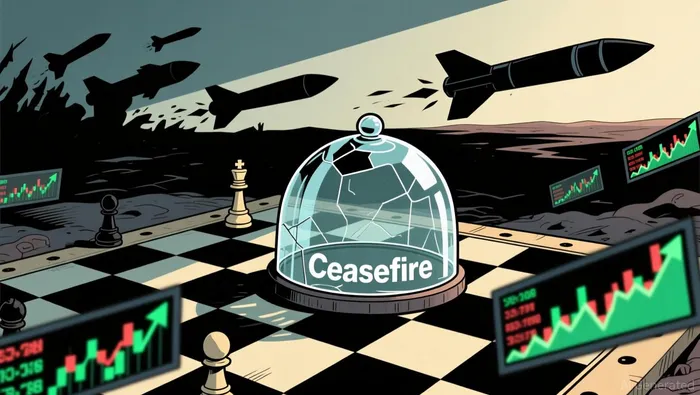
Volume data supports the credibility of this repricing. Total volume exceeds $22 million, with 24-hour activity surging past $355,000 — levels that indicate exceptional global interest and deep liquidity. The weekly price move is therefore not a thin-market artifact; it is backed by genuine capital commitment. The minor one-day decline of -$0.02 on moderate volume suggests profit-taking or hedging rather than a directional reversal. The market’s depth, with liquidity around 50,000, means large positions can be entered or exited without excessive slippage, reinforcing the signal quality of the current price.
Trading Judgment & Follow-up Observation Points
The current price embeds a high degree of confidence that the ceasefire will survive the August deadline, but this confidence is contingent on the absence of a direct, attributable Israel-Iran military event. The most important variable to track is whether any reported military action meets the contract’s attribution threshold — specifically, whether credible reporting and official statements converge on identifying Israel or Iran as the responsible party. A proxy attack that remains ambiguous in attribution could create a scenario where the real-world ceasefire frays but the market continues to price “Yes,” generating a sharp correction only when consensus firms. Secondary variables include the status of Iran’s Supreme Leader and the progress of U.S.-brokered talks, which could either reinforce the ceasefire or produce a breakdown that crosses the resolution boundary. The market’s depth and tight spreads suggest it can absorb news efficiently, but the resolution rules’ built-in delay means that even after a triggering event, price discovery may be chaotic for up to three days.

Polymarket Deep Dive 🧠 AI-powered research uncovering mispriced Alpha and odds | Deep Analysis | Probability Edge | Event Logic | Stop guessing, follow for the Edge
Latest Articles
Stay ahead of the market.
Get curated U.S. market news, insights and key dates delivered to your inbox.


AInvest
PRO
AInvest
PRO




Comments
No comments yet