
Ceasefire Calculus: Why the Iran-Israel Market Is Pricing Calm Despite a Storm of Headlines
 Aime Summary
Lead
The Polymarket contract asking whether the Israel-Iran ceasefire will hold through August 31 is trading near 79 cents, a level that signals strong conviction in a peaceful outcome. Yet the surrounding news flow is a cacophony of brinkmanship: hardline Israeli rhetoric, linked conflicts in Lebanon, and ongoing U.S.-Iran negotiations over the Strait of Hormuz. This article dissects the gap between the market’s serene pricing and the turbulent geopolitical reality, examining how resolution rules, recent news, and trading dynamics shape the true probability embedded in the price.
Event Definition
This market bets on a simple binary question: will the ceasefire between Israel and Iran remain in effect through 11:59 PM Iran Standard Time on August 31, 2026? A "Yes" outcome requires that no qualifying military action—defined as an airstrike or surface-to-surface missile strike directly impacting terrestrial territory—occurs between the market’s creation and the end date. The core disagreement is not about whether tensions exist, but whether they will escalate into a specific, rule-defined kinetic event before the deadline.
Latest News & Information Increments
The market is currently operating in a high-noise, high-signal environment where diplomatic and military developments pull expectations in opposite directions. On the diplomatic front, U.S.-Iran negotiations regarding safe passage through the Strait of Hormuz are reportedly nearing a resolution, though significant concessions are still required from both sides. This progress supports the "Yes" side by suggesting a broader de-escalatory framework.
However, this positive signal is being aggressively countered by Israel. Prime Minister Benjamin Netanyahu has declared that the war will only end with the collapse of the Iranian regime or a halt to its nuclear ambitions, a hardline stance complicating ceasefire extension. This is reinforced by Israeli security officials who have labeled current U.S.-Iran talks as "useless" and indicated a willingness to act unilaterally against Iran’s nuclear capabilities. Furthermore, Israel’s intensification of attacks on Hezbollah in southern Lebanon directly links the Iranian front to a secondary conflict, with Iranian officials stating that a ceasefire in Lebanon is contingent on a ceasefire with the U.S. This interconnectedness creates multiple potential flashpoints that could violate the market’s specific resolution criteria, even if the primary Israel-Iran channel remains quiet.
Market Resolution Rules Analysis
A critical distinction for this market is that not all military action triggers a "No" resolution. The contract settles to "No" only if a qualifying military action occurs: specifically, an airstrike or a surface-to-surface missile strike that directly impacts terrestrial territory. The determination relies on official information from the governments and militaries of Israel and Iran, as well as credible reporting. The strict time boundary is the end of August 31, 2026, Iran Standard Time.
Rule Risk Points & Disputed Scenarios
The rules introduce two significant edge-case risks that could cause a divergence between perceived reality and the final settlement. First, if conflicting reports emerge regarding the occurrence, attribution, or timing of a strike, the market remains open for three full calendar days to allow for resolution. This delay mechanism creates a window of uncertainty where the market price may not reflect the eventual outcome. Second, the rules explicitly exclude minor surface-to-surface strikes, including those by short-range loitering munitions and FPV drones. This is a crucial carve-out: a low-level drone attack that makes global headlines might not constitute a qualifying action, potentially leading to a "Yes" settlement even amid a perceived escalation.
Market Overview
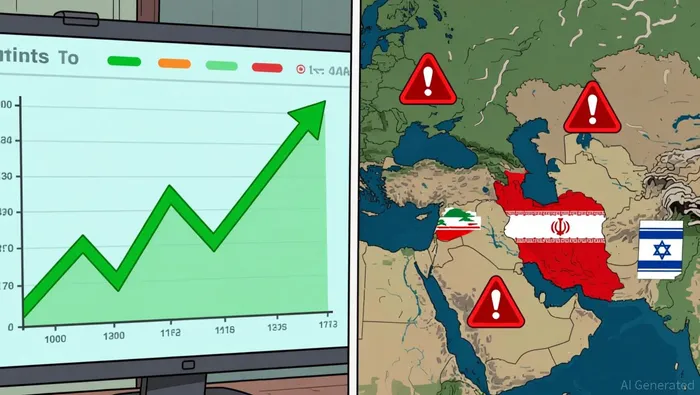
With "Yes" shares trading at approximately 0.79 and "No" shares at 0.21, the market is pricing in a roughly 79% probability that the ceasefire will hold under the contract’s specific terms. This is a skewed, low-disagreement market, far from the 0.50 threshold that signals deep uncertainty. The current price implies that participants heavily discount the hawkish Israeli rhetoric and view the diplomatic track as the dominant, controlling variable. The tight bid-ask spread of 0.02 (0.78 bid / 0.80 ask) suggests a reasonably efficient market for immediate trades, though the price should be viewed as a consensus within this specific contract’s framework rather than a holistic geopolitical forecast.
Market Dynamics (Volatility & Volume)
The market’s price action reveals a fascinating divergence between short-term and medium-term sentiment. Over the past week, the "Yes" outcome has experienced a substantial bullish repricing of +0.195, indicating a strong shift in conviction toward the ceasefire holding. However, the past 24 hours have seen a minor downward correction of -0.015. This recent dip is likely a direct response to the fresh wave of Israeli hardline statements and the escalation in Lebanon, which momentarily challenged the dominant bullish narrative. The fact that this pullback is so small relative to the weekly gain suggests the market is interpreting the aggressive rhetoric as noise rather than a signal of an imminent, rule-qualifying strike.
This price action is supported by exceptional trading volume. The market has amassed a lifetime volume of over $22 million, with a massive 24-hour surge exceeding $363,000. This volume profile is critical; it confirms that the recent price stability and the weekly bullish trend are not artifacts of a thin or illiquid market. The high level of capital commitment provides strong validation that the current pricing near 0.79 reflects genuine, deep-conviction positioning by a broad base of participants, rather than being susceptible to manipulation by a few large traders.
Trading Judgment & Follow-up Observation Points
The current price of 0.79 represents a high-confidence bet on the absence of a specific, rule-defined military event, not a bet on the absence of conflict. The market has effectively priced out the risk of a major airstrike or missile attack, but the primary risk to this position is a sudden, unilateral Israeli strike on Iranian territory—a scenario openly threatened by its leadership. The key observation points going forward are threefold: first, any shift in the status of U.S.-Iran Hormuz talks, as a breakdown there could uncork the geopolitical pressure valve; second, the trajectory of the Israel-Hezbollah conflict in Lebanon, given its direct linkage to the Iranian ceasefire; and third, and most crucially, the nature of any reported military incident, which must be measured against the contract’s strict definition of a "qualifying military action" to determine if it truly threatens a "No" settlement.

Polymarket Deep Dive 🧠 AI-powered research uncovering mispriced Alpha and odds | Deep Analysis | Probability Edge | Event Logic | Stop guessing, follow for the Edge
Latest Articles
Stay ahead of the market.
Get curated U.S. market news, insights and key dates delivered to your inbox.


AInvest
PRO
AInvest
PRO




Comments
No comments yet