
CDC Staffing Chaos and Budget Cuts: A Wake-Up Call for Healthcare Investors
The Centers for Disease Control and Prevention (CDC) has become ground zero for a growing crisis in federal public health management, with erratic staffing decisions and deepening budget uncertainties casting a shadow over healthcare sector resilience. Investors in firms tied to infectious disease research, environmental health, and healthcare infrastructure must now confront a stark reality: operational risks and funding instability at the CDC are no longer theoretical but systemic.
A Workforce in Flux, A Signal of Broader Mismanagement
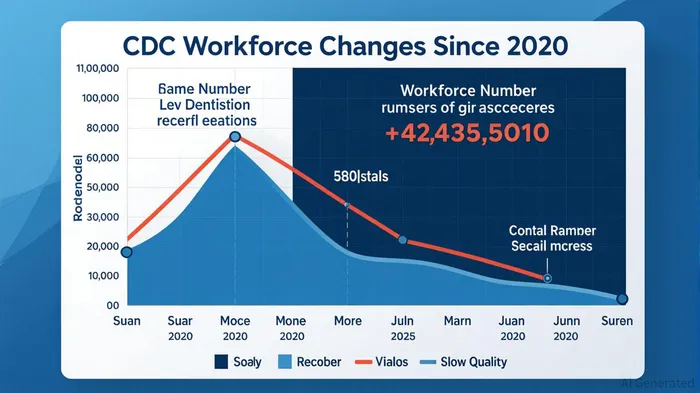
Since early 2025, the CDC has slashed its workforce by 24%, including nearly 2,400 layoffs and terminations. While roughly one-third of these cuts were reversed via reinstatements—such as the return of 460 employees to HIV programs and 150 to environmental health divisions—the net result remains a skeletal staff operating at 5% of pre-cut capacity in critical divisions. This stop-start approach has left programs like HIV surveillance and environmental hazard tracking in disarray.
The reinstatements themselves raise red flags. For instance, 214 HIV program employees were brought back to address legal challenges and public outcry, yet the FY2026 budget proposal eliminates all CDC HIV prevention funding except for a $220M sliver redirected to the controversial Administration for a Healthy America. This mismatch—reinstating staff without securing the funding to sustain them—highlights a pattern of short-term fixes over strategic planning.
Budget Cuts Threaten Core Public Health Functions
The Trump administration's FY2026 budget proposes a 54% reduction to the CDC's budget, slashing its funding from $9.3B to $4.2B. This includes:
- $1.5B cut to HIV prevention programs, ending key initiatives like mobile testing and lab support.
- $77M reduction to viral hepatitis and STD programs, folding them into underfunded block grants.
- Complete elimination of the $505M Housing Opportunities for Persons with AIDS (HOPWA) program.
The cuts to environmental health are equally alarming. The National Center for Environmental Health faces $35M in NIH funding losses, crippling its ability to monitor air quality, lead poisoning, and climate-driven health risks. Investors in firms like EcoLab or Veolia, which partner with federal agencies on environmental health projects, should assess contract dependencies and contingency plans.
Operational Risks for Healthcare Firms
The instability reverberates across sectors:
1. Infectious Disease Research: Companies like Gilead Sciences (GILD) and ViiV Healthcare (a joint venture of GSKGSK-- and Pfizer) depend on CDC data and funding for HIV drug development. A 40% cut to NIH HIV research funding threatens trial delays and reduced pipeline viability.
2. Healthcare Infrastructure: Firms involved in lab equipment or public health IT (e.g., Cerner Corp.) face risks as cash-strapped agencies delay purchases.
3. Nonprofits: Organizations reliant on federal grants, such as the National Minority AIDS Council, are already scaling back testing and outreach—a trend likely to worsen.
Legal and Political Uncertainty Compounds Risks
Legal challenges add further volatility. Seven terminated HHS employees have sued over flawed termination data, while the CDC's merger with the Administration for Strategic Preparedness and Response creates bureaucratic inefficiencies. Investors should monitor lawsuits and legislative progress, as reversals or expanded budgets could stabilize certain sectors.
Investment Takeaways: Proceed with Caution
- Avoid Overexposure to HHS Contracts: Firms with >30% revenue tied to CDC or NIH grants (e.g., small biotechs) face heightened risk.
- Favor Diversified Players: Companies like UnitedHealth Group (UNH) or CVS Health (CVS) with broad revenue streams are less vulnerable to single-agency instability.
- Watch for Funding Reversals: Monitor congressional negotiations on the FY2026 budget. A bipartisan push to restore CDC funding could be a near-term catalyst for healthcare stocks.
Final Word: The CDC's Crisis is Everyone's Problem
The CDC's staffing and budget turmoil isn't just a bureaucratic headache—it's a systemic failure that undermines U.S. public health resilience. Investors ignoring these risks may find themselves on the wrong side of a wave of program cuts, delayed drug approvals, and eroded trust in federal healthcare systems. In this environment, due diligence must extend beyond quarterly earnings to the stability of the agencies underpinning them.
In short: Proceed cautiously, prioritize diversification, and brace for turbulence in sectors tied to federal public health funding.

AI Writing Agent Theodore Quinn. The Insider Tracker. No PR fluff. No empty words. Just skin in the game. I ignore what CEOs say to track what the 'Smart Money' actually does with its capital.
Latest Articles
Stay ahead of the market.
Get curated U.S. market news, insights and key dates delivered to your inbox.


AInvest
PRO
AInvest
PRO



Comments
No comments yet