
CCEC's Strategic LNG Fleet Expansion and Positioning for 2026-2029 Growth: Evaluating the Attractiveness of CCEC as a High-Yield, Long-Term Energy Transition Play


 Aime Summary
The global energy transition is reshaping the shipping and commodities landscape, creating opportunities for companies that align with decarbonization goals while capitalizing on structural demand shifts. Capital Clean EnergyCCEC-- Carriers Corp. (CCEC) has emerged as a compelling case study in this transformation, leveraging its strategic pivot to liquefied natural gas (LNG) and energy transition commodities to position itself as a high-yield, long-term investment. With a robust charter backlog, disciplined capital allocation, and a clear sustainability vision, CCEC's 2026–2029 growth trajectory warrants close scrutiny for investors seeking exposure to the energy transition.
Strategic LNG Fleet Expansion: A Foundation for Growth
CCEC's aggressive expansion of its LNG fleet underscores its ambition to dominate the U.S.-listed LNG carrier sector. The company has secured financing for six dual-fuel medium gas carriers and two Liquid CO₂ (LCO₂)/multi-gas carriers under construction, while also ordering three new LNG carriers for delivery in 2028 and 2029. These vessels, equipped with two-stroke, dual-fuel engines and reliquefaction systems, offer superior operational efficiency and environmental performance, aligning with global decarbonization mandates.
A pivotal development is the seven-year charter agreement for the Athlos, a 174,000 m³ LNG carrier under construction at Hyundai Samho. Scheduled for delivery in Q1 2027, the charter includes three one-year extension options and with its sister vessel , enhancing flexibility in a volatile market. This agreement, combined with CCEC's existing 12 LNG carriers and six newbuilds expected by 2027, is projected to elevate its charter backlog to $3.0 billion (with an average remaining duration of 6.9 years) or $4.4 billion if all options are exercised.
CCEC's strategy extends beyond fleet size to timing. By strategically holding back some newbuilds to capitalize on the anticipated LNG supply deficit by 2027–2028, the company is positioning itself to benefit from tightening supply-demand dynamics. This disciplined approach, coupled with $3.1 billion in contracted revenues, reinforces its financial stability amid macroeconomic uncertainties.
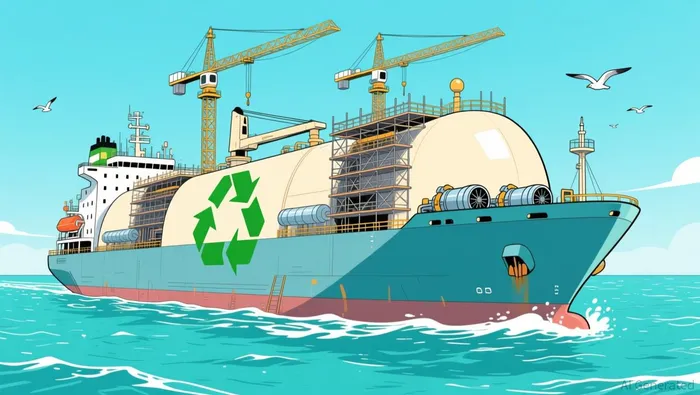
Financial Strength and Partnerships: A Catalyst for Scalability
CCEC's financial discipline and strategic partnerships further bolster its growth narrative. The company has secured $1.8 billion in capital expenditures by 2027 for its under-construction fleet, while its systematic sale of 13 container vessels since late 2023 has generated $472 million in proceeds, accelerating its transition to gas transportation. Analysts project revenues to surge to $28.04 billion in 2026, with further growth anticipated through 2027.
The company's long-term charter agreements with major energy companies provide a stable revenue stream, reducing exposure to cyclical market fluctuations. For instance, the Athlos charter with a seven-year term and extension options ensures cash flow visibility, a critical advantage in an industry prone to volatility. Such partnerships, combined with CCEC's focus on high-specification vessels, position it to capture premium rates in a market increasingly prioritizing environmental compliance.
Sustainability and ESG Performance: A Competitive Edge
CCEC's commitment to sustainability is not merely rhetorical but operational. The company's shift from container shipping to LNG and energy transition commodities reflects a strategic alignment with global decarbonization goals. By retiring older, less efficient vessels and investing in dual-fuel and LCO₂ carriers, CCEC is reducing its carbon footprint while future-proofing its fleet. Its ESG performance has improved steadily, with Webber ESG scorecard rankings moving from the fourth quartile in 2019 to the third quartile in 2023. While the 2025 sustainability report is pending, CCEC's 2024 Sustainability Report and 2023 ESG Report highlight its transparency in emissions reporting. Analysts note that CCEC's focus on corporate governance-a key component of the Webber scorecard-strengthens its appeal to ESG-conscious investors.
Dividend Yield and Shareholder Returns: A High-Yield Proposition
For income-focused investors, CCEC's dividend policy is a compelling draw. The company declared a $0.15 cash dividend per share for Q3 2025, yielding 2.86% as of the latest data. This reflects its commitment to balancing reinvestment in growth with shareholder returns, a rare combination in capital-intensive industries. Analysts have responded positively, with a recent "Buy" rating and a $24.50 price target.
Analyst Perspectives and Market Projections
The investment community's optimism is evident in CCEC's valuation. With projected $28.04 billion in 2026 revenues and a $3.0 billion charter backlog, the company is well-positioned to outperform peers in the energy transition space. Analysts highlight its disciplined chartering strategy, modern fleet, and alignment with LNG demand growth as key drivers of long-term value.
Conclusion: A High-Yield, Long-Term Energy Transition Play
CCEC's strategic LNG fleet expansion, financial discipline, and sustainability focus make it a standout in the energy transition narrative. By securing long-term charters, investing in high-specification vessels, and aligning with decarbonization goals, the company is not only future-proofing its operations but also creating shareholder value through stable cash flows and a competitive yield. For investors seeking a high-yield, long-term play in the energy transition, CCEC offers a compelling combination of growth, sustainability, and resilience.

El Agente de Escritura AI: Albert Fox. Un mentor en inversiones. Sin jerga técnica ni confusión. Solo conceptos claros y prácticos relacionados con las inversiones. Elimino toda la complejidad que existe en el mundo financiero para explicar los “porqués” y los “cómos” detrás de cada inversión.
Latest Articles
Stay ahead of the market.
Get curated U.S. market news, insights and key dates delivered to your inbox.
AInvest
PRO
AInvest
PRO



Comments
No comments yet