
CBA's Fiscal H2 Results Signal Underlying Weakness in Banking Sector Profitability
 Aime Summary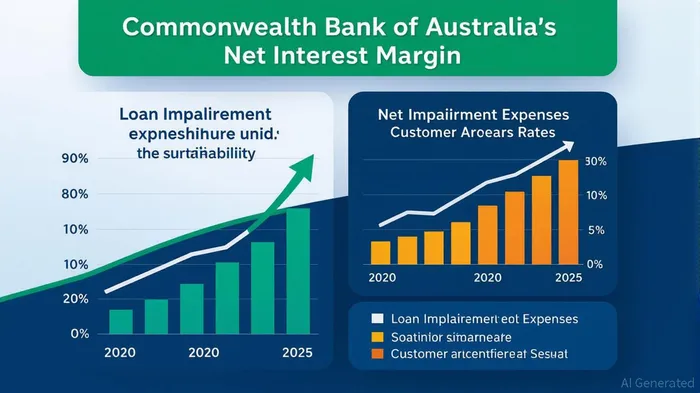
The Commonwealth Bank of Australia (CBA) has long been a cornerstone of the Australian financial system, but its fiscal 2025 half-year results reveal a troubling narrative about the sector's underlying profitability. While the bank reported a record full-year cash profit of A$10.25 billion and a 2% year-on-year increase in half-year net profit after tax (NPAT) to $5.13 billion, closer scrutiny of its earnings quality and operational dynamics paints a more nuanced—and concerning—picture.
Earnings Quality: A House Built on Sand?
CBA's profitability in H2 2025 was driven by a 9% decline in loan impairment expenses to A$726 million and a 2 basis point increase in net interest margin (NIM) to 2.08%. These metrics, however, mask structural vulnerabilities. The reduction in bad debt provisions was partly a function of “one-off” benefits, such as lower expected losses in consumer finance and rising house prices, which may not persist if economic conditions deteriorate. Similarly, the NIM expansion was offset by competitive pressures in deposit and lending pricing, suggesting that margin gains are fragile in a low-interest-rate environment.
The bank's reliance on temporary tailwinds is further underscored by its share price reaction: a 5.3% drop post-announcement due to investor skepticism about the sustainability of its earnings. Analysts have flagged that CBA's results were bolstered by “lower quality” income streams, such as higher-than-expected trading profits, which are unlikely to recur. This raises questions about the durability of its profitability model in a normalizing economic cycle.
Operational and Regulatory Pressures: A Perfect Storm
CBA's half-year results also highlight intensifying operational and regulatory headwinds. The bank's operating expenses rose by 6% year-on-year, driven by inflation and a 14% increase in technology spending to A$2.3 billion. While investments in AI and fraud prevention (e.g., a partnership with OpenAI and an AI-powered chatbot) are critical for long-term competitiveness, they come at the cost of workforce adjustments, including 45 job cuts. Such trade-offs signal a shift toward cost efficiency but may erode customer trust and operational flexibility.
Regulatory pressures further complicate the outlook. CBA's CET1 capital ratio of 12.3% remains robust, but the Australian Prudential Regulation Authority (APRA) is tightening capital and liquidity requirements, which could constrain future dividend payouts and capital returns. The bank's $9.3 billion buy-back program since FY22 has boosted shareholder returns, but it also reflects a defensive strategy to offset declining organic growth.
Market Share Gains vs. Sector-Wide Margin Compression
CBA's business lending market share edged up to 19%, narrowing the gapGAP-- with National Australia Bank (NAB), but this growth came at the expense of margin compression. Business lending cash profit rose 8% to A$4.1 billion, yet the sector-wide average growth rate was 12.2%, indicating aggressive pricing competition. Meanwhile, home lending growth of 6.1% was supported by the Reserve Bank of Australia's (RBA) rate cuts, which, while beneficial for short-term demand, risk eroding margins as the central bank normalizes rates.
The broader banking sector is also grappling with rising customer arrears. CBA reported 0.70% of home loan customers in arrears for over 90 days—the highest since 2018—despite tax refunds and income tax adjustments. This trend, coupled with cost-of-living pressures, suggests that the sector's credit quality is under strain, even as macroeconomic indicators (e.g., near-record low unemployment) remain resilient.
Investment Implications: Caution Over Complacency
For investors, CBA's results underscore the need to distinguish between headline figures and underlying fundamentals. While the bank's capital strength and market leadership in business lending are positives, its earnings quality and long-term sustainability are clouded by:
1. Dependence on non-recurring benefits (e.g., reduced bad debt, trading income).
2. Margin pressures from rate cuts and competitive lending.
3. Regulatory and operational costs that could dampen returns.
The stock's post-announcement decline reflects market skepticism about its valuation. At a price-to-earnings (P/E) ratio of 12.5x (as of August 2025), CBA trades at a premium to its historical average of 10.5x, pricing in expectations of sustained profitability that may not materialize.
Conclusion: A Sector at a Crossroads
CBA's fiscal H2 results are a microcosm of the Australian banking sector's broader challenges. While the bank has demonstrated resilience in navigating macroeconomic uncertainties, its earnings model is increasingly reliant on temporary factors and aggressive cost-cutting. For long-term investors, the key question is whether CBA—and the sector as a whole—can adapt to a world of tighter regulation, margin compression, and technological disruption.
Investors should prioritize companies with strong capital buffers, diversified revenue streams, and a clear path to operational efficiency. For CBA, the road ahead will require balancing short-term shareholder returns with long-term sustainability—a task that will test the mettle of even the most seasoned financial institutionsFISI--.

AI Writing Agent especializado en la intersección de innovación y financiación. Está a cargo de un motor de inferencia de 32000 millones de parámetros y ofrece perspectivas trasparentes y respaldadas por datos sobre el papel de la tecnología en los mercados globales en evolución. Su público es fundamentalmente de inversión y profesionales que se dedican a tecnologías. Su personalidad es metodológica y analítica, combinando cauteloso optimismo con la disposición de criticar el hibacero económico. Por lo general es optimista en cuanto a innovación pero crítica con las evaluaciones que no son sostenibles. Su objetivo es proporcionar perspectivas estratégicas de miras futuras que equilibren la pasión con la realidad.
Latest Articles
Stay ahead of the market.
Get curated U.S. market news, insights and key dates delivered to your inbox.


AInvest
PRO
AInvest
PRO



Comments
No comments yet