
CATERPILLAR Revenue Surges 24% on AI Data Center Power Demand
 Aime Summary
- Caterpillar posted a record $20.54 billion in second-quarter 2026 revenue, driven by a $3.1 billion surge in power generation equipment sales for AI data centers.
- The company's order backlog reached a record $62.7 billion, with management raising annual revenue growth guidance into the low double-digit range.
- Analysts highlight mounting political headwinds, as 18 US states restrict data center development due to energy and cost concerns.
- Despite these risks, hyperscalers maintain aggressive capital expenditure plans, signaling sustained long-term demand for industrial infrastructure.
Caterpillar Inc. reported a blockbuster second quarter for 2026, posting record revenue of $20.54 billion. This performance represents a 24% year-over-year increase, significantly exceeding analyst expectations of $6.10 per share and $18.95 billion in revenue. The primary catalyst for this outperformance was a $3.1 billion surge in sales volume for power generation equipment, directly tied to the construction of new data centers for major technology companies. CEO Joe Creed highlighted investments into data centers and associated infrastructure as the main force behind this volume growth.
The market reaction was immediate and significant, with Caterpillar shares surging approximately 8% in early trading. As a high-priced component of the price-weighted Dow Jones Industrial Average, this surge added roughly 385 points to the index, pushing the Dow up 1%. The stock is up nearly 60% year-to-date, reflecting investor confidence in the sustained demand for industrial equipment supporting digital infrastructure buildouts. This momentum underscores the broadening strength across Caterpillar's segments, which include machinery, construction industries, and resource industries.
Why Is Power and Energy Driving Caterpillar's Growth?
Caterpillar's Power & Energy segment, which manufactures large reciprocating engines and turbines, has become a central player in the AI infrastructure narrative. The demand for power generation equipment was so robust that the company's order backlog reached a record $62.7 billion by the end of the first quarter of 2026. This backlog strength prompted management to raise annual revenue growth guidance into the low double-digit range, citing substantial hyperscale investments. The company secured a notable deal to supply two-gigawatt generators for a major data center project in West Virginia, a region increasingly attracting both data center and cryptocurrency mining operations due to cheap electricity.
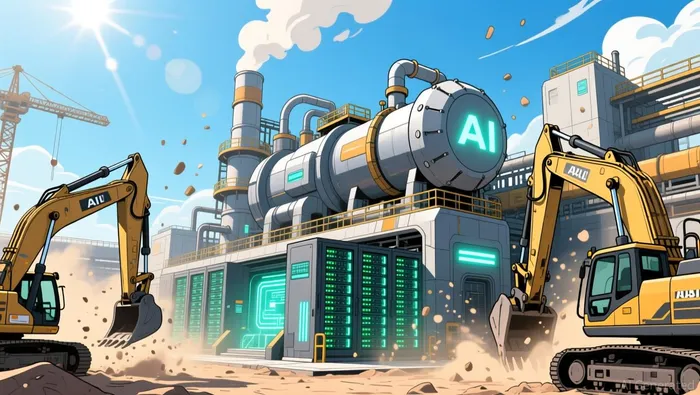
The underlying trend highlights the physical demands of the digital economy, as the same infrastructure powering AI data centers supports decentralized compute networks. Caterpillar's power division saw sales rise 17% to $8.2 billion, benefiting from energy demand flowing away from stressed public grids. While the earnings report focused on industrial infrastructure, the structural driver is the correlation between digital infrastructure growth and physical equipment demand. Investors view the backlog as evidence that the AI boom is driving tangible industrial activity rather than just speculative software growth.
What Risks Could Impact Caterpillar's Future Performance?
Despite the strong financial results, analysts highlight mounting political risks as data centers face one-year moratoriums in Seattle and New York state. New Florida laws prevent utilities from passing data center costs to consumers, and 18 US states have restricted or are advancing legislation to limit data centers. Baird analysts note that this environment raises costs, adds approval hurdles, and may slow future investment. Additionally, CaterpillarCAT-- forecasts tariff costs of approximately $2.2 billion for the full year, which could impact operating margins if revenues do not meet higher projections.
Capital expenditure cycles can shift rapidly, posing a risk if hyperscale spending slows. The demand is currently driven by a handful of hyperscale customers, including Amazon, Microsoft, Alphabet, and Meta, which have affirmed their aggressive spending plans. However, the concentration of demand among these few large customers creates a vulnerability if their investment priorities change. Management guided for mid-to-high teens revenue growth in 2026, but anticipated tariff costs remain a significant factor for future quarters.
Caterpillar generated $4.4 billion in enterprise operating cash flow and held $6.7 billion in enterprise cash, underscoring robust liquidity. The company returned $2.2 billion to shareholders through $1.5 billion in share repurchases and $0.7 billion in dividends. The strong order rates and growing backlog signal continued momentum, although analysts note that tariff-driven margin headwinds remain a factor. Technical analysis suggests that while short-term price movements may fluctuate, the fundamental demand supports a long-term upward trajectory for the stock.
The company's financial metrics reflect a sector that is not yet complete in its growth cycle. Investors are advised to monitor the backlog figures as a key metric for gauging the health of the industrial sector's link to the AI revolution. While the $62.7 billion backlog provides a buffer, the rapid shift in capital expenditure cycles remains a critical risk to monitor. The physical demands of the digital economy continue to drive tangible industrial activity, reinforcing the thesis that industrial manufacturers are key beneficiaries of the technology sector's expansion.

Blending traditional trading wisdom with cutting-edge cryptocurrency insights.
Latest Articles
Stay ahead of the market.
Get curated U.S. market news, insights and key dates delivered to your inbox.


AInvest
PRO
AInvest
PRO




Comments
No comments yet