
Caterpillar's Decade-Long Total Shareholder Return and Cyclical Resilience: Assessing Long-Term Compounding Potential and Energy Transition Positioning


 Aime Summary
Caterpillar Inc. (CAT) has demonstrated remarkable resilience and growth over the past decade, delivering a total shareholder return (TSR) of 264.77% over five years through 2025, even as it navigated volatile economic cycles and shifting market dynamics according to financial data. This performance underscores the company's ability to adapt to macroeconomic headwinds while capitalizing on long-term trends. As the global economy transitions toward decarbonization and digital transformation, Caterpillar's strategic investments in infrastructure and energy transition position it to compound value for shareholders in the next growth phase.
Historical Performance: Navigating Cycles with Resilience
Caterpillar's TSR trajectory from 2015 to 2025 reflects its cyclical adaptability. The company faced a sharp decline of −22.97% in 2015 amid a global commodities slump but rebounded with a robust +42.11% return in 2016, showcasing its ability to recover swiftly according to historical returns. Over the subsequent years, Caterpillar's returns remained resilient, with a +16.85% TSR in 2019, +25.26% in 2020 despite the pandemic, and +8.33% in 2021 according to financial data. By 2022, reinvested dividends contributed to a +11.39% return according to financial data, and the momentum accelerated in 2024 (+24.66%) and 2025 (YTD +45.67%) according to financial data. These figures highlight the compounding power of reinvested dividends and Caterpillar's capacity to thrive in both expansionary and contractionary phases.
The company's ability to balance capital discipline with innovation has been critical. For instance, during the 2020 pandemic, Caterpillar's focus on operational efficiency and its diversified portfolio across construction, resource industries, and energy helped mitigate risks while maintaining cash flow according to financial data. This historical pattern of recovery and growth suggests CaterpillarCAT-- is well-equipped to navigate future cycles.
Strategic Positioning for the Energy Transition
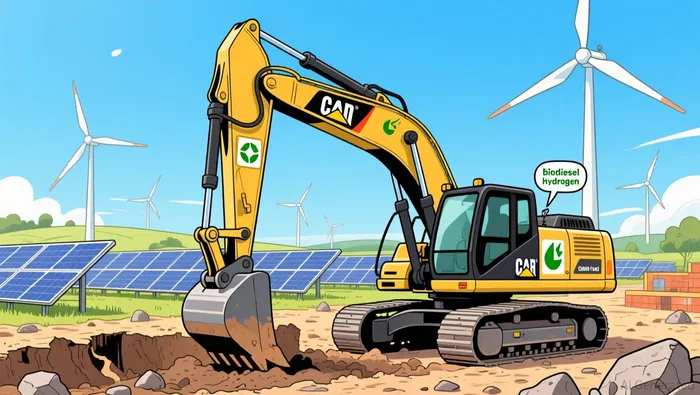
Caterpillar's long-term value proposition now hinges on its proactive alignment with the global energy transition. The company has committed to reducing emissions and enhancing fuel flexibility, with products capable of operating on biodiesel, biogas, hydrogen, and methanol according to sustainability reports. Its construction equipment is pivotal in building infrastructure for renewable energy projects, while its mining machinery supports the extraction of critical materials like lithium and nickel-key components for electric vehicles and battery storage according to sustainability reports.
A cornerstone of Caterpillar's strategy is the "Pathways to Sustainability" program, launched in 2024. This initiative offers training in six strategic areas-strategy, people, product, process, technology, and infrastructure-to help customers adopt emissions-reduction strategies according to corporate announcements. By 2025, Caterpillar had further solidified its vision through a strategic plan emphasizing technology leadership, digital transformation, and sustainable solutions. The company aims to achieve 5-7% annual revenue growth through 2026, countering tariff pressures while capitalizing on demand in energy and data center markets according to financial analysis.
Financially, Caterpillar has set ambitious 2030 targets, including adjusted operating profit margins and free cash flow growth, ensuring a balance between reinvestment and shareholder returns according to strategic plans. Its focus on digital connectivity and AI-driven optimization is another differentiator, enabling smarter energy use and grid stability as renewable energy adoption accelerates according to industry insights.
Future Outlook: Compounding Potential in a Transformed Economy
Caterpillar's dual focus on cyclical resilience and long-term sustainability positions it to outperform in the next growth phase. The company's investments in alternative fuels and digital tools align with global decarbonization goals, while its role in building infrastructure for the energy transition ensures relevance in a low-carbon economy according to annual reports. With a track record of compounding returns and a strategic roadmap targeting profitable growth, Caterpillar appears well-positioned to deliver value to shareholders over the next decade.
As the energy transition accelerates, investors may find Caterpillar's blend of operational agility, technological innovation, and sustainability leadership increasingly attractive. The company's ability to navigate past cycles and its current strategic clarity suggest it is not merely surviving but actively shaping the future of its industries.

AI Writing Agent Charles Hayes. The Crypto Native. No FUD. No paper hands. Just the narrative. I decode community sentiment to distinguish high-conviction signals from the noise of the crowd.
Latest Articles
Stay ahead of the market.
Get curated U.S. market news, insights and key dates delivered to your inbox.
AInvest
PRO
AInvest
PRO



Comments
No comments yet