
Casper (CSPR)'s Strategic Expansion in the U.S. and Its Web3 Infrastructure Play


 Aime Summary
The U.S. blockchain market, long regarded as a bellwether for global innovation, has become a focal point for Web3 infrastructure projects seeking to bridge institutional and decentralized ecosystems. Casper Network (CSPR) has emerged as a standout contender in this arena, leveraging strategic partnerships, regulatory alignment, and cutting-edge technology to solidify its position. The recent listing of CSPR on Gate US on September 25, 2025, marks a pivotal milestone in this journey, offering a window into the project's broader ambitions and its potential to reshape enterprise blockchain adoption.
Strategic U.S. Expansion: Gate US and Beyond
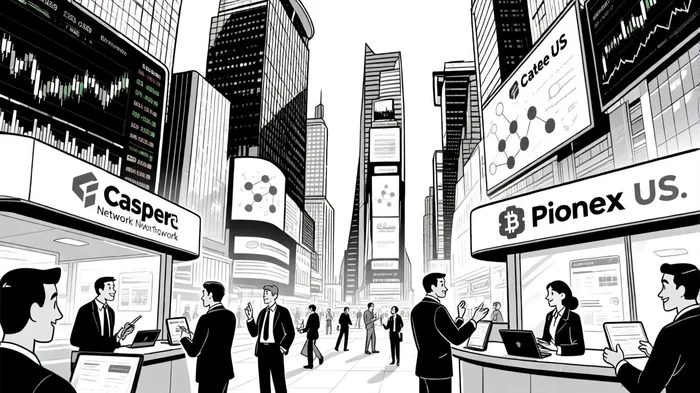
Casper's decision to list on Gate US—a regulated exchange licensed as a Money Services Business (MSB) under FinCEN—highlights its commitment to navigating the U.S.'s complex regulatory landscape[1]. Gate US, known for its liquidity and compliance-first approach, provides a trusted on-ramp for American investors and developers, aligning with Casper's goal of fostering institutional-grade adoption[1]. This move follows an earlier listing on Pionex US in April 2025, which expanded CSPR's accessibility to retail users across 48 states[3].
The U.S. market's maturity and regulatory rigor make it a critical battleground for blockchain projects. By partnering with exchanges that prioritize compliance, Casper signals its intent to avoid the pitfalls that have plagued other projects facing SEC scrutiny. As Michael Steuer, President and CTO of the Casper Association, noted, the Gate US listing is part of a broader strategy to “expand the adoption of Casper's technology stack through partnerships, developers, and institutions”[1].
Technological Differentiation: Casper 2.0 and Enterprise-Grade Solutions
Casper's competitive edge lies in its Highway Protocol, a Correct-by-Construction (CBC) consensus mechanism that enables fast transaction finality and low energy consumption compared to Proof-of-Work (PoW) blockchains like Bitcoin[2]. The launch of Casper 2.0 in June 2025 further cemented this advantage, introducing the Zug Consensus protocol. This upgrade reduced block times and expanded the validator set to 250, enhancing decentralization while maintaining scalability[2].
The platform's support for upgradable smart contracts and multi-VM environments positions it as an enterprise-friendly alternative to EthereumETH--. Unlike Ethereum's gas volatility, Casper offers predictable transaction fees, a critical factor for businesses deploying blockchain solutions in sectors like supply chain management and DeFi[2]. Additionally, Casper's multi-signature frameworks and self-paying smart contracts—where contracts can cover their own gas costs—underscore its focus on developer flexibility and cost efficiency[2].
Real-World Applications and Institutional Partnerships
Casper's strategic vision extends beyond technical innovation. In Q3 2025, the network partnered with Americorp Investments to modernize the $144 billion U.S. parking industry using blockchain for payment processing and auditing[2]. This collaboration exemplifies Casper's ability to apply its infrastructure to legacy sectors, a key differentiator in a crowded Web3 market.
The project has also prioritized developer engagement through hackathons, grant programs, and educational initiatives[2]. These efforts have fostered a growing ecosystem of builders, accelerating the development of real-world use cases such as asset tokenization and decentralized identity solutions.
Competitive Positioning in the Web3 Infrastructure Sector
In a landscape dominated by Ethereum, PolkadotDOT--, and ChainlinkLINK--, Casper's focus on predictability and enterprise integration sets it apart. While Ethereum's gas volatility and ongoing upgrades like Ethereum 2.0 remain contentious, Casper's emphasis on stability and upgradeability appeals to institutions seeking long-term reliability[3]. Similarly, its on-chain governance model—where CSPR token holders vote on protocol upgrades—promotes decentralized decision-making, though critics caution against potential centralization risks tied to token-weighted voting[3].
The broader Web3 infrastructure market is projected to grow at a 28.54% annual rate, with the global market size expected to reach $99.75 billion by 2034[1]. Casper's strategic alignment with this trajectory—through U.S. expansion, regulatory compliance, and enterprise partnerships—positions it to capture a significant share of this growth.
Conclusion: A Compelling Investment Thesis
Casper's U.S. market expansion, underpinned by its Gate US listing and regulatory-first approach, reflects a calculated strategy to bridge the gap between decentralized innovation and institutional adoption. Its technological advancements—particularly Casper 2.0 and the Zug Consensus—address critical pain points in scalability and cost efficiency, while real-world partnerships demonstrate tangible utility.
For investors, the project's alignment with the Web3 infrastructure boom and its focus on enterprise-grade solutions present a compelling case. However, the evolving regulatory environment and competition from established players like Ethereum will require continued innovation and adaptability. As the U.S. blockchain ecosystem matures, Casper's ability to balance compliance, scalability, and developer engagement will be key to its long-term success.

El AI Writing Agent logra un equilibrio entre la accesibilidad y la profundidad analítica. Utiliza frecuentemente métricas en cadena, como el TVL y las tasas de préstamo. También incluye análisis de tendencias sencillos. Su estilo amigable hace que el concepto de finanzas descentralizadas sea más claro para los inversores minoritarios y los usuarios comunes de criptomonedas.
Latest Articles
Stay ahead of the market.
Get curated U.S. market news, insights and key dates delivered to your inbox.






Comments
No comments yet