
Cash Cat Meme Coin Surges 77% After Robinhood Listing
 Aime Summary
- US-listed spot BitcoinBTC-- and EthereumETH-- ETFs recorded their strongest weekly inflows since April, with BlackRock capturing over 80% of the capital.
- Cash Cat (CASHCAT) surged 77% in 24 hours following its listing on RobinhoodHOOD--, highlighting the platform's focus on viral retail trends.
- The CASHCAT token has no official affiliation with Robinhood and derives value entirely from community narrative rather than technological utility.
- Recent hardware wallet security breaches have reinforced the institutional preference for regulated custody solutions amid shifting investor sentiment.
Robinhood Markets listed the CASHCAT memeMEME-- coin on August 6, 2026, triggering a rapid price rally among retail traders. The token surged 77.7% in 24 hours prior to the listing, rising from $0.08994 to $0.1598 per unit. This immediate price action underscores the volatility inherent in community-driven assets when they gain access to centralized trading platforms . However, the asset has since retreated from its all-time high of $0.2288 reached on July 11, trading around $0.1012 at the time of reporting .
CASHCAT is a community-driven cryptocurrency with no official connection to Robinhood. Its name references a 2021 anecdote where Robinhood founder Vlad Tenev confirmed the company was originally going to be called 'Cash Cat' . The token operates on typical meme coin dynamics, deriving value from social media buzz and community excitement rather than underlying utility . It serves as a cultural artifact celebrating the brokerage's early history rather than offering technological functionality.
The token is native to the Robinhood Chain, an Ethereum Layer-2 network built on ArbitrumARB-- technology that launched on July 1, 2026. Although the chain is designed for tokenized real-world assets (RWAs), meme coins like CASHCAT have dominated its early trading volume . The tokenomics are intentionally simple, featuring a fixed total supply of 1 billion CASHCAT tokens with no taxes . 100% of the initial liquidity was provided into a decentralized exchange pool, and the liquidity provider tokens were burned, permanently locking the foundational liquidity .
At the time of reporting, CASHCAT had a market capitalization of approximately $99.76 million and a 24-hour trading volume of $87.61 million . This listing exemplifies Robinhood's approach to integrating high-volatility, trend-driven assets into its platform to capture retail investor interest . The project is steered by its community and anonymous founders, with no complex governance or staking mechanisms in place .
Why Is Retail Capital Flocking To Meme Tokens?
While institutional investors are shifting toward regulated products, retail traders continue to chase viral narratives. CASHCAT's listing on Robinhood highlights the platform's strategy of capitalizing on viral internet trends. The token's value is derived entirely from shared narrative and social engagement within the ecosystem . This dynamic positions the asset as 'fan fiction with a ticker,' where price movements are driven by sentiment rather than fundamentals .
The contrast between retail and institutional behavior is stark in the current market environment. While meme coins like CASHCAT dominate early trading volume on new chains, institutional investors are flocking to regulated exchange-traded funds. This divergence highlights the split in investor objectives, with retail traders seeking high-volatility opportunities and institutions prioritizing long-term exposure.
How Do Institutional Investors View Bitcoin Exposure Now?
US-listed spot Bitcoin and Ethereum exchange-traded funds pulled in more than $1 billion in fresh cash this week, marking their strongest inflows since April . Data from SoSoValue shows that spot Bitcoin ETFs attracted $853.54 million during the week ended Aug. 7, with inflows recorded in every trading session . The total surpassed the roughly $824 million collected during the week of April 24, signaling a rebound in regulated crypto investment demand .
BlackRock’s iShares Bitcoin Trust (IBIT) dominated the latest inflow week, accounting for roughly $693 million of the weekly total. This means the world’s largest asset manager captured more than four-fifths of the new money entering the spot Bitcoin funds . These inflows add to the scale the products have amassed since their US debut in January 2024, with the group now overseeing about $80 billion in net assets .
The renewed demand arrived days after disclosures of a security flaw affecting Coldcard hardware wallets. Researchers estimated that attackers drained roughly 1,816 BTC, worth about $116 million, from more than 5,200 addresses beginning July 30 . Bloomberg Intelligence ETF analyst Eric Balchunas pointed to the timing of the fund flows following the Coldcard losses, arguing that the breach could strengthen the case for institutional custody among investors . For investors seeking long-term exposure rather than transactional utility, the failure of self-custody hardware underscores reliability of large financial institutions' security infrastructure.
Ethereum-focused ETFs also staged a sharp improvement, collecting $244.94 million for their strongest week since April. BlackRock’s iShares Ethereum Trust (ETHA) attracted roughly $203 million during the week, equivalent to more than 80% of the category’s total inflows . Together, IBIT and ETHA absorbed about $896 million, or more than four-fifths of the nearly $1.1 billion that flowed into the two groups .
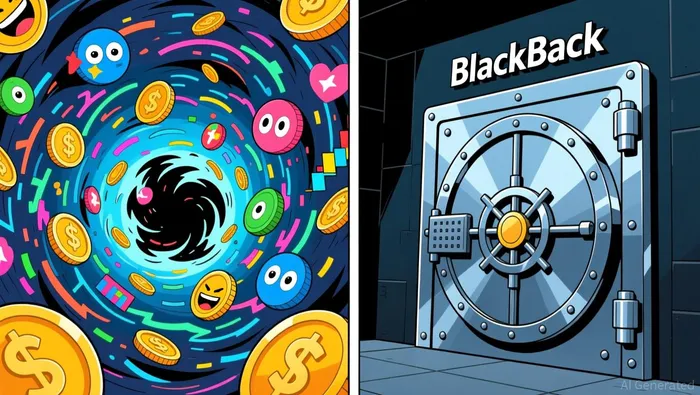
While meme coins like CASHCAT capture retail attention through viral listings, institutional capital continues to consolidate in regulated products. The divergence between these two investor classes highlights the maturing structure of the digital asset market. As new chains like Robinhood Chain experiment with meme token dominance, traditional finance continues to deepen its foothold through ETFs .

Blending traditional trading wisdom with cutting-edge cryptocurrency insights.
Latest Articles
Stay ahead of the market.
Get curated U.S. market news, insights and key dates delivered to your inbox.


AInvest
PRO
AInvest
PRO




Comments
No comments yet