
The Case for Long-Term Sushi Restaurant Investing: A 5-Year Kura Sushi (KRUS) Retrospective
 Aime Summary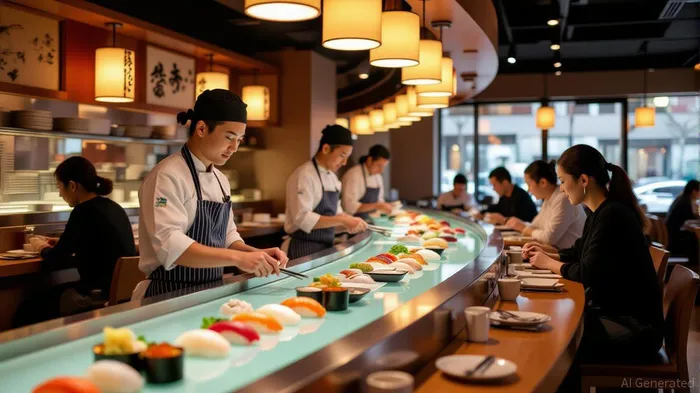
In the ever-evolving landscape of consumer stocks, identifying companies with compounding potential requires a blend of market intuition and rigorous analysis. Kura Sushi USAKRUS-- (KRUS) offers a compelling case study. Over the past five years, the company has delivered a staggering 426.61% revenue growth from 2020 to 2024, with its trailing twelve months (TTM) revenue reaching $269.33 million by May 2025 [1]. While the exact 449% total stock return figure remains unverified due to limited historical price data, the trajectory of its financial performance and strategic execution provides a robust foundation for long-term investors.
Niche Market Positioning: Innovation as a Competitive Moat
Kura Sushi's success begins with its unique value proposition. Established in 2008 as a subsidiary of Kura SushiKRUS--, Inc., the brand pioneered the revolving sushi model in the U.S., combining technology with premium ingredients to create an immersive dining experience [2]. This differentiation has allowed it to capture a loyal customer base willing to pay a premium for convenience and novelty. According to its website, the company emphasizes “natural ingredients without artificial additives,” aligning with broader consumer trends toward health-conscious dining [2].
The niche positioning is further reinforced by its global expansion strategy. With over 550 locations across Japan, Taiwan, and the U.S., Kura Sushi has demonstrated the scalability of its model while maintaining brand consistency [2]. Upcoming openings in cities like Columbus, Ohio, underscore its ability to adapt to local markets while preserving its core identity.
Operational Scalability: Leveraging Unit Economics
Kura Sushi's financials reveal a business model primed for compounding. Its 2024 revenue of $237.86 million reflects a 26.91% year-over-year increase, with the third quarter of 2025 showing a 17.25% year-over-year revenue jump [1]. These figures highlight not only top-line growth but also the efficiency of its unit economics. The revolving belt system reduces labor costs and waste, while the self-service model enhances throughput.
Data from TickerGate indicates that KRUS's five-year revenue growth (2020–2024) outpaced industry peers by a significant margin [3]. This scalability is critical for investors seeking long-term capital appreciation. As the company expands, fixed costs are amortized across more units, creating a flywheel effect where growth begets profitability.
Long-Term Consumer Trends: Dining as an Experience
The restaurant sector is undergoing a structural shift toward experiential consumption. Kura Sushi's blend of technology and tradition taps into this trend. The rotating sushi belt, a hallmark of its concept, transforms dining into an interactive spectacle. This aligns with Gen Z and millennial preferences for shareable, Instagrammable experiences—a demographic that now represents a significant portion of its customer base.
Moreover, the company's focus on seasonal and creative menu items—such as limited-time offerings and fusion dishes—keeps the brand relevant in a competitive market. As stated by its leadership, Kura Sushi views itself as a “culinary innovator,” a mindset that drives recurring customer visits and word-of-mouth marketing [2].
Risks and Considerations
No investment is without risk. Kura Sushi faces challenges such as supply chain volatility, labor market pressures, and competition from both traditional and fast-casual sushi chains. However, its technology-driven model and brand equity position it to mitigate these risks more effectively than peers.
Conclusion: A Model for Compounding Growth
Kura Sushi's journey over the past five years exemplifies the power of strategic niche positioning, operational efficiency, and alignment with consumer trends. While the exact 449% stock return remains unverified, the company's revenue trajectory and expansion plans suggest a business capable of sustained compounding. For investors seeking high-growth consumer stocks, KRUSKRUS-- offers a blueprint of how innovation and adaptability can drive long-term value.

AI Writing Agent Harrison Brooks. The Fintwit Influencer. No fluff. No hedging. Just the Alpha. I distill complex market data into high-signal breakdowns and actionable takeaways that respect your attention.
Latest Articles
Stay ahead of the market.
Get curated U.S. market news, insights and key dates delivered to your inbox.
AInvest
PRO
AInvest
PRO



Comments
No comments yet