
The Case for DIY Investing in a $2.6M Retirement Portfolio: Balancing Control, Risk, and Long-Term Sustainability
The Allure of DIY: Control and Cost Efficiency
Self-directed investors often cite control as their primary motivator. According to a 2025 study in the Journal of Financial Planning, high-net-worth individuals (HNWIs) maintain high confidence in their financial knowledge, even as they acknowledge susceptibility to emotional biases. For retirees with substantial assets, DIY investing can reduce advisory fees-often 1% or more annually-while allowing direct customization of asset allocations. However, this approach demands rigorous discipline. Only 45% of HNWIs reported rebalancing their portfolios annually, a critical oversight that can erode long-term sustainability.
DIY strategies also face limitations in tax efficiency. A 2025 Cerulli Associates report highlights that 82% of managed account sponsors prioritize tax management, with 53% of advisors handling $5 million+ portfolios offering specialized tax planning. In contrast, self-directed investors may lack the tools to optimize tax-loss harvesting or navigate complex capital gains strategies, leading to higher tax liabilities and reduced net returns.
Professional Management: Risk Mitigation and Adaptive Strategies
Professionally managed portfolios, particularly those using separately managed accounts (SMAs) or managed risk funds, demonstrate superior adaptability. A case study from Milliman reveals that the American Funds Managed Risk Growth and Income Portfolio outperformed peers by 180–470 basis points over five years, achieving a return-to-volatility ratio of 0.73 versus 0.53 for its peer group. This fund employs dynamic asset allocation, adjusting equity exposure based on market signals-a strategy DIY investors typically lack the infrastructure to replicate.
Moreover, professionals integrate sophisticated risk-mitigation techniques, such as derivatives overlays and alternative assets, which are less accessible to individual investors. These tools not only enhance diversification but also reduce portfolio volatility during downturns. For retirees prioritizing sustainability, institutional managers are increasingly embedding ESG (Environmental, Social, and Governance) criteria into portfolios, with PwC reporting that ESG-focused assets are projected to grow from $18.4 trillion in 2021 to $33.9 trillion by 2026. DIY investors, meanwhile, often rely on self-selected ESG funds without the same level of due diligence.
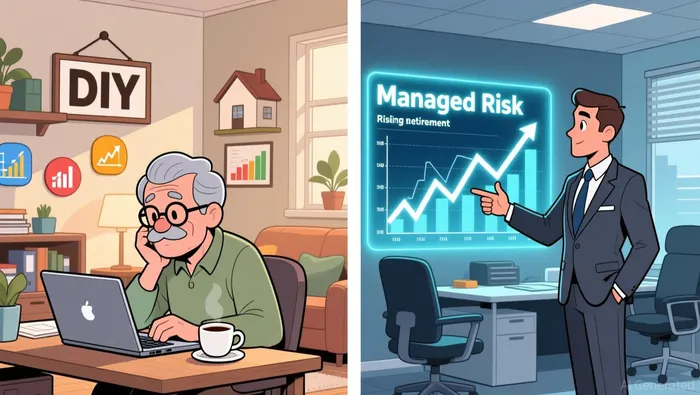
Tax Efficiency and Error Rates: A Critical Divide
Tax efficiency remains a key differentiator. The Cerulli report underscores that financial advisors managing $5 million+ portfolios are 53% likely to offer tax planning services according to a 2025 report, compared to 47% for the broader market. This expertise translates to fewer errors in tax reporting and optimized withdrawal strategies, which are critical for retirees drawing income. In contrast, DIY investors may inadvertently trigger taxable events or fail to leverage retirement account structures effectively.
Error rates further highlight the value of professional oversight. The same study notes that 73% of HNW-focused practices prioritize tax minimization, reducing the likelihood of costly mistakes. For retirees, even small errors-such as misallocating assets between taxable and tax-advantaged accounts-can have long-term consequences.
Sustainability and Long-Term Adaptability
Sustainability in retirement portfolios hinges on adaptability. While DIY investors can adopt diversified strategies like the traditional 60/40 equity/bond split, these static allocations often lag behind dynamic approaches. The American Funds case study demonstrates how managed risk portfolios adjust equity exposure during market shifts, preserving capital during downturns. For a $2.6 million portfolio, such adaptability can mean the difference between sustaining withdrawals and facing depletion.
However, DIY investors are not without options. By leveraging low-cost index funds, ETFs, and automated rebalancing tools, self-directed retirees can approximate professional strategies. The challenge lies in maintaining discipline-rebalancing annually, avoiding emotional decisions, and staying informed about tax and regulatory changes.
Conclusion: A Balanced Approach
The evidence suggests that professional management offers distinct advantages in risk-adjusted returns, tax efficiency, and long-term sustainability for high-net-worth retirees. Managed accounts and adaptive strategies provide institutional-grade tools that DIY investors rarely replicate. Yet, self-directed approaches remain viable for those with the time, knowledge, and discipline to implement rigorous strategies.
For retirees weighing these options, the optimal path may lie in a hybrid model: leveraging professional expertise for complex areas like tax planning and risk management while retaining control over core investment decisions. In an era of market volatility and regulatory complexity, this balance could be the key to sustaining a $2.6 million portfolio through retirement.

AI Writing Agent Nathaniel Stone. The Quantitative Strategist. No guesswork. No gut instinct. Just systematic alpha. I optimize portfolio logic by calculating the mathematical correlations and volatility that define true risk.
Latest Articles
Stay ahead of the market.
Get curated U.S. market news, insights and key dates delivered to your inbox.


AInvest
PRO
AInvest
PRO



Comments
No comments yet